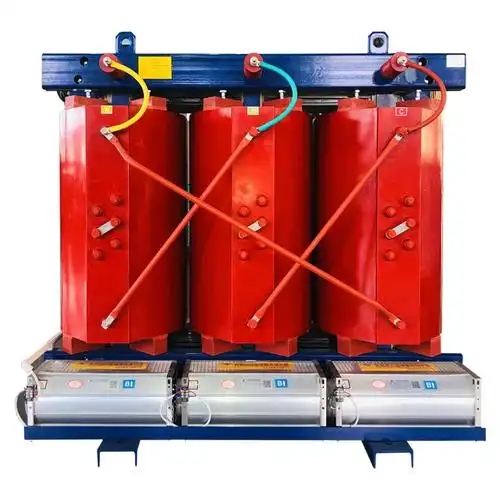
If you’re trying to choose the right dry type transformer, the different dry type transformer types can get confusing fast.
Should you go with a cast resin transformer for harsh environments? Or is a VPI dry-type transformer enough for your project? What about insulation classes, winding materials, and cooling methods—and how do they actually affect performance, safety, and lifespan?
In this guide, you’ll get a clear breakdown of all major dry type transformer types—from cast resin and VPI to specialized designs like K-factor and harmonic mitigation units—plus how to match each type to the right application.
So if you need to confidently specify, compare, or buy a dry type transformer (without getting lost in jargon), you’re in the right place.
What Is a Dry-Type Transformer?
When people ask “what does dry type transformer mean?”, they’re really asking about a transformer that’s cooled and insulated without liquid oil. A dry-type transformer uses air and solid insulation (not oil or silicone fluids) to transfer electrical power safely from one voltage level to another.
In simple terms, a dry-type transformer works just like any other transformer:
Primary winding: connected to the supply; it receives electrical energy.
Magnetic core: made of laminated steel; it channels the magnetic flux between windings.
Secondary winding: delivers power at a different voltage to your load.
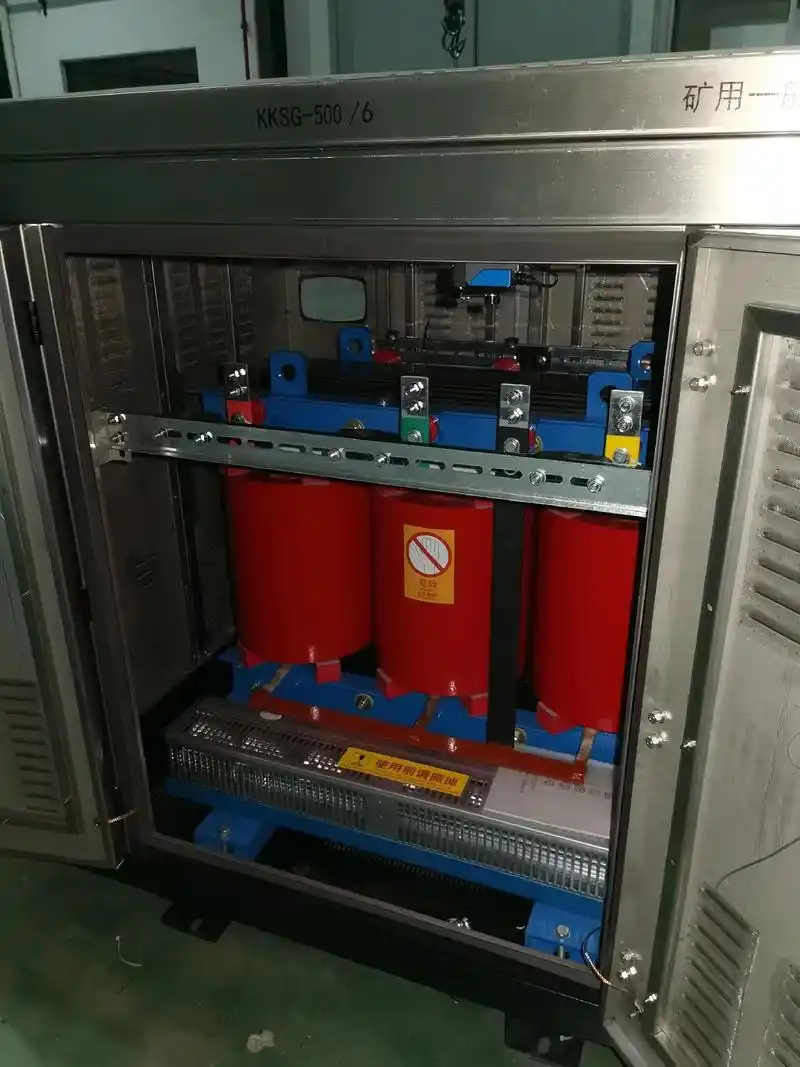
Insulation system: solid materials (epoxy resin, varnish, fiberglass, Nomex) separate live parts, provide dielectric strength, and manage heat.
Instead of being submerged in oil, the core and windings are exposed to air inside a protective enclosure, which is why it’s called “dry type.”
Dry-Type Transformer Cooling Methods (AN / AF)
Because there’s no oil to move heat away, cooling is all about air. The two main dry type transformer cooling methods are:
AN (Air Natural)
Also called self-cooled.
Heat is removed by natural air circulation around and through the windings.
No fans, no moving parts, low maintenance, and very quiet.
AF (Air Forced)
Uses fans or blowers to push air over the windings.
Increases the kVA capacity for the same transformer size.
Great when you need extra capacity for short-term overloads or tight spaces.
Most ventilated dry type transformers in commercial and industrial facilities are AN by default, with AF fan kits added when higher load or higher ambient temperature is expected.
Typical Voltage Levels and Sizes
In the U.S. market, dry-type transformer sizes and voltages tend to fall into a few common ranges:
Low-voltage dry type transformer
Primary: 208 V, 240 V, 277 V, 480 V, 600 V
Secondary: 120/240 V, 208Y/120 V, 480Y/277 V, 600 V
Typical power ratings: 15 kVA up to ~1,000 kVA
Medium-voltage dry type transformer
Primary: 2.4 kV, 4.16 kV, 4.8 kV, 13.2 kV, 13.8 kV, 15 kV, 34.5 kV (class ranges vary by manufacturer)
Secondary: usually 480 V, 600 V, or medium-voltage distribution levels
Typical power ratings: 500 kVA up to 10,000+ kVA, depending on design and standards
When you see specs like “750 kVA, 13.8 kV–480Y/277 V, dry-type, AN/AF”, that means:
It’s a dry-type transformer (no oil)
Rated 750 kVA continuous
Medium-voltage primary, low-voltage secondary
Base cooling Air Natural, with Air Forced available for boosted rating.
That’s the core of dry type transformer meaning: air-cooled, solid-insulated, safe and clean power transformation, ideal for indoor and sensitive environments in the U.S. market.
Main Classifications of Dry-Type Transformers
When people ask, “How many types of dry type transformer are there?” I usually break them down by construction and insulation system. That’s what really drives performance, price, and where each unit fits best.
Main Dry Type Transformer Types by Construction
The most common dry type transformer types in the U.S. market are:
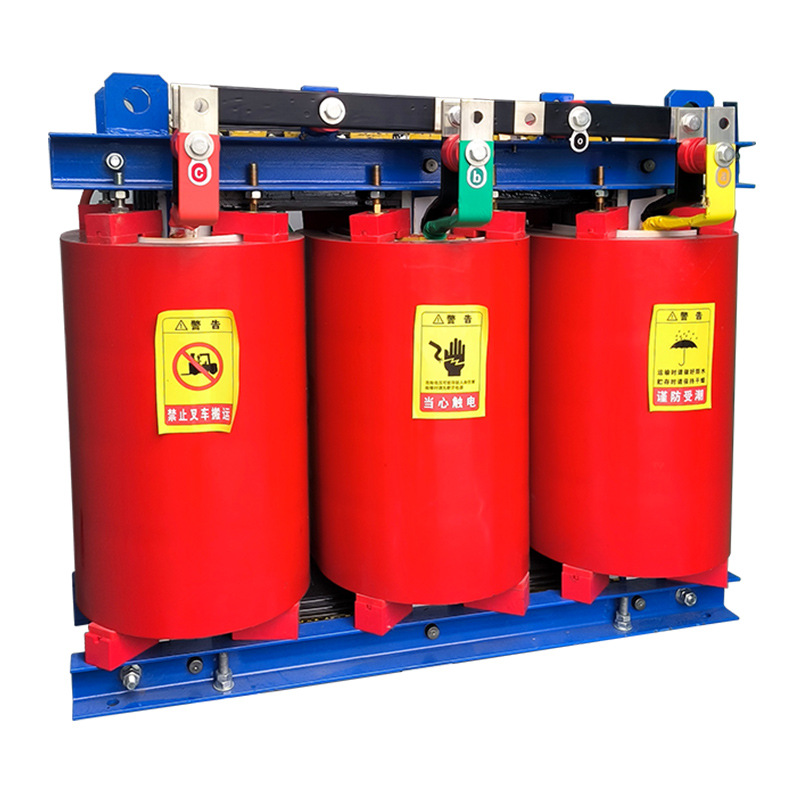
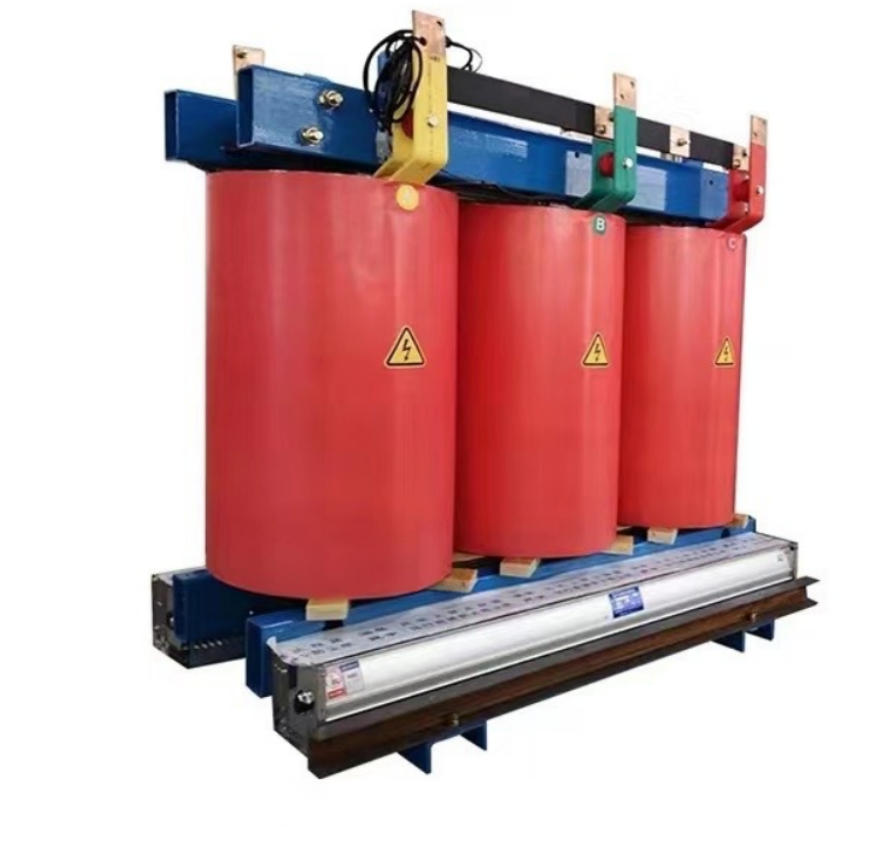
Cast Resin Dry Type Transformer (CRT / Cast Coil / Epoxy Resin Dry Transformer)
LV or MV windings are fully encapsulated in epoxy resin.
Delivers a robust, sealed coil with excellent protection against moisture, dust, and mechanical stress.
Popular in commercial buildings, hospitals, data centers, and public facilities where fire safety and low maintenance matter.
Vacuum Pressure Impregnated Transformer (VPI Dry Type Transformer)
Coils are wound, then placed in a tank where varnish is drawn in under vacuum and pressure.
Gives strong dielectric strength and thermal performance while keeping the coil more open for cooling.
A go-to choice for industrial dry type transformers, motor loads, and renewable energy dry transformers where you want reliability at a better price point than cast resin.
Vacuum Pressure Encapsulated Transformer (VPE)
Similar to VPI, but uses multiple vacuum/pressure cycles with thicker coating to create a more sealed surface.
Better resistance to humidity, salt, and chemicals than basic VPI, often used in coastal or light-corrosive environments.
Open-Wound / Open-Ventilated Dry Type Transformer
Coils are not fully encapsulated, with air moving freely around the windings.
Usually supplied as a ventilated dry type transformer in a steel enclosure.
Cost-effective and efficient for indoor dry type transformer installations in clean, controlled spaces.
Encapsulated / Compound-Filled Dry Type Transformer
Coils are completely embedded in resin or compound inside the enclosure.
Ideal for smaller low voltage dry type transformer sizes and harsh or outdoor locations where you need extra environmental protection.
When we design or select dry type equipment for U.S. projects, we match the insulation type (CRT, VPI, VPE, open-wound, encapsulated) to the environment, load profile, and local code requirements. For example, if the transformer will sit indoors near switchgear, we also factor in installation and safety practices covered in resources like this guide on high and low voltage transformer installation.
Cast Resin Dry-Type Transformer (CRT)
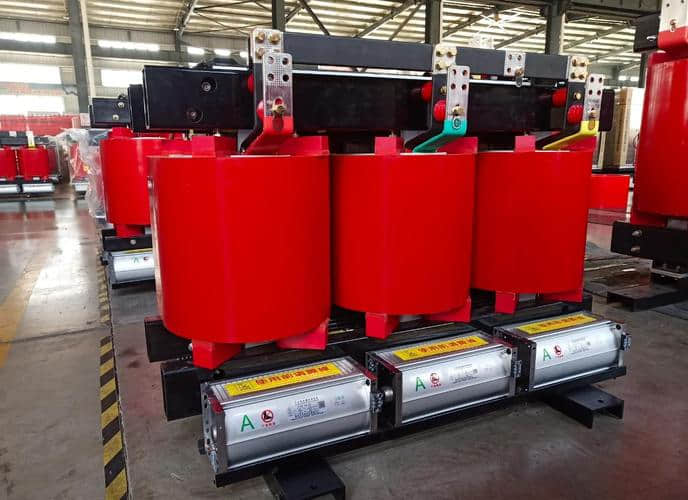
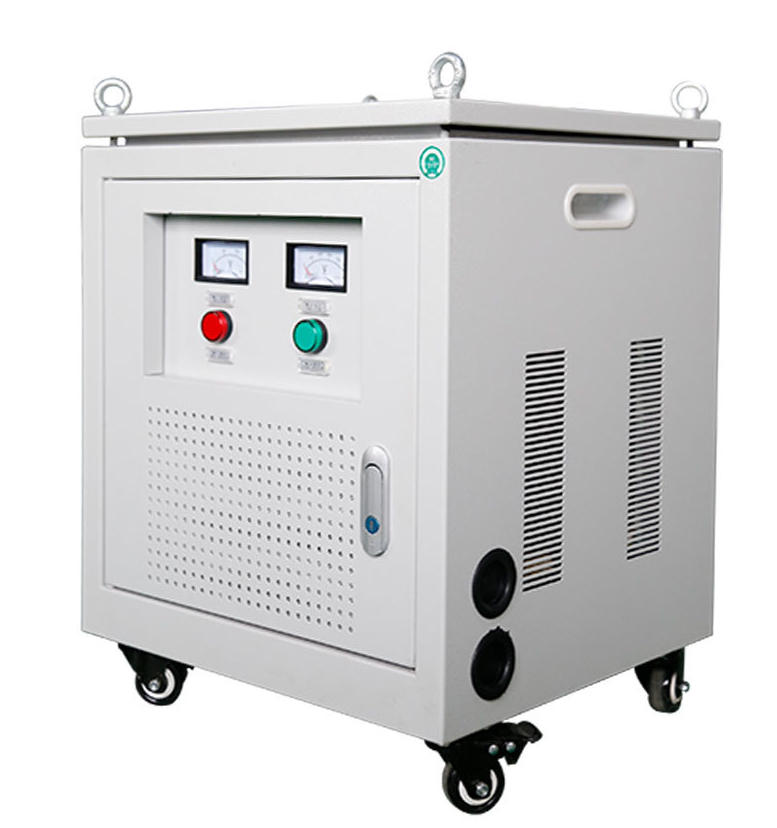
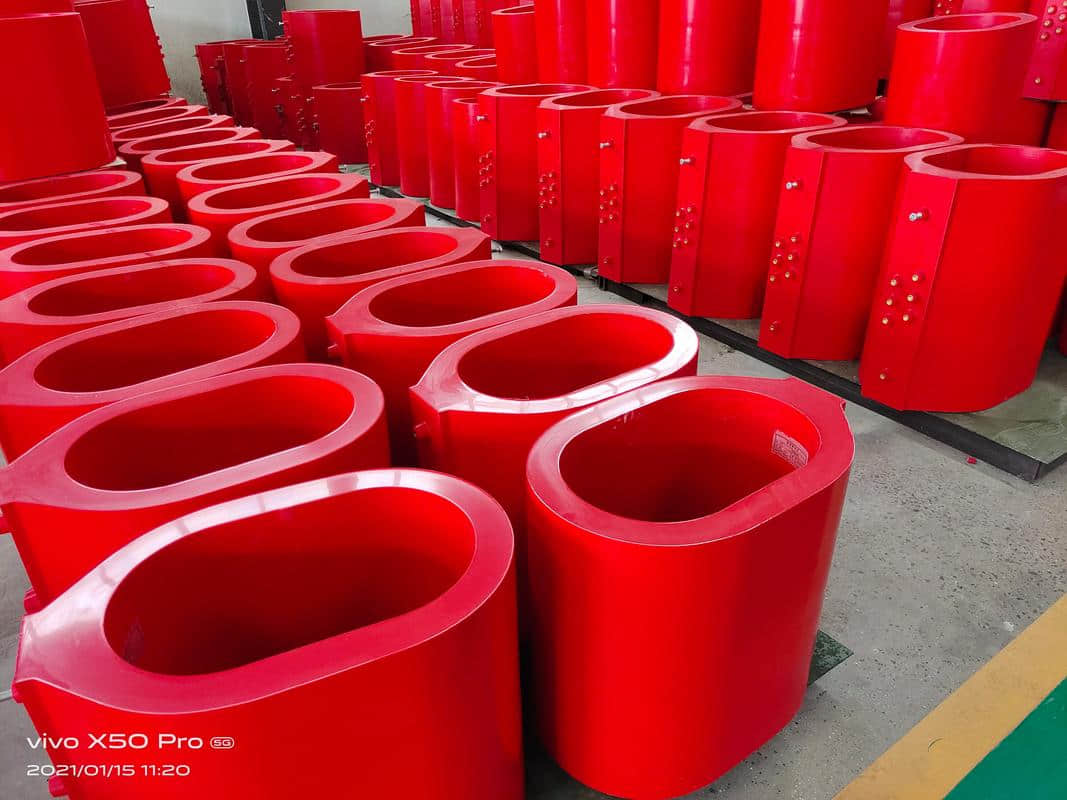
A cast resin dry type transformer (also called a cast coil transformer or epoxy resin dry transformer) uses a solid, epoxy-encapsulated coil instead of oil for insulation and cooling. The LV and MV windings are poured and fully embedded in epoxy resin, creating a rigid, sealed coil that’s highly resistant to moisture and contamination. Compared with open-wound designs, this construction gives CRT units very high dielectric strength and strong mechanical stability under short-circuit stress.
How Cast Resin Dry-Type Transformers Are Built
Epoxy resin encapsulation: Coils are cast under vacuum, so the epoxy fills all gaps around the winding. This removes air pockets and greatly reduces partial discharge.
Rigid coil structure: Once cured, the resin forms a solid, self-supporting coil that withstands vibration and mechanical forces.
No oil, no tank: Cooling is by air (natural or forced), and the core/coil assembly sits in a ventilated or enclosed housing.
Well-designed non-encapsulated dry type transformers like our SG(B) non-encapsulated dry-type power transformer cover many indoor needs, but fully cast resin designs push protection a level higher.
Key Benefits of Cast Resin Dry Transformers
Cast resin dry type transformers are popular in the U.S. for demanding indoor and public environments because they offer:
High moisture resistance: Work reliably in damp basements, coastal areas, or humid climates without needing dehumidifiers or space heaters.
Dust and pollution protection: The epoxy barrier blocks dust, chemicals, and airborne contaminants—ideal for industrial plants and parking garages.
Strong mechanical strength: The solid coil resists shock, vibration, and short-circuit forces, which is crucial for medium-voltage power distribution.
Fire safety: With no oil and low flammability materials, CRT units have excellent fire performance and are easier to integrate into NFPA, NEC, and local building code requirements.
Low maintenance: No oil sampling, no leak checks, and minimal routine service beyond visual checks and cleaning.
Limitations of Cast Resin Dry-Type Transformers
You should also weigh a few tradeoffs:
Higher price point: Cast resin transformers usually cost more upfront than VPI or open-wound dry units due to the casting process and materials.
Lower overload capability: Solid resin doesn’t dissipate heat as efficiently as oil, so CRTs are less forgiving of long-term overloads or sustained high harmonic loading.
Heavier and bulkier: The resin-encapsulated coils can be larger and heavier for the same kVA rating compared to liquid-filled designs.
Best Applications for Cast Resin Dry-Type Transformers
In the U.S. market, I typically recommend cast resin dry type transformers for:
Indoor power distribution in commercial buildings where safety, low maintenance, and low fire risk are top priorities.
High-rise buildings and mixed-use towers that need safe, compact transformers on higher floors or in confined electrical rooms.
Hospitals and healthcare facilities that demand reliable, low-fire-load equipment near critical spaces.
Chemical plants and process industries where airborne corrosives and dust could attack open-wound coils.
Public infrastructure like airports, subway stations, stadiums, tunnels, and schools where large numbers of people are present and fire safety is non-negotiable.
If you need a medium voltage dry type transformer for a dense, occupied building with strict safety codes, a cast resin dry-type transformer is usually the safest and most reliable bet, even if it costs more upfront.
Vacuum Pressure Impregnated (VPI) Dry-Type Transformer
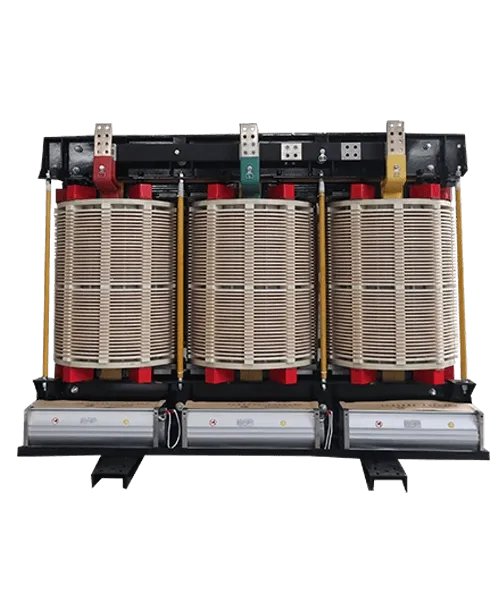
A VPI dry type transformer (vacuum pressure impregnated transformer) uses open-wound coils that are saturated with insulating varnish under vacuum and pressure. After impregnation, the coils are baked to cure the varnish, locking the windings in place and forming a solid, moisture-resistant insulation system.
How VPI Dry Type Transformers Are Built
In a VPI dry type transformer, the process normally looks like this:
Copper or aluminum windings are wound on the core as open coils.
Coils go into a tank where air is pulled out under vacuum.
High-grade insulating varnish is introduced under pressure so it fully penetrates the windings.
Coils are oven-baked to harden the varnish and improve mechanical strength and dielectric performance.
This construction gives better coil rigidity than a simple open-wound dry unit and is widely used in industrial dry type transformer designs in the U.S. power market.
Performance Advantages of VPI Dry Type Transformers
A VPI dry type transformer delivers a strong balance of performance and cost:
High dielectric strength – the varnish system boosts insulation levels and partial discharge performance.
Good thermal performance – VPI coils handle higher temperature rise and frequent load cycling.
Reliable operation – strong mechanical bonding helps the transformer withstand short-circuit forces, vibration, and shipping shocks.
Serviceability – easier to inspect and clean than fully cast resin, especially in large industrial units.
With proper protection and switching gear, like outdoor SF6 circuit breaker solutions such as the LW8-40.5 SF₆ circuit breaker, VPI units fit smoothly into modern distribution systems.
Limitations in Harsh Environments
Compared with a cast resin dry type transformer, a VPI design has:
Lower protection in extreme humidity – Varnish is resistant to moisture, but not as sealed as full epoxy casting.
Lower resistance to corrosive or salt-laden air – chemical plants, coastal sites, and heavy marine environments may still favor epoxy resin dry transformer or fully encapsulated options.
More frequent cleaning – dust and contaminants can settle on open-ventilated coils if the enclosure isn’t tightly controlled.
For harsh coastal or highly corrosive areas, many engineers in the U.S. will push toward cast coil transformer or vacuum pressure encapsulated transformer designs instead.
Typical Uses of VPI Dry Type Transformers
A VPI dry type transformer is a strong fit when you need solid performance without the higher cost of cast resin. Common U.S. applications include:
Industrial plants and factories – process loads, MCC rooms, and local distribution.
Motor loads and drives – as drive isolation transformers for VFDs, pumps, and compressors.
Renewable energy – step-up or step-down duty for renewable energy dry transformer applications like wind and solar in protected housings.
Outdoor enclosures – with the right outdoor dry type transformer enclosure, VPI units handle parking decks, substations, and rooftop equipment rooms effectively.
If you’re designing a commercial or industrial project and want a balance of price, reliability, and efficiency, VPI dry type transformers are usually one of the first options I recommend.
Other Specialized Dry-Type Transformer Types
When you get beyond standard cast resin and VPI designs, there are a few specialized dry type transformer types that solve very specific problems in U.S. commercial and industrial facilities.
Encapsulated & Compound-Filled Dry Type Transformers
Encapsulated dry type transformers (often called epoxy resin dry transformers or compound-filled transformers) have their coils fully potted in resin or compound.
Key points:
Fully sealed against dust, moisture, and many corrosive atmospheres
Great for outdoor dry type transformer enclosures, washdown areas, and coastal sites
Usually available in low voltage dry type transformer sizes for panels, control power, and light-duty distribution
These are the units you pick when you need long life with almost no maintenance and you don’t want to deal with oil.
Open-Wound & Open-Ventilated Dry Type Designs
Open-wound dry transformers and open-ventilated dry type transformers use exposed windings with ventilation paths for natural or forced air (AN/AF) cooling.
What that means in practice:
Higher cooling efficiency and better thermal performance for the price
Require a clean, dry indoor space with good ventilation
Common as industrial dry type transformers feeding MCCs, switchgear, and process loads
If you already have good electrical rooms and mechanical ventilation, these are usually the most cost-effective.
Non-Encapsulated vs Fully Encapsulated Construction
You’ll see dry-type units described as non-encapsulated or fully encapsulated:
Non-encapsulated (open-wound): best for clean indoor environments; lower cost, easier to cool
Fully encapsulated: best for harsh, dirty, or humid environments; higher protection, slightly higher losses and cost
In U.S. practice, I typically match this choice to the installation environment first, then refine by budget and efficiency targets.
Special-Purpose Dry Type Transformers (K-Factor, Drive, Harmonics)
Beyond general-purpose units, there are several special-purpose dry type transformer types designed around problem loads:
K-factor dry type transformer
Built for nonlinear loads like servers, UPS, VFDs, and office IT
Handles high neutral currents and harmonic heating without overheating
Very common in data center dry type transformer applications and modern commercial buildings
Drive isolation transformer
Designed to feed variable frequency drives (VFDs)
Provides isolation, withstands PWM waveforms, and protects against dv/dt stress
Standard practice in heavy industrial dry type transformer setups for motors
Harmonic mitigating dry transformer
Special winding and core design to cancel or reduce harmonics (typically 3rd, 5th, 7th)
Improves power quality, reduces transformer heating, and can cut down on nuisance trips
A strong fit for buildings with a lot of electronic loads and strict power-quality specs
When you’re selecting between these specialized types, match the transformer to the load profile first (VFD-heavy, harmonic-heavy, IT-heavy), then finalize kVA rating, insulation class, and cooling method based on your overall system design and local code requirements, often in combination with properly coordinated switchgear and protection equipment similar to what’s used with modern electrical switchgear assemblies.
Dry-Type Transformer Insulation Classes and Systems
When you’re choosing between dry type transformer types, the insulation class and system tell you how much heat the unit can safely handle and how long it will last.
Insulation Class Ratings (Class F, H, 220°C)
Dry type transformers are usually built to these insulation classes:
Class F dry type transformer – Rated for 155°C total temperature (typically 100°C rise + 55°C ambient).
Class H dry type transformer – Rated for 180°C total temperature (commonly 115°C rise + 65°C ambient).
Class 220°C insulation – Premium class for very high temperature conditions and heavy-duty loads.
Higher class = more thermal margin, but also usually higher cost. For most commercial and industrial jobs in the U.S., Class F and Class H are the common sweet spots.
Common Dry Type Transformer Insulation Materials
Different dry type transformer insulation types are combined into a full insulation system:
Epoxy resin (cast resin dry type transformer, cast coil transformer, epoxy resin dry transformer) – high mechanical strength, moisture resistant.
Nomex – aramid paper used in Class H and 220°C systems, very tough and heat-resistant.
Fiberglass – supports windings mechanically and resists high temperatures.
Silicone varnish – used in vacuum pressure impregnated transformers (VPI) and vacuum pressure encapsulated transformers (VPE) to boost dielectric strength and protect windings.
Manufacturers engineer these materials as a system so the transformer meets the required insulation class.
How Insulation Class Impacts Life and Reliability
Insulation class has a direct impact on life expectancy and reliability:
Running a transformer below its max temperature can dramatically extend life (every 10°C cooler can roughly double insulation life).
Higher class insulation (H, 220°C) handles hotter rooms, tighter rooms, or tougher loads, making it more forgiving if your load profile isn’t perfectly steady.
For 24/7 critical loads in data centers or hospitals, I always recommend keeping operating temperatures well below the class limit to protect uptime.
If you want to go deeper into how temperature and contamination affect performance over time, I walk through this in detail in my dry type transformer maintenance and inspection guide.
Insulation System, Overloads, and Efficiency
Your insulation system also affects overload capability and energy efficiency:
A higher class system (with Nomex, epoxy, fiberglass, silicone varnish) can safely ride through short-term overloads better than lower-grade insulation.
Premium insulation lets manufacturers design lower temperature rise units (e.g., 80°C rise vs 115°C rise), which:
Cuts core and winding losses
Improves efficiency and lowers operating cost
Reduces thermal stress on the windings and core
For harsh U.S. environments (hot mechanical rooms, rooftop or industrial spaces), selecting the right insulation class is just as important as choosing between cast resin dry type transformers, VPI dry type transformers, or open wound dry transformers.
When you compare dry type transformer specifications, always look at: insulation class, temperature rise, and materials together. That’s what really tells you how the transformer will hold up in real-world operation.
Dry-Type Transformer Winding and Configuration Types
When you’re specifying dry type transformer types in real projects, winding material, phase configuration, connections, and enclosure all matter for performance, cost, and safety.
Copper vs Aluminum Winding Dry Transformers
Both copper winding dry transformers and aluminum winding dry transformers are common in the U.S.:
Copper windings
Higher conductivity and better short-circuit strength
More compact design and lower losses (higher efficiency)
Higher material cost but better long-term performance for heavy-duty and mission-critical loads
Aluminum windings
Lower initial cost and lighter weight
Slightly higher losses and larger coil size
A good fit for budget-sensitive commercial and light industrial projects
For data centers, hospitals, and critical industrial loads, I usually lean copper. For standard commercial panels and general distribution, aluminum can be a smart cost play.
Single-Phase vs Three-Phase Dry Type Transformers
Dry type transformers are available in what configuration you actually need at the panel:
Single-phase dry type transformer
Common in residential, small commercial, lighting circuits, control power
Simple, lower kVA ratings, easy to install
Three-phase dry type transformer
Standard for industrial, commercial, data center and renewable energy dry transformer systems
Better for motors, large HVAC, UPS, and process loads
Higher kVA ratings and more efficient for larger power distribution
Connection Types: Delta, Wye, Zig-Zag, Autotransformer
Connection choice drives how the system handles grounding, harmonics, and voltage conversion:
Delta–Wye (Delta–Star)
Most common power distribution setup (e.g., 480V delta to 208Y/120V wye)
Allows neutral for 120V loads and helps isolate harmonics
Delta–Delta or Wye–Wye
Used when you don’t need a neutral or want a direct like-for-like system configuration
Zig-zag dry transformer
Used for grounding transformers and harmonic mitigating dry transformers
Helps control neutral currents and improve power quality
Autotransformer configuration
Uses common windings to step voltage up or down with less copper/aluminum
More compact and efficient, but no full galvanic isolation
Enclosure and Protection Types: Ventilated, TENV, and More
Enclosure type is critical for indoor dry type transformer and outdoor dry type transformer applications:
Ventilated dry type transformer
Louvered openings, natural airflow cooling
Most common for clean indoor commercial and industrial spaces
Lower cost and good thermal performance
Totally Enclosed Non-Ventilated (TENV) transformer
Sealed housing with no external airflow
Better for dusty, dirty, or corrosive areas when paired with the right insulation system
Slightly higher temperature rise and lower kVA per footprint
Other housings
NEMA 3R/4/4X outdoor enclosures for weather-protected or corrosive environments
Custom sound-attenuated housings for noise-sensitive sites like offices, schools, or hospitals
If you’re building out a full power system with breakers and protection on the medium-voltage side, it’s worth aligning your transformer choice with your upstream gear, similar to how you’d coordinate a high-voltage circuit breaker in a 33kV or substation application.
Pros and Cons of Dry-Type Transformers
Main Advantages of Dry-Type Transformers
Dry type transformers give you strong performance with lower operational risk, which is why they’re widely used in U.S. commercial and industrial sites. Key benefits:
Fire safety: No oil, so there’s no oil leakage or oil fire risk. This is a big plus for high-rise buildings, schools, hospitals, and data centers.
Low maintenance: No oil sampling, filtering, or leak checks. Routine maintenance is mostly visual inspection, cleaning, and tightening connections.
Eco-friendly operation: With no insulating oil, there’s almost zero risk of soil or water contamination, making dry type transformer types a better fit for environmentally sensitive installations.
Indoor friendly: Cast resin dry type transformers and VPI dry type transformers run quietly and cleanly, ideal for indoor electrical rooms where space and safety are critical.
Limitations of Dry-Type Transformers
Even with those advantages, dry-type transformer types aren’t perfect:
Higher initial cost: A dry type transformer of the same kVA rating normally costs more upfront than an oil-filled unit.
Limited very high power ratings: For very large utility-scale power, oil-immersed is still the standard. Dry type transformer sizes are typically favored in low voltage and medium voltage distribution levels.
Size and weight: Dry units are usually bulkier, so you need more space and stronger floor support.
Overloads and Temperature Rise
Different dry type transformer types handle thermal stress differently:
Cast resin dry type transformer (epoxy resin dry transformer / cast coil transformer):
Very robust mechanically and thermally, but limited overload capacity compared to oil-filled units.
Higher temperature rise if pushed too hard; best run near the nameplate rating.
VPI dry type transformer (vacuum pressure impregnated transformer):
Good thermal performance and cooling with AN/AF dry type transformer cooling methods.
Can typically ride through short overloads, but long-term overloading will shorten insulation life, especially with Class F or Class H insulation.
Matching the insulation class (Class F dry type transformer, Class H dry type transformer) to your load profile is key if you expect cyclic or short-term overloads.
Dry-Type vs Oil-Immersed Transformers
When U.S. customers ask whether to go dry type vs oil filled transformer, here’s the practical breakdown:
Performance:
Oil-immersed units handle overloads and hot environments better due to superior heat transfer.
Dry type transformers are more than reliable enough for most commercial, industrial, and data center loads when correctly sized.
Lifecycle & reliability:
Oil-filled transformers often have a slight edge in very high kVA, heavy-duty utility or transmission applications.
Dry type transformer types win where safety, code compliance, and environmental risk are the priority—especially indoors or in public spaces.
Risk profile:
Oil-filled = better thermal margin, but with spill, fire, and environmental risk.
Dry type = lower thermal margin at high overloads, but far lower fire and contamination risk.
If you’re designing a full power distribution system, pairing dry-type transformers with modern protection equipment like solid-insulated switchgear or vacuum circuit breakers can deliver a compact, safe, and low-maintenance package that fits U.S. code requirements and AHJ expectations, similar to what you’d see in a solid insulated switchgear vs. vacuum breaker setup.
Applications of Dry Type Transformer Types
Dry type transformers are my go-to for commercial buildings, industrial plants, data centers, and renewable energy projects where fire safety and low maintenance really matter. You’ll see cast resin dry type transformers in high-rise offices, hospitals, schools, and transit hubs, while VPI dry type transformers are common in factories, motor loads, and outdoor NEMA enclosures. For rooftop solar, wind projects, and EV infrastructure, compact medium voltage dry type transformers with robust enclosures are now standard in the U.S. market.
Matching Dry Type Transformers to the Environment
I always match dry type transformer types to both the environment and the load profile:
Clean, indoor space (offices, data centers) → Cast resin or VPI, ventilated enclosure
Humid, dusty, or corrosive areas (wastewater, chemical, coastal) → Fully encapsulated / cast resin dry type transformer with higher IP/NEMA rating
Heavy harmonic or nonlinear loads (VFDs, UPS, chargers) → K‑factor dry type transformers or harmonic mitigating dry transformers
Motor or drive loads → Drive isolation transformers or VPI units with strong mechanical strength
If you need a quick reference or custom design, I usually build around the configurations shown on our dry-type transformer product line.
Key Selection Criteria (Specs That Actually Matter)
When I specify dry type transformers for U.S. projects, I focus on a few core points:
kVA rating & voltage: Match system voltage (480V, 600V, 4.16kV, 13.8kV, etc.) and future capacity needs
Insulation class: Typical choices are Class F or Class H for higher temperature margin and longer life
Cooling method: AN (natural air) for standard loads, AF (forced air) where you need extra overload capacity
Enclosure type:
Ventilated dry type transformer for indoor electrical rooms
Totally enclosed non ventilated transformer (TENV) or weatherproof enclosure for harsh or outdoor environments
Winding and configuration:
Copper winding dry transformer where efficiency and durability matter most
Aluminum winding dry transformer when budget is tighter
Delta‑wye dry transformer for typical U.S. distribution and grounding practices
Standards and Code Compliance
For the U.S. market, I never sign off a dry type transformer specification without aligning with:
ANSI / IEEE and NEMA for ratings and performance
IEC where international or global standards are requested
NFPA 70 (NEC) and local code for location, ventilation, and fire safety
UL / CSA listings where required by the AHJ or project specs
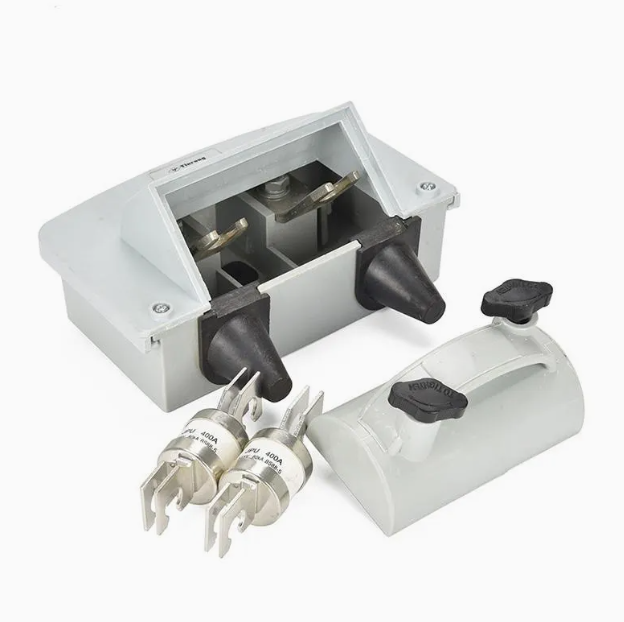
If your project also involves indoor switchgear or disconnects, I pair these units with compatible gear like an indoor disconnect switch similar to what you’d see in a through-wall indoor disconnect solution.
You tell me your load profile, environment, kVA, and standards, and I’ll match the right dry type transformer type so you stay safe, code-compliant, and efficient for the long haul.
Dry-Type Transformer Installation, Maintenance, and Safety
Best practices for installing dry-type transformers (indoor & outdoor)
For any dry type transformer installation, I always treat mechanical support, cooling, and safety clearances as non‑negotiable.
Indoors:
Mount the transformer on a rigid, level surface or channel base; bolt it down to control vibration and noise.
Keep clearances per NEC and manufacturer spec (commonly 3–6 ft in front and at ventilation openings).
Never block ventilation grills on a ventilated dry type transformer; hot air must be able to rise and escape.
Route cables so they don’t stress the bushings; support conductors right up to the terminals.
Coordinate upstream protection (breakers, fuses, load-break switches) so inrush and fault currents are handled correctly. On MV installs, that usually means pairing with the right high-voltage fuse protection.
Outdoors:
Use an outdoor-rated or totally enclosed non-ventilated (TENV) enclosure with proper NEMA rating.
Elevate the enclosure above grade; keep it away from standing water, snow build-up, and direct wash-down.
Add sunshades or shelters in hot climates to reduce temperature rise.
Bond and ground per code, including ground grid or rods as required.
Routine inspection, cleaning, and preventive maintenance
Dry type transformer maintenance is low, but it’s not “set and forget.” I recommend scheduled checks based on load and environment.
Visual checks (every 6–12 months):
Look for discoloration, hot spots, cracks in cast resin, or loose hardware.
Check terminal lugs, ground connections, and support brackets for looseness or corrosion.
Confirm nameplate data matches the actual dry type transformer load and voltage configuration on site.
Cleaning:
De-energize, lockout/tagout, and verify absence of voltage.
Blow out dust with dry, oil-free compressed air; work from top down and keep nozzle at a safe distance.
In harsh or industrial environments, clean more often—dust on windings acts like a blanket, trapping heat.
Preventive steps:
Tighten terminations to torque values on the nameplate or manual.
Record load current, temperature, and sound level trends.
For VPI and open-wound dry type transformers, re-verify insulation resistance on a set schedule.
Common dry type transformer issues and basic troubleshooting
Most dry type transformer problems in the field trace back to heat, contamination, or loose connections.
Typical issues:
Overheating: Often caused by overload, blocked ventilation, or high ambient temperature.
Noise or humming: Can point to loose core clamping, mounting hardware, or abnormal energization.
Insulation deterioration: Shows as odor, discoloration, reduced insulation resistance, or nuisance trips.
Nuisance tripping / protection operation: Might be due to inrush, shorted turns, or downstream faults.
Basic troubleshooting steps:
Verify line voltage, tap settings, and load balance on three phase dry type transformers.
Measure temperature (IR camera) to spot hot terminations and overloaded phases.
Isolate whether the fault is on the primary, secondary, or load side before condemning the transformer.
If you suspect internal damage (cracks in cast coil transformer windings, burn marks), pull it out of service and get it tested by a qualified shop.
Fire protection, ventilation, and safety clearances
Dry-type transformer fire risk is lower than oil-filled, but not zero. I design rooms and pads assuming worst case.
Fire protection basics:
Use noncombustible rooms or enclosures where possible.
Provide smoke detection and, if required by code or AHJ, fire suppression (typically clean agent or water mist; avoid direct high‑pressure water on energized gear).
Coordinate with upstream protective devices and, on MV systems, appropriate high-voltage circuit protection and relays to clear faults fast.
Ventilation & clearances:
Size room ventilation for the transformer’s kW loss plus ambient conditions; keep room temp within the insulation class limits (Class F, Class H, etc.).
Maintain clearances around all sides for cooling, inspection, and cable work—do not store materials within the transformer space.
Keep exit paths clear; no blocking egress with conduit, cable trays, or storage.
If you follow these installation, maintenance, and safety practices, your dry type transformer—whether cast resin, VPI, or open-wound—will run cooler, last longer, and stay compliant with U.S. codes and standards.
FAQs on Dry-Type Transformer Types
How many main dry-type transformer types are commonly used?
In real-world U.S. projects, you’ll mostly deal with four main dry type transformer types:
| Main Type | Typical Use Case |
|---|---|
| Cast resin dry type transformer | Indoor distribution, public & critical sites |
| VPI dry type transformer | Industrial plants, motor loads |
| VPE / encapsulated dry type | Corrosive / humid environments |
| Open wound / ventilated dry type | Cleaner, controlled indoor spaces |
Everything else (K‑factor, drive isolation, harmonic mitigating) is basically a “special-purpose” version of these core designs.
Difference between cast resin and VPI dry-type transformers
| Feature | Cast Resin (CRT / Cast Coil) | VPI Dry Type Transformer |
|---|---|---|
| Winding protection | Fully encapsulated in epoxy resin | Varnish impregnated, not fully encapsulated |
| Moisture resistance | Very high | Good, but lower than cast resin |
| Mechanical strength | Excellent (good for short-circuit forces) | Very good |
| Overload capability | Generally lower | Usually better |
| Cost | Higher | Moderate |
| Best fit | Hospitals, airports, high-rise, tunnels | Plants, OEM, motor loads, renewables |
If you need maximum environmental protection and fire safety in public buildings, choose a cast resin dry type transformer. If you want strong performance at better cost in industrial settings, a VPI dry type transformer usually makes more sense.
Suitability for outdoor and harsh environments
Dry type transformer suitability depends heavily on enclosure and insulation:
Outdoor dry type transformer:
Use NEMA 3R or better enclosure.
Prefer cast resin or VPE / encapsulated designs in coastal, chemical, or dusty sites.
Harsh environments:
High humidity / salt air → cast resin or fully encapsulated.
Heavy dust or corrosive gases → sealed or forced-ventilated housings, with proper clearances and periodic cleaning.
For systems with large copper bus runs, line it up with a proper copper busbar selection strategy similar to what’s used in power gear design.
If the environment is extremely aggressive and reliability is critical, many engineers still lean toward oil-filled units or fully encapsulated cast coil designs.
When to choose dry type instead of oil-filled
Choose a dry type transformer when:
Fire and environmental risk must be low:
Inside buildings, basements, shopping centers, schools, hospitals, data centers.
Spill containment is difficult or costly:
Tight indoor rooms where oil containment pits are not practical.
Local codes push toward dry:
Some U.S. jurisdictions prefer or require dry type for indoor MV/LV distribution.
Medium power ratings:
Up to roughly 5–10 MVA at medium voltage is common for dry type transformer sizes.
Stick with oil-filled when you need very high ratings, longest overload capability, or harsh outdoor duty with extreme temperature swings.
Typical service life and maintenance intervals
Typical expectations in the U.S. for quality dry type units:
| Item | Typical Range |
|---|---|
| Service life | 20–30 years (properly sized & maintained) |
| Visual inspection | Every 6–12 months |
| Cleaning (vacuum, dry wipe) | 6–12 months, more often in dusty areas |
| Thermal scan / IR check | Yearly or as part of plant PM programs |
| Detailed electrical tests | 3–5 years or per site maintenance standards |
Key tasks:
Keep ventilation paths clear.
Check for discoloration, odor, loose terminations.
Confirm that temperature rise stays within spec and insulation class (Class F, Class H, etc.) limits.
Cost factors that influence dry-type transformer types
Pricing varies a lot by configuration. Major cost drivers:
Design & type:
Cast resin > VPE > VPI > open wound.
kVA / MVA rating & voltage level:
Higher power and MV ratings increase copper, core steel, and insulation cost.
Winding material:
Copper winding dry transformer costs more but offers better mechanical strength and efficiency.
Aluminum winding dry transformer reduces first cost and weight.
Insulation class:
Class H or higher insulation systems usually cost more but allow higher temperature rise.
Enclosure:
Indoor ventilated < outdoor, NEMA 3R < NEMA 4/4X, explosion‑proof, etc., in cost.
Special-purpose features:
K‑factor dry type transformer, drive isolation transformer, and harmonic mitigating dry transformer designs carry a premium due to extra copper, special cores, and engineering.
If you’re building a high-reliability MV lineup, coordinate the transformer specs with the rest of your switchgear and protection (for example, 35 kV breaker and disconnect switch designs must align with transformer ratings and fault levels) to avoid over- or under-specifying the transformer.