— An Electrical Engineer's Deep Dive: Why Focusing on Upfront Price Will Always Cost You More —
I. Introduction: The Direct Answer and Core Thesis
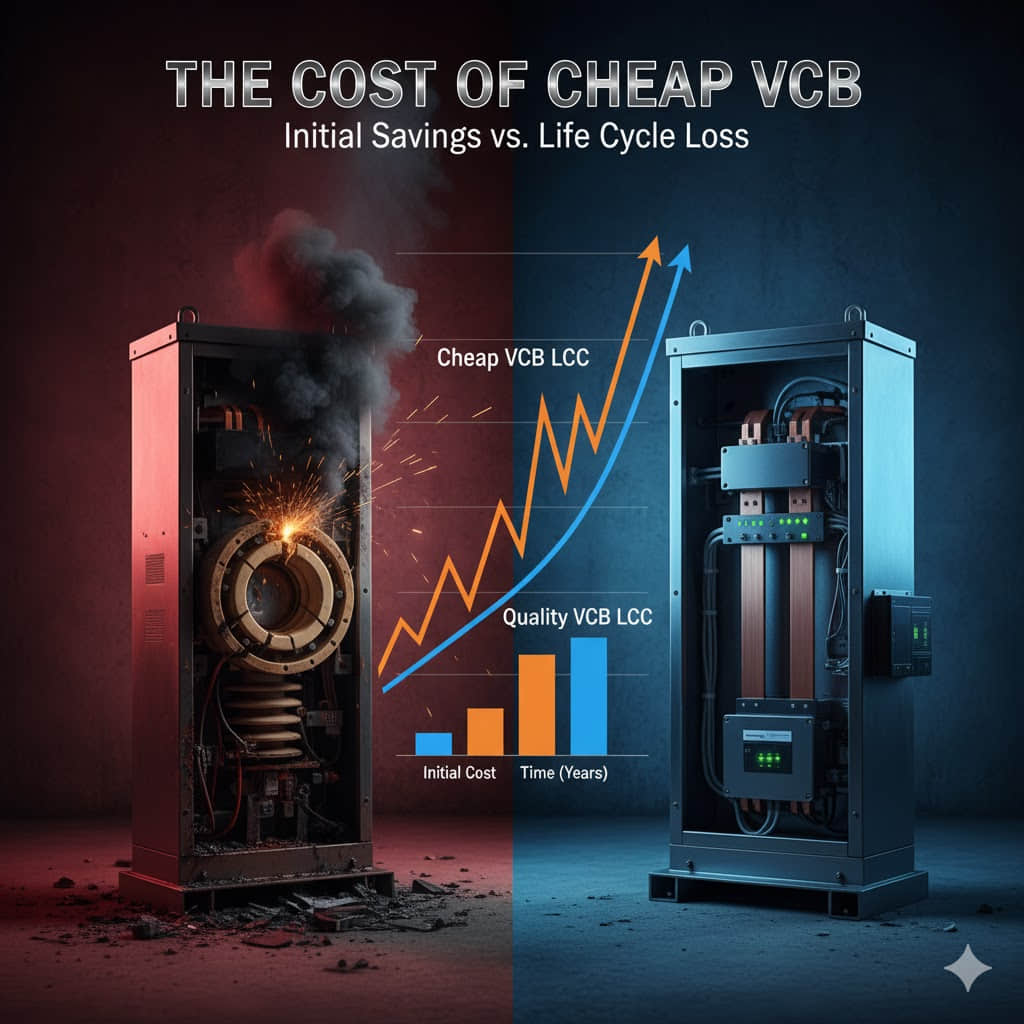
A cheap Vacuum Circuit Breaker (VCB) will inevitably cost you more in the long run. This high long-term expense is directly tied to the degradation of core materials like arc chamber ceramics, contact alloys, and conductive copper.
These compromises lead to diminished arc quenching capability, increased contact resistance, and severely reduced mechanical lifespan. Crucially, cheaper units often lack digital monitoring features, preventing crucial predictive maintenance and triggering catastrophic system failures, expensive unplanned downtime, and unmanageable Life Cycle Costs (LCC).
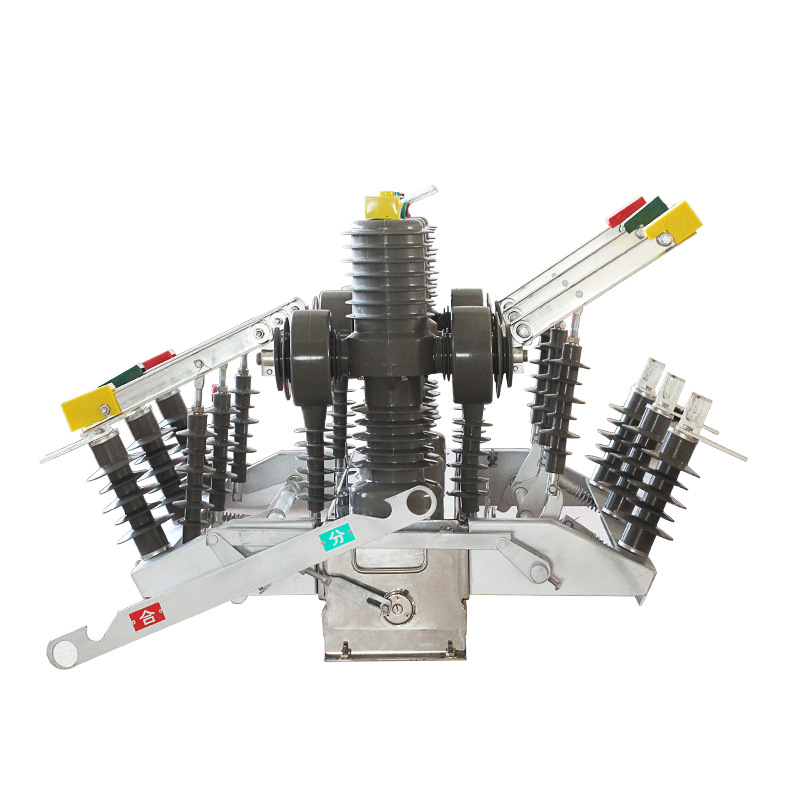
The Vacuum Circuit Breaker (VCB) acts as the critical protector, the “heart,” of any medium-to-high voltage power distribution network. It is entrusted with the vital role of safely and quickly interrupting large fault currents, alongside its routine duty of connecting and disconnecting rated currents.
A VCB’s reliability is non-negotiable; it guarantees power continuity, grid stability, and the fundamental safety of personnel and expensive equipment. Facing a market flooded with VCBs at vastly different price points, many procurement teams are easily swayed by the allure of a lower initial price, mistakenly equating it with effective cost saving. This price-driven decision-making, however, comes at the direct expense of the VCB's most critical electrical performance and longevity.
A high-quality VCB is the result of systematic engineering centered around four core functions: insulation, conduction, arc interruption, and structural support. The material selection for every single component must rigorously satisfy the demanding operational requirements of high voltage, high current, and frequent operation.
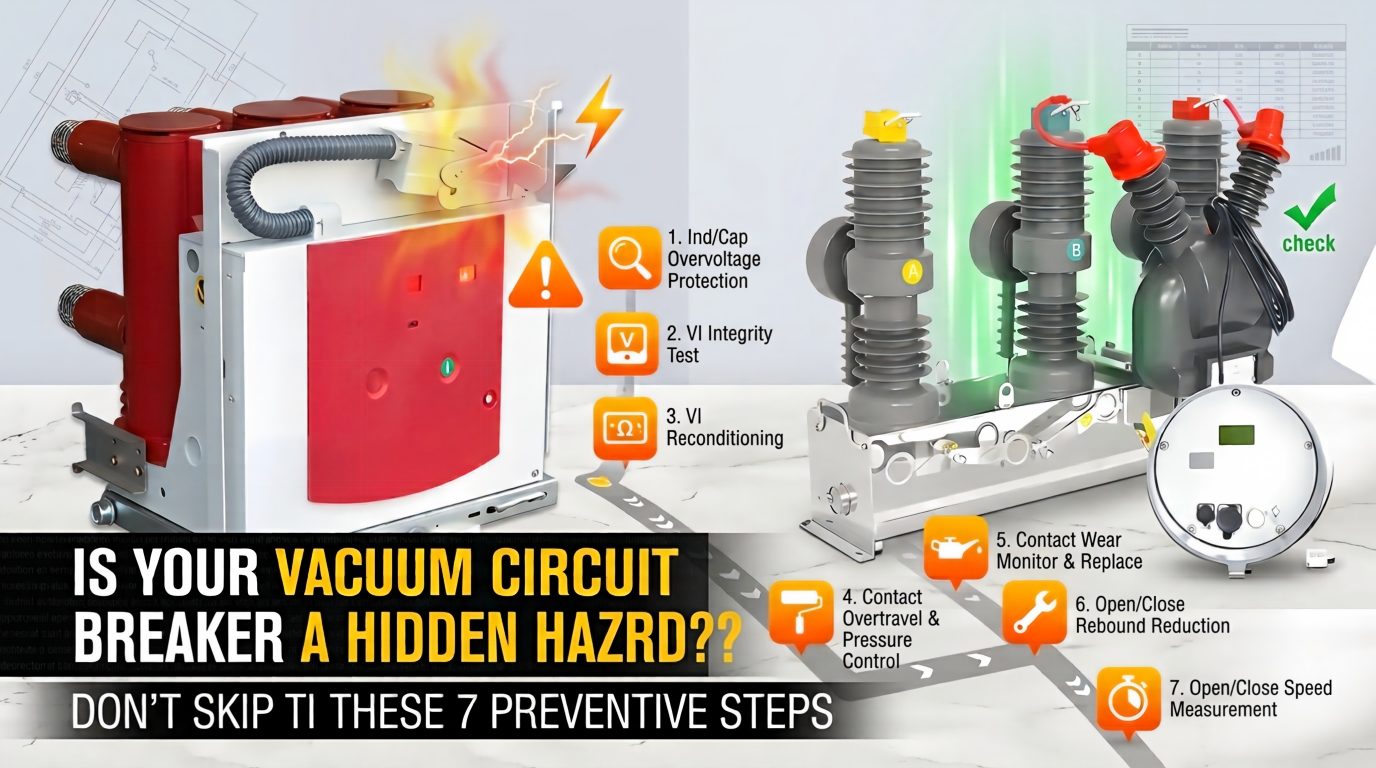
This article, penned from an electrical engineer's perspective, aims to dissect the fatal compromises made in the core materials of low-cost VCBs. We also introduce the unique perspective of "missing digital operational capabilities," revealing how these engineering deficits escalate into massive operational risks and uncontrollable LCC. Ultimately, we prove that purchasing a cheap VCB is the classic example of being "penny-wise and pound-foolish"—a hazardous investment.
II.Key Takeaways (Core Insights)
Long-Term Expense: Initial savings on cheap VCBs are negligible; they generate significantly higher unplanned downtime losses, exorbitant emergency repair fees, and perpetual energy waste. These factors will likely inflate the Life Cycle Cost (LCC) by 5 to 10 times.
Fatal Material Flaws: Low-cost VCBs primarily compromise on two material fronts: the contact alloy within the vacuum interrupter (CuCr) and the high-purity copper used in the conductive path. This compromise directly sacrifices arc interruption capability and electrical efficiency.
Extreme Risk: Material defects can lead to arc failure and contact welding, causing equipment explosions and cascading grid failures. The consequences are often catastrophic and irreversible.
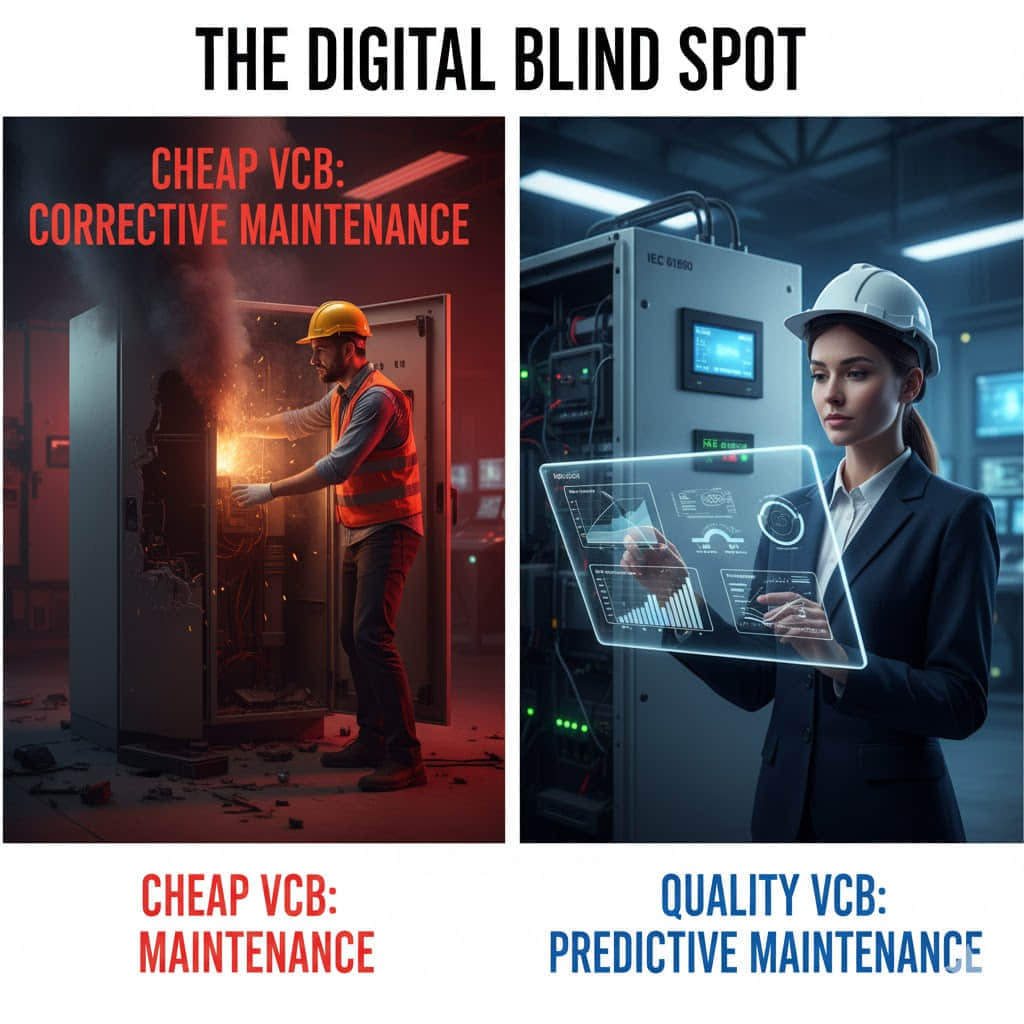
Maintenance Blind Spot: Cheaper products routinely lack digital monitoring interfaces (e.g., for Partial Discharge or Operating Curves), forcing organizations into costly corrective maintenance rather than intelligent predictive maintenance.
The Engineer's Mandate: In the medium-to-high voltage sector, reliability equals the highest cost-effectiveness. Selection must prioritize authoritative certifications (KEMA/CESI) and material traceability over mere unit price.
III. Body Content: Material Degradation and Five Core Risks
A. Core Risk One: Failure Due to Degradation of Arc Quenching Materials
The Vacuum Interrupter (VI) chamber is the most critical and high-tech component within the VCB. Its performance and lifespan directly determine the overall reliability of the entire circuit breaker. Material degradation in this area of a cheap VCB is the largest and most dangerous flaw.
1. The VI Shell — The Last Line of Insulation Defense
High-Quality Materials: Reputable manufacturers primarily use high-purity alumina ceramic or aluminum nitride ceramic. Alumina ceramic offers outstanding insulation properties and high mechanical strength, enabling it to withstand the pressure differential of a long-term vacuum environment and the operational shocks associated with arc interruption.
Cheap VCB Compromise: These units often utilize low-purity ceramic with unstable quality.
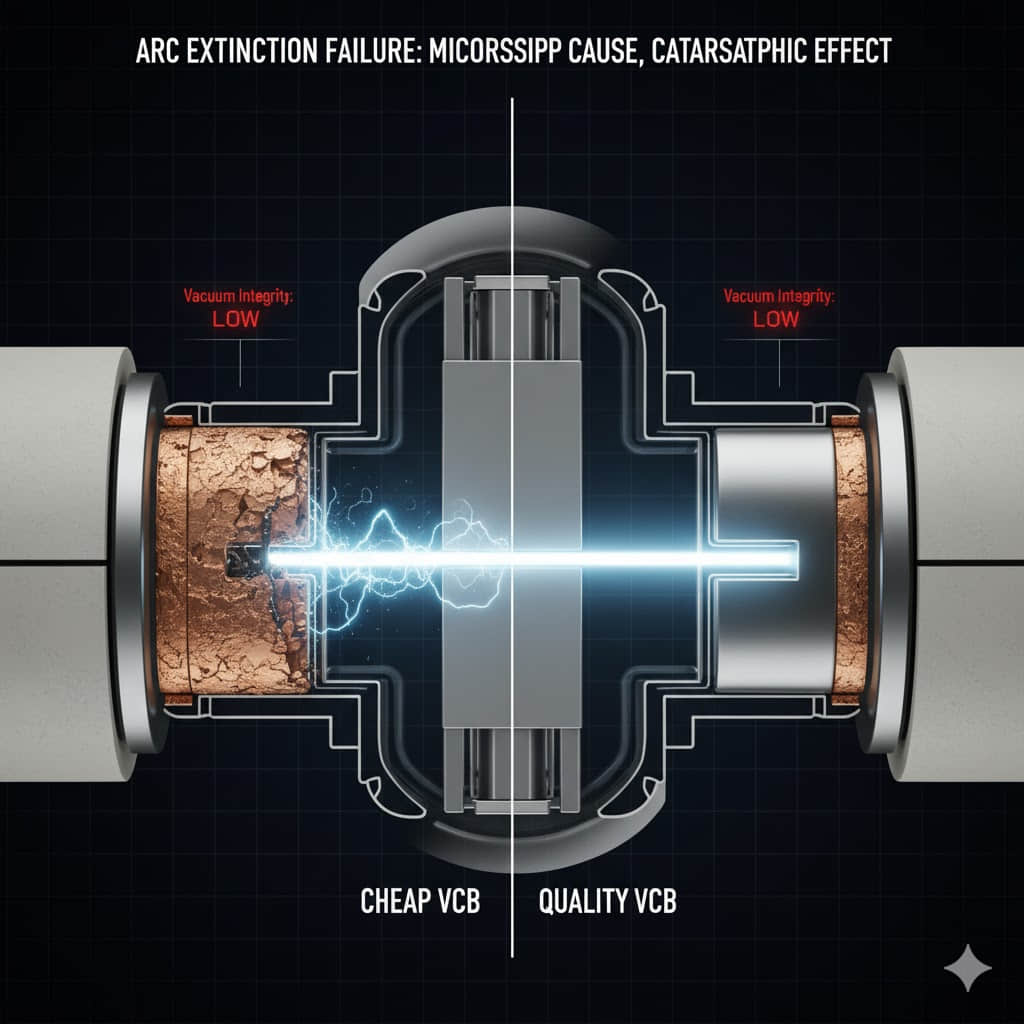
Long-Term Risk and Cost: The result is insufficient insulation performance, poor pressure resistance, and low impact tolerance. Low-purity ceramics are prone to micro-cracks under long-term high voltage or mechanical stress, leading to a rapid decline in vacuum integrity.
Should the vacuum pressure drop below a critical threshold, the VI will be unable to successfully interrupt a short-circuit current. This triggers restrike, explosions, and severe equipment accidents that cause cascading grid failures, with incalculable losses.
2. Contact Material — The Lifeline of Breaking Capacity
High-Quality Materials: High-performance units widely adopt Copper-Chrome (CuCr) alloy, engineered to combine the high conductivity of copper with the high arc-resistance and anti-welding capability of chrome. Copper ensures superior conductivity, while chrome significantly boosts contact stability under arc erosion, effectively inhibiting contact material burn-off.
High-quality manufacturers like Weisho Electric strictly control the alloy ratio and process. They ensure contacts remain structurally sound after numerous switching operations.
Cheap VCB Compromise: Manufacturers substitute with pure copper or low-chrome content copper alloys that have scientifically unsound metallurgical ratios.
Long-Term Risk and Cost: The contact’s arc resistance sharply deteriorates, causing severe contact erosion during the interruption of large short-circuit currents and drastically reducing the electrical lifespan. High-quality VCBs typically guarantee an electrical lifespan of over 100,000 operations, whereas cheap units can fail after only a few thousand operations due to severe contact burning or welding (contacts fusing).
Contact welding prevents the breaker from protecting against a fault, leading to a system blackout and permanent damage to equipment. This mandates expensive, unplanned downtime for emergency replacement, skyrocketing both spare parts and labor costs.
3. Shield Material — Guardian of Vacuum Integrity
High-Quality Materials: Premium units use highly conductive, high-purity oxygen-free copper or high-strength stainless steel. The primary function of the shield is to absorb metal vapor evaporated from the contacts during the arc-quenching process, preventing it from depositing on the inner ceramic shell and degrading insulation.
Cheap VCB Compromise: Substitutions include ordinary copper materials or low-grade steel that is prone to oxidation and rust.
Long-Term Risk and Cost: Poor adsorption and low thermal conductivity of the shield lead to metal vapor contamination of the VI’s internal insulation surfaces. This results in rapid degradation of vacuum integrity, which is the single biggest factor reducing the lifespan of any VCB.
Note: Defects in VI chamber materials, particularly the contact alloy degradation, directly limit the VCB's short-circuit breaking duty cycles. This is an irreparable hardware defect. The only recourse when contacts weld is expensive, unscheduled downtime for emergency replacement.
💡 Visual Aid: Understanding VCB Arc Quenching in One Minute
To gain a more intuitive grasp of the massive challenges faced by the Vacuum Interrupter (specifically the contact material) when interrupting large fault currents, and to visualize how cheap materials lead to arc failure, please watch the video below. This animation clearly demonstrates the sequence of contact separation, arc formation, dispersion, and rapid extinction within the vacuum environment of a high-quality VCB. Watching this will help you concretize the risks of contact erosion and welding discussed in the text.
【In-Article Image Prompt after A. Core Risk One】
B. Core Risk Two: Increased Conductive Path Resistance and Energy Loss
The conductive path's materials are responsible for current transmission and must balance conductivity, heat resistance, and mechanical strength. Compromises made by cheap VCBs in this area immediately translate into massive energy waste and critical safety hazards.
1. Conductive Rods — The Critical Current Path
High-Quality Materials: Premium units use high-purity oxygen-free copper or copper alloys such as copper-silver. Oxygen-free copper contains extremely low oxygen content ($\le 0.003\%$), boasting electrical conductivity near that of pure copper (resistivity $\le 0.0172 \Omega \cdot mm^2/m$). This specification avoids the high-temperature embrittlement problems caused by oxygen impurities, ensuring stable transmission under heavy currents.
Cheap VCB Compromise: Manufacturers use ordinary copper materials with high oxygen content or copper alloys with excessive impurities.
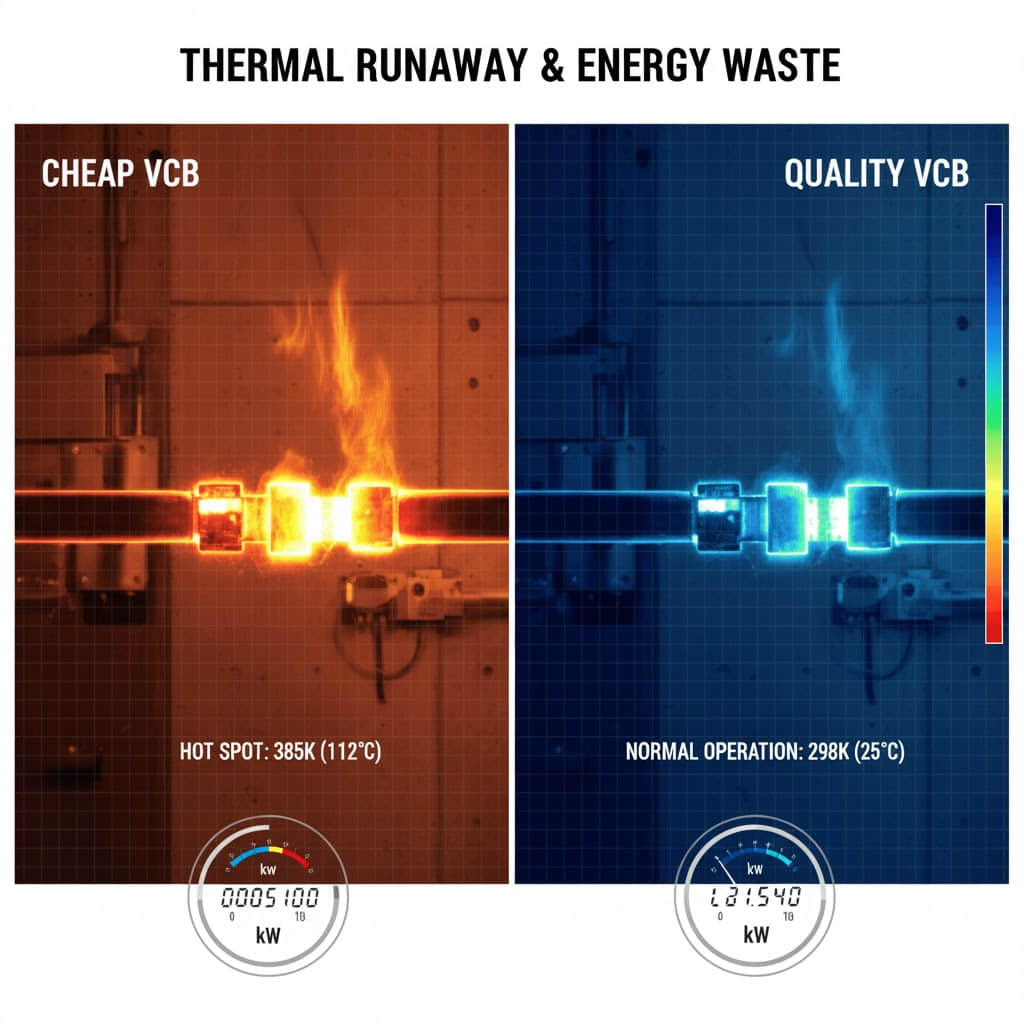
Long-Term Risk and Cost: The increased resistivity leads to severe heating in the electrical path ($I^2R$ losses). At a rated current of $4000A$, for example, every single $1m\Omega$ increase in resistance results in substantial power loss ($P=I^2R$).
Temperature rises often exceed IEC/IEEE standard limits by $20-30K$. This persistent overheating not only causes continuous energy loss (higher utility bills) but, more catastrophically, accelerates the aging and creep of surrounding insulation components (like epoxy resin), eventually causing connections to loosen or even burn out.
2. Terminal Connectors — Contact Resistance and Oxidation
High-Quality Materials: High-quality units are typically T2 copper, usually treated with silver or tin plating on the surface. This protective layer prevents oxidation and significantly lowers contact resistance.
Cheap VCB Compromise: Manufacturers may use unplated copper, a low-quality plating layer of insufficient thickness, or even recycled copper.
Long-Term Risk and Cost: High contact resistance promotes oxidation and corrosion, creating localized overheating, or "hot spots." These hot spots are a common, primary cause of connection failures and burnout.
Furthermore, when connecting to aluminum cables, cheap units often fail to use high-quality copper-aluminum transition materials. Direct contact without proper transition accelerates electrochemical corrosion.
Tip: The temperature rise is the most visible indicator of VCB conductive path quality. If you observe any localized temperature in your VCB cubicle significantly higher than the ambient environment, it is likely due to low-grade copper or poor connection resistance.
【In-Article Image Prompt after B. Core Risk Two】
C. Core Risk Three: Mechanical Fatigue and Operational Unreliability
The VCB’s mechanical operating mechanism is the bedrock for its electrical performance reliability. Even the finest VI is rendered useless if the mechanical operation is inaccurate or unreliable.
1. Springs — The Core Operational Power
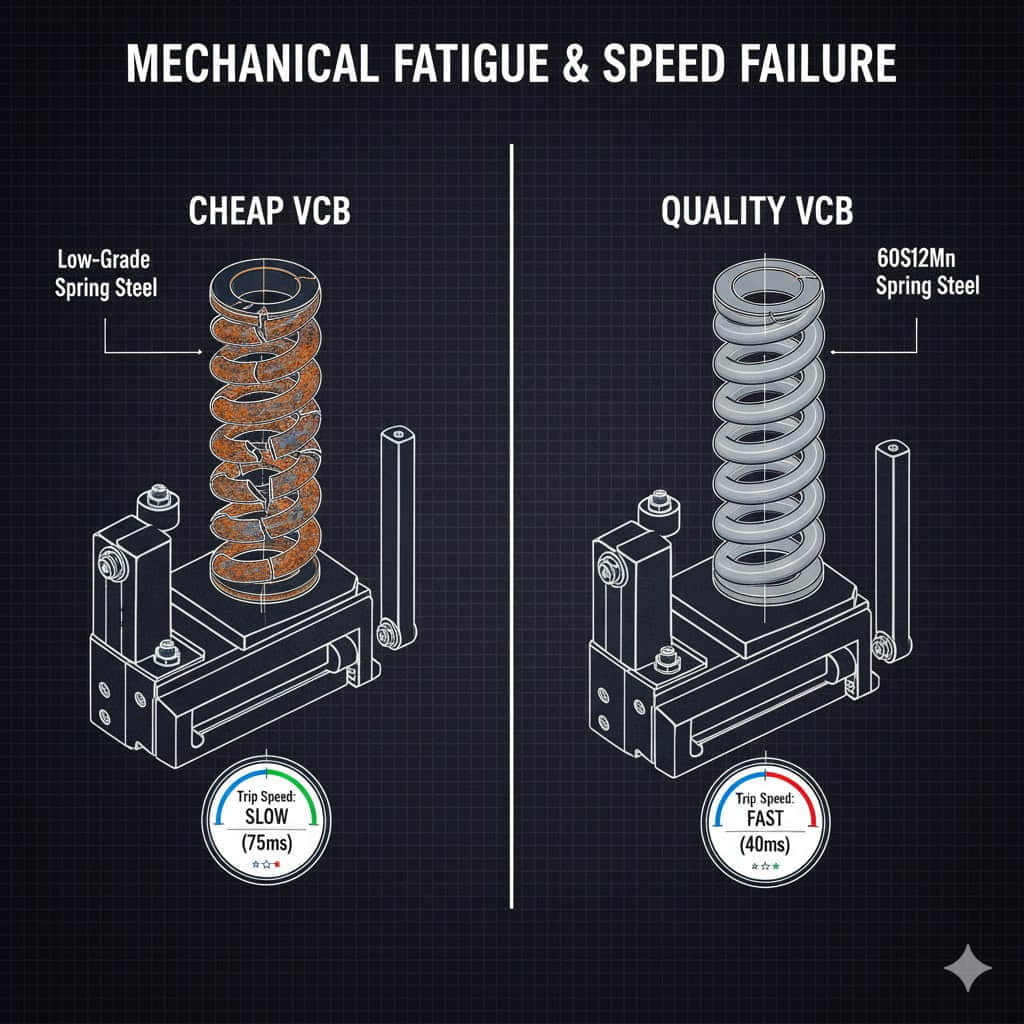
High-Quality Materials: Professional spring steel (60Si2Mn) is used, meticulously heat-treated to ensure an extremely high elastic limit and fatigue life. This guarantees the operating mechanism retains its rated tension after tens of thousands of cycles.
Cheap VCB Compromise: They use low-grade, common carbon spring steel.
Long-Term Risk and Cost: The low elastic limit leads to poor fatigue life. The spring loses its tension before reaching its specified number of operations, causing the operating mechanism to actuate slowly or fail to complete the opening/closing cycle.
Technology-focused brands like Weisho Electric ensure their products strictly adhere to precise opening time specifications (typically completed within $30-60ms$), which is critical for rapidly clearing faults. Slow opening increases the risk of the current failing to clear before the next zero-crossing point, significantly heightening the risk of arc failure.
2. Transmission Linkages — Guaranteeing Precision
High-Quality Materials: Alloy structural steel ($45\#$ steel) or stainless steel is used, often subject to heat treatments like quenching to enhance wear resistance.
Cheap VCB Compromise: Manufacturers use ordinary carbon steel or low-strength steel that has not been heat-treated.
Long-Term Risk and Cost: Insufficient mechanical fatigue life makes the linkages prone to fracture or deformation. This directly causes the breaker to malfunction or operate non-simultaneously (poles opening or closing at different times).
Non-simultaneous operation can generate transient overvoltages on the grid, severely threatening expensive peripheral equipment such as transformers.
【In-Article Image Prompt after C. Core Risk Three】
D. Core Risk Four: Insulation Degradation and Breakdown Hazard
Insulation support components function to isolate live parts from grounded sections. They must possess both high dielectric strength and excellent resistance to aging.
High-Quality Materials: Post insulators commonly utilize epoxy resin fiberglass composite materials.
Cheap VCB Compromise: They substitute with ordinary resins or low-fiber content injection molded parts.
Long-Term Risk and Cost: This results in a simultaneous decrease in dielectric strength and mechanical stability. Furthermore, manufacturing and assembly of cheap VCBs often introduce air voids or microscopic defects within the insulation components, which, under high voltage, can generate Partial Discharge (PD).
PD is the single most critical precursor to insulation deterioration and eventual failure. It gradually erodes the insulating material, culminating in dielectric breakdown and a destructive short-circuit accident.
E. The Unique Differentiator: Lack of Digital and Smart Maintenance Capability
In the contemporary field of medium-to-high voltage asset management, the biggest hidden cost of a cheap VCB is the "monitoring blind spot" it creates. In the era of Industry 4.0, an unmonitored asset represents the highest possible risk.
1. Missing Sensors and Interfaces — The Inability to Predict Failure
The Fatal Flaw of Cheap VCBs: They lack the internal sensors or external interfaces required for monitoring crucial operational parameters. These parameters include contact wear, spring energy status, opening/closing coil current curves, and temperature monitoring.
Consequences and Cost: This omission makes Predictive Maintenance impossible. Maintenance crews are forced to rely solely on calendar schedules or simple operational counts, which inevitably leads to either over-maintenance (wasting resources) or under-maintenance (leading to failure).
When a failure finally occurs, the necessity for expensive Corrective Maintenance significantly extends downtime.
2. Impossibility of Mechanical Operation Curve Analysis — Missing the Repair Window
The Advantage of Quality VCBs: High-quality units can record and analyze data for every open and close operation, tracking parameters such as operating time, speed, and contact bounce time. These data curves serve as the gold standard for assessing the mechanical state of the operating mechanism and the extent of contact wear.
The Risk of Cheap VCBs: Lacking this data acquisition capability, the facility has no way to detect the nascent stages of mechanical failure (such as spring fatigue or lubrication issues). Maintenance personnel miss the optimal repair window, allowing small faults to escalate into major failures.
3. Poor Standardization and Integration Barriers — The Price of Data Isolation
The Risk of Cheap VCBs: These products typically fail to comply with industry-standard communication protocols like IEC 61850. This makes their integration into existing SCADA, EMS, or Asset Management Systems difficult or impossible, creating isolated data silos.
Cost: Achieving data collection and integration later requires substantial additional custom development costs or forces the use of isolated monitoring systems. This inefficiency ultimately results in unacceptably high management costs.
Note: Lacking digital monitoring capability effectively turns your VCB into a "black box." The risk of failure is invisible and unquantifiable, forcing all maintenance to be passive and reactive. This approach is fundamentally unacceptable in modern power systems.
【In-Article Image Prompt after E. The Unique Differentiator】
IV. Data Table: Life Cycle Cost (LCC) Comparison
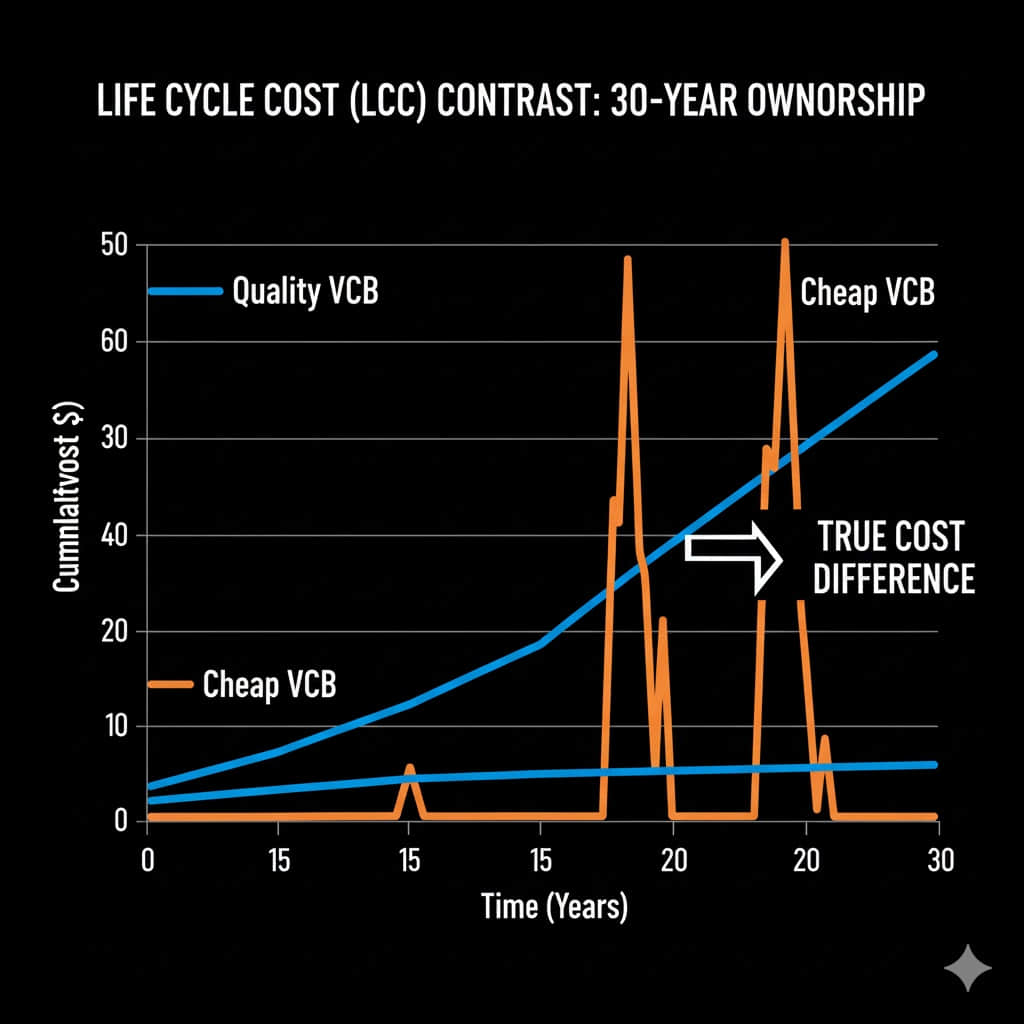
Life Cycle Cost (LCC) serves as the only scientifically sound benchmark for electrical engineers to evaluate assets. The table below clearly demonstrates how the initial price savings are quickly negated and surpassed by subsequent costs.
| Cost Element | Cheap VCB (Low Upfront Cost) | High-Quality VCB (Higher Initial Investment) | Long-Term LCC Impact Analysis |
| Initial Purchase Cost ($C_1$) | Very Low | Higher (2-5x) | Initial savings are minimal, often only 5%-10% of the total LCC. |
| VI Chamber Lifespan ($V_i$) | 2-5 Years (Vacuum degrades rapidly) | 20-30 Years (Based on duty cycles) | Core component replacement cost ($C_r$) dominates the total LCC. |
| Energy Loss ($I^2R$) | High (High path resistance, severe heating) | Low (Oxygen-free copper, low resistance) | Cumulative electricity loss over the years adds up to a significant, recurring cost. |
| Unplanned Downtime Loss ($C_d$) | Extremely High (High failure rate) | Very Low (Operation is highly reliable) | One hour of lost production can easily exceed the unit's entire purchase price. |
| Smart Maintenance Capability | None (Only post-failure repair) | Available (Enables predictive maintenance) | Maintenance efficiency is low, and maintenance costs ($C_m$) are unpredictable. |
| System Recovery Time | Long (Failure analysis is difficult) | Short (Diagnosis is clear, repair is fast) | Extended downtime severely impacts industrial productivity and service delivery. |
| Overall LCC ($C_1+C_m+C_r+C_d+...$) | HIGH and Uncontrollable | LOW and Predictable | One cheap purchase decision can inflate your total LCC by 5 to 10 times. |
【In-Article Image Prompt after IV. Data Table: Life Cycle Cost (LCC) Comparison】
VI. Frequently Asked Questions (FAQ) and Professional Answers
1. Q: My cheap VCB has been running fine for two years. Does this mean the quality is acceptable?
A: This is the most common misconception. VCB failures are typically not immediate; they are cumulative.
The fundamental problem with cheap VCBs is their sudden, cliff-like failure curve: vacuum integrity, mechanism fatigue, and insulation PD are all irreversible degradation processes. A high-quality VCB can operate reliably for decades.
A cheap unit, however, might suddenly experience arc failure during a crucial high-fault-current interruption moment, leading to catastrophic consequences. If the equipment lacks monitoring interfaces, you are effectively gambling that it will not fail at the worst possible time.
2. Q: What is the true economic difference between high-performance CuCr contacts and ordinary copper contacts?
A: The difference is not in the material cost; it is entirely in the life cycle. High-performance CuCr alloy contacts are designed to withstand over 100,000 mechanical operations and upwards of 30 short-circuit interruptions.
Ordinary copper contacts may become severely eroded or weld together after only a few thousand operations or a handful of short-circuit events. The cost of replacing one VI (spare parts + downtime + labor) vastly outweighs the initial material cost difference.
Viewing this investment as an insurance premium ensures you never have to pay out a catastrophic claim.
3. Q: How can I determine if my VCB lacks smart monitoring capability?
A: The most straightforward way to tell is by checking the outputs. If your VCB can only provide simple open/close signals and spring charged status, but cannot output contact wear data, trip speed curves, coil current profiles, or temperature/Partial Discharge (PD) data, then it lacks modern digital operational capabilities.
Quality products offer standardized communication interfaces (like the IEC 61850 protocol). This allows for seamless integration into advanced asset management systems.
4. Q: If I have a limited budget, where should I compromise, and where should I absolutely not compromise?
A: The absolute non-negotiable area is the Vacuum Interrupter (VI) performance and reliability. This is the life core of the VCB.
You may be able to moderately compromise on minor mechanical components (for applications with infrequent operations), or choose an enclosure material with a lower protection rating (in non-coastal or non-corrosive environments).
However, any compromise concerning vacuum integrity, contact material (CuCr alloy), trip speed, or temperature rise is a direct and unacceptable threat to system safety.
5. Q: Can a cheap VCB affect my insurance and regulatory compliance?
A: Yes, and this represents a significant hidden cost. In the event of a major electrical fire or explosion caused by a substandard device, insurance companies conducting loss adjustments will thoroughly investigate the equipment's certification and maintenance records.
If non-standard, uncertified, low-quality products were used, or if maintenance was improperly managed, it could negatively impact your claim payout. Furthermore, using non-compliant equipment in regulated jurisdictions can lead to substantial fines and mandated corrective actions by regulatory bodies.
V. Conclusion and Professional Recommendation
Core Thesis Summary: The true value of a VCB in an industrial or utility system does not lie in its raw material cost. Its value is the capability and reliability it guarantees when protecting millions, or even billions, of dollars in assets during extreme conditions.
The pricing battle for cheap VCBs is fundamentally fought by sacrificing core material integrity and smart maintenance capability. Every single deficit in a low-cost unit—from vacuum level and conductivity to digital readiness—directly translates into higher future operational risks and catastrophic costs.
Engineer's Guide to Procurement and Quality Check:
Certification and Traceability: Insist on procuring branded products that have successfully passed rigorous type testing by international authoritative bodies (such as KEMA or CESI). Demand that the supplier provide material traceability reports for the VI and contact alloy (CuCr content).
Core Performance Metrics: You must verify the VI’s rated electrical life (operation cycles), the trip speed performance curve, and the temperature rise test report. This confirms the unit's thermal performance remains within acceptable limits under rated load.
Smart Configuration: Make "smart monitoring interfaces" and "condition monitoring functionality" mandatory procurement requirements. It is always better to spend an extra 5% of your budget on a VCB with monitoring capabilities than to face 500% of the cost from an unpredictable downtime loss.
🚨 Take Action Now: Contact Our Expert Consulting Team
Do not treat your VCB as a simple procurement cost; view it as a critical variable in your "System Reliability" and "Life Cycle Cost (LCC)" equation.
The risks facing your power system are real and immediate. One poor VCB procurement decision can potentially inflate your LCC by 5 to 10 times.
As professional electrical engineering consultants, we recommend focusing on high-quality VCB suppliers who strictly control material and manufacturing processes, such as Weisho Electric. We also provide the following specialized consulting services:
VCB Selection and Evaluation: We assist your procurement team with LCC-based VCB selection, including technical audits and material traceability verification of potential suppliers.
Asset Condition Monitoring Systems (CMS): We deploy non-intrusive monitoring systems (like Partial Discharge and thermal monitoring) on your existing VCB assets, upgrading your system from "post-failure repair" to "predictive maintenance."
Custom Risk Reporting: We produce comprehensive risk assessment reports for your aging VCB assets, quantifying the probability of failure and the cost of downtime, helping you formulate a scientific replacement schedule.
Contact us today to schedule a complimentary VCB Asset Reliability consultation. Choosing a high-quality VCB, like those from a professional brand such as Weisho Electric, is the best possible long-term investment in your enterprise's productivity, asset safety, and operational stability.