Introduction: Clearly Defining the Core Mandate
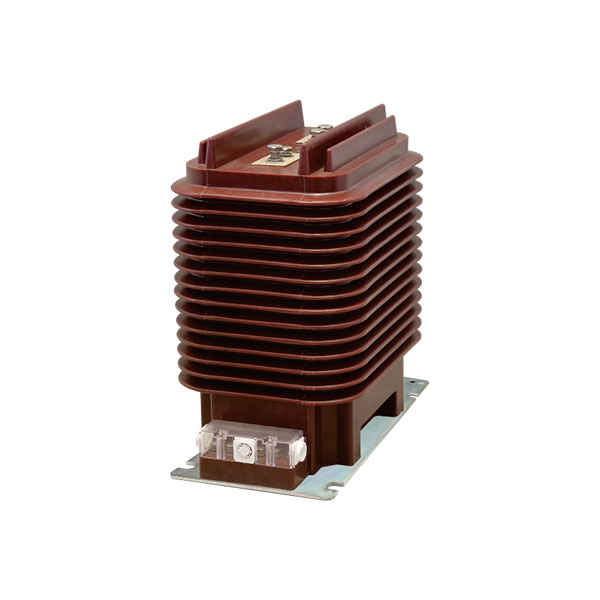
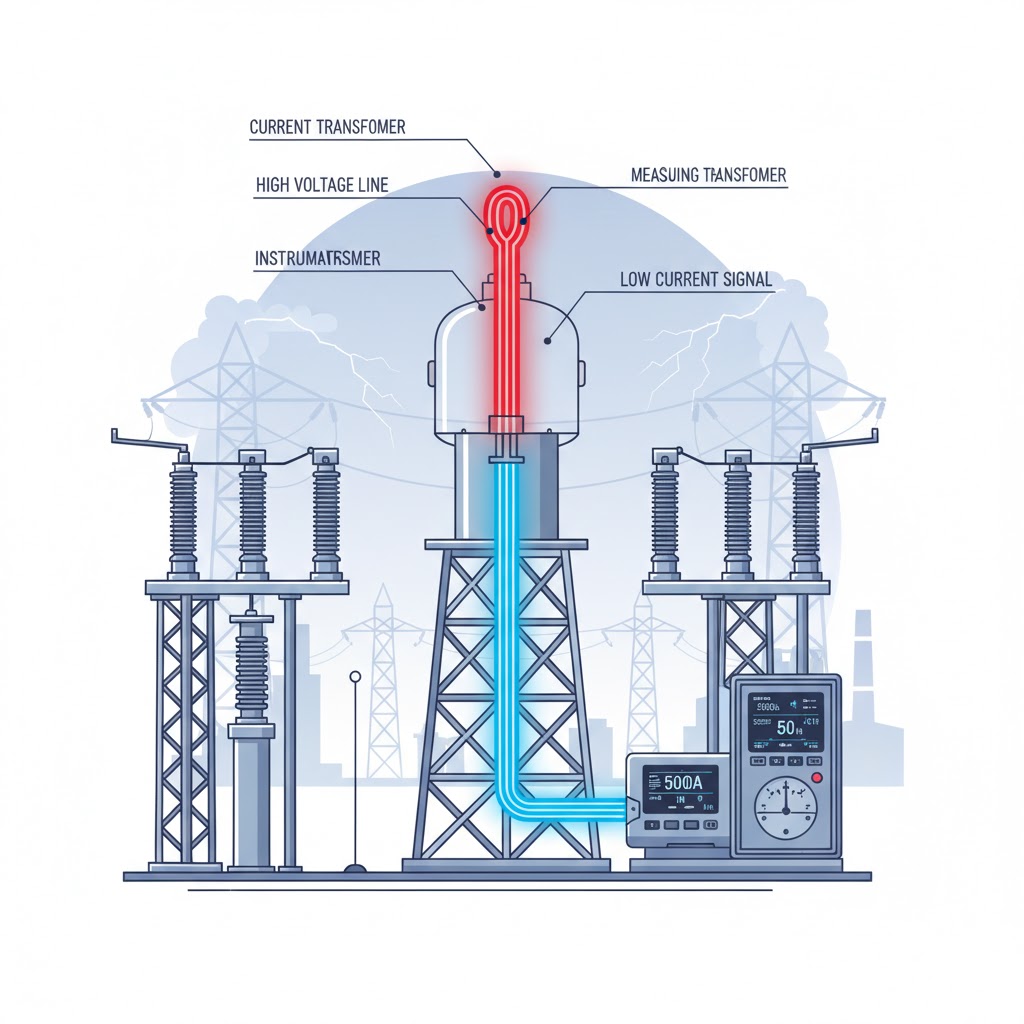
The primary function of a Current Transformer (CT) is to precisely and proportionally step down the high-voltage, high-magnitude current flowing through the main power circuit into a standardized, safe low-level current, which is typically standardized to 5 A or 1 A. This essential transformation allows various measuring instruments and protective relay systems to operate safely and reliably while concurrently establishing crucial electrical isolation between the high-voltage primary system and the low-voltage control circuits.
In the complex architecture of a modern power grid, the current magnitudes within generating stations, transformers, and high-voltage transmission lines often reach hundreds or even thousands of amperes. Attempting to directly measure these high-energy currents or connecting them to sensitive protection devices is not only technically impractical but also poses a grave and potentially fatal threat to both equipment and operating personnel.
The Current Transformer, functioning as a highly accurate instrument transformer, effectively resolves this central engineering challenge. It acts as an indispensable data bridge connecting the power system’s eyes (the measurement points) to its heart (the control and protection mechanisms).
A CT ensures accurate electrical energy metering, provides real-time monitoring of equipment status, and enables the rapid, dependable isolation of faults when they occur. Ultimately, the CT serves as a cornerstone for both commercial energy billing and the overall safe and stable operation of the entire electrical infrastructure.
Key Takeaways
Core Role: Proportional reduction of high-magnitude AC to ensure the safety and feasibility of both measurement and protection.
Dual Applications: Highly accurate electrical energy metering (for commercial billing) and fast, reliable protective relaying (for fault tripping).
Safety Feature: Providing vital electrical isolation between the high-voltage primary circuit and the low-voltage control circuitry.
Critical Safety Rule: The CT's secondary terminals must never be open-circuited under any circumstances while the primary is energized, as this generates dangerously high voltage spikes.
Future Trend: Digital substations are progressively adopting Non-Conventional Instrument Transformers (NCITs), such as Rogowski Coils and Optical CTs, to meet demanding requirements for enhanced precision and transient response.
Core Function Analysis: Safe Current Reduction and High-Fidelity Signal Transfer
The central operating philosophy of a Current Transformer hinges on two principles: maintaining a constant turns ratio and ensuring galvanic isolation. Therefore, a CT should not be viewed merely as a simple current-reducing device, but rather as a precision instrument capable of high-fidelity current signal transmission.
The Safety Foundation: Proportional Reduction and Electrical Isolation
The primary current, denoted as , and the secondary current, , are linked by a precise, fixed nominal ratio:
This defined transformation ratio allows currents that may be several hundred amperes to be safely stepped down to a standardized, manageable level of 5 A or 1 A.
This process of standardization is extremely valuable, making instrument design universal and scalable for mass production, thereby significantly reducing the cost associated with monitoring and controlling large electrical grids. Without the CT, every ammeter or relay would need to be engineered to directly withstand kilovolt-level voltages and kiloampere-level currents, a scenario that is practically difficult, financially prohibitive, and inherently extremely dangerous.
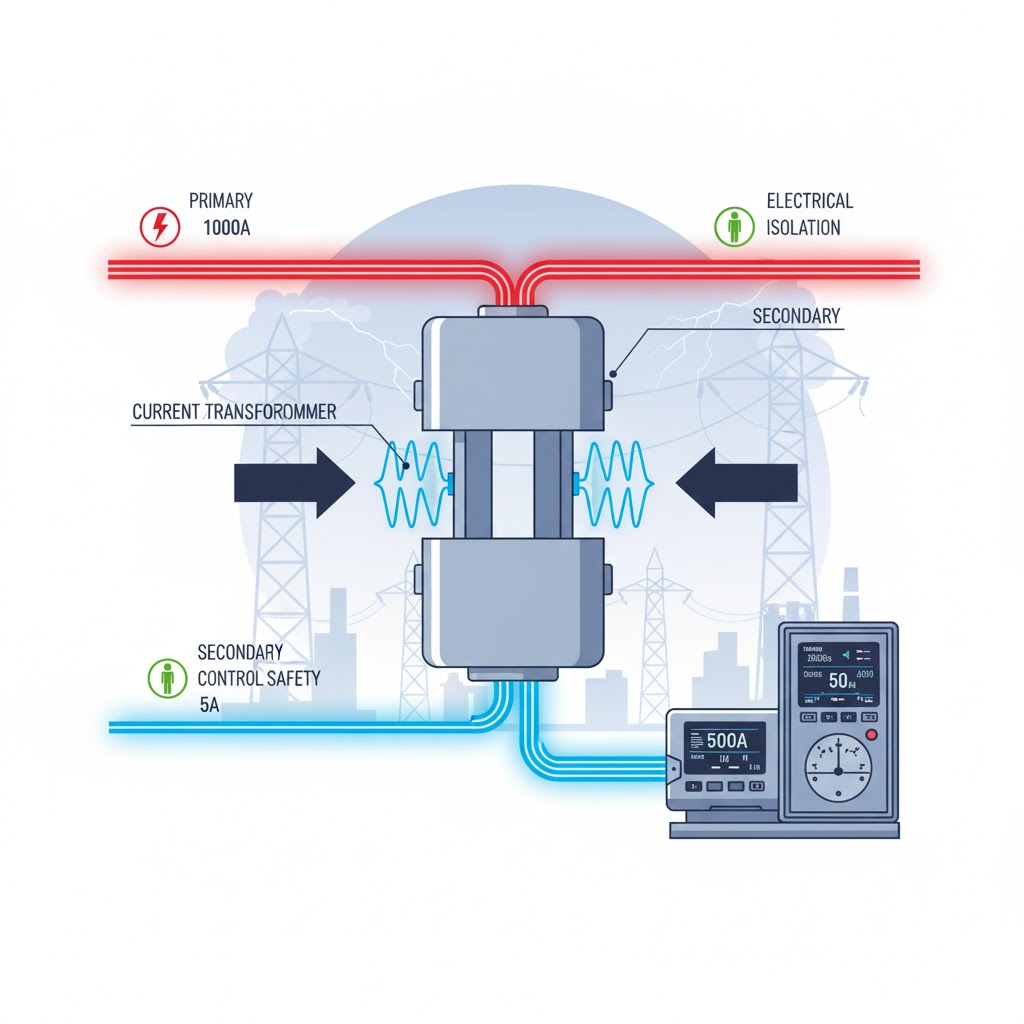
The CT establishes a non-negotiable safety boundary through the robust insulation separating its primary and secondary windings. This barrier provides essential electrical isolation, meticulously separating the high-voltage potentials of the main circuit from the connected low-voltage measuring devices, protective relays, and the personnel operating the control equipment.
This isolation function serves two critical purposes:
1. Protects sensitive low-voltage electronics from high-voltage surges
2. Guarantees personal safety for engineers and technicians performing inspections and maintenance
Note: The fundamental purposes of a CT are to achieve "scale reduction" and "potential isolation," which are the twin cornerstones of its existence within the electrical power system framework.
The Dual Roles: Two Pillars of Application
Based on functional requirements, CT applications are divided into two major roles:
1) Metering
High accuracy in normal current range (5%–120% of nominal)
Used for commercial billing, energy statistics
Accuracy classes: 0.2S, 0.5
Sensitive to saturation; accuracy critical for revenue
2) Protection
Rapid response under fault conditions (up to 10–20× nominal current)
Feeds fault data to protective relays
High ALF (Accuracy Limit Factor) required
Accuracy under normal load secondary to performance under fault
📺 Visual Supplement: Current Transformer Principles and Applications Complete Guide
This video visually reinforces key concepts such as ratio, CT types, dangers of open secondary circuits, burden calculation, and accuracy requirements.
Structural Variations of CTs in Practical Engineering
From an engineering standpoint, CT structure dictates voltage suitability, installation method, and cost. Engineers must select the type carefully based on site conditions and required performance.
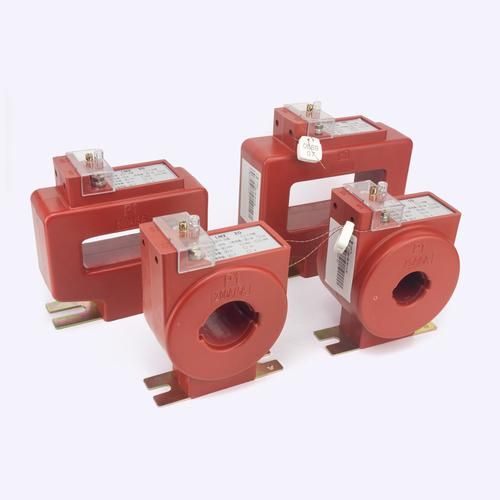
[2] Side-by-side comparison illustration of the three main Current Transformer types:
1. Wound-Type CT
2. Bushing/Bar-Type CT
3. Split-Core/Clamp-on CT
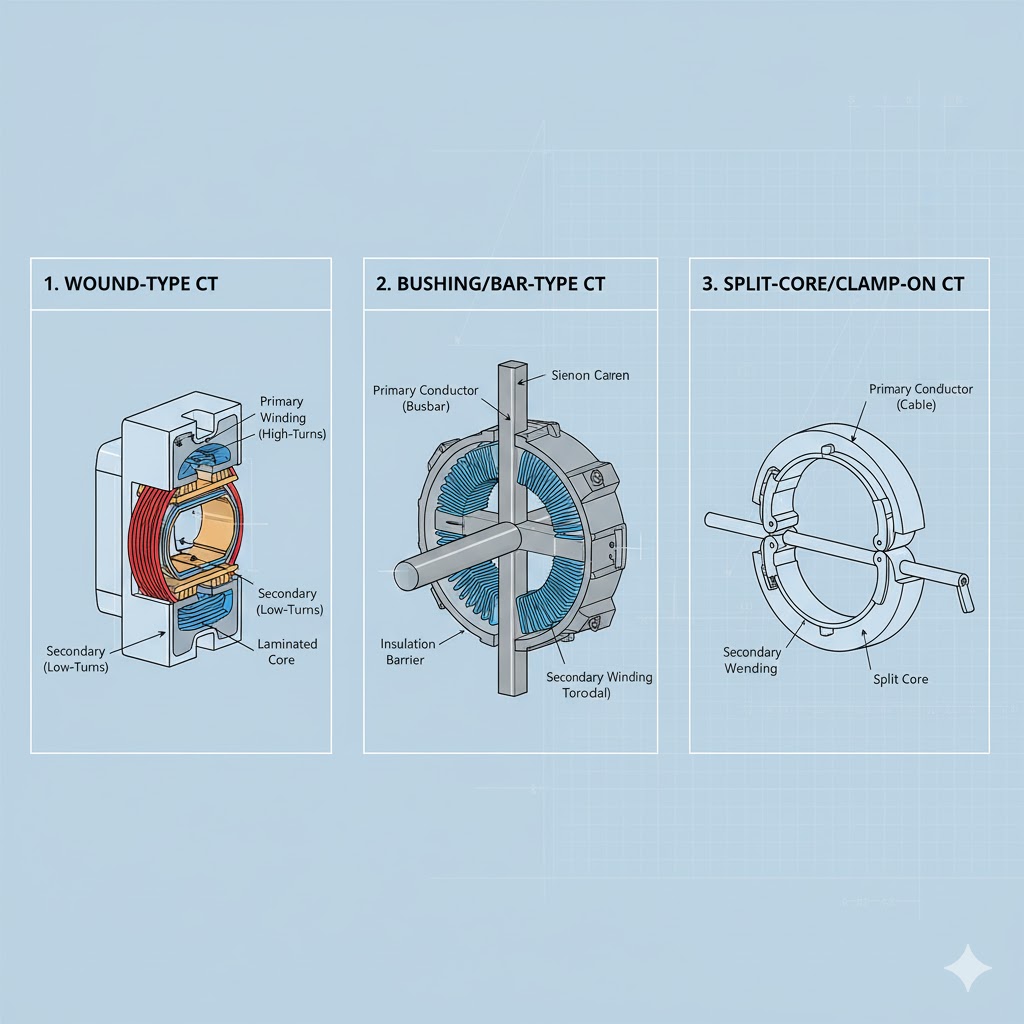
Use clean cutaway views to highlight structural differences. Engineering blueprint style.
| CT Type | Structural Features | Application Scenario | Engineering Advantages |
|---|---|---|---|
| Wound-Type CT | Both primary and secondary windings are insulated; primary turns are clearly defined | LV systems, lab testing, and precision small currents | High intrinsic accuracy, controllable ratio, strong secondary burden capability |
| Bushing/Bar-Type CT | Primary = conductor/busbar through core | HV circuit breakers, transformer bushings | Integrated insulation, lower cost, compact, small footprint |
| Split-Core/Clamp-on CT | Hinged magnetic core around the conductor | Temporary measurements, hot maintenance, and field diagnostics | Installation without power shutdown, quick setup, simplified maintenance |
In-Depth Analysis of the Bushing CT
Most prevalent in HV applications
The conductor itself acts as a single-turn primary
Insulation provided by the main equipment bushing
Demands precise insulation coordination and magnetic alignment
Tip: For substations, bushing CTs are often preferred if space allows; clamp-on CTs are ideal for field diagnostics.
Primary Function I: Achieving Accurate Measurement
Measurement impacts utility revenue and consumer billing.
Accurate Energy Metering
Connects to energy meters (active/reactive)
High precision required: 0.2S, 0.5 class
Ensures magnitude & phase errors remain minimal
Operational Current Monitoring
Connects to ammeters, power meters, and frequency meters
Data acquired by SCADA systems for load trend analysis and dispatch decisions
Monitoring-grade CTs allow slightly lower accuracy (1.0 class)
Note: Saturation of metering CT cores immediately distorts readings and affects billing integrity.
Primary Function II: Ensuring System Stability Through Protective Relaying
Protection-grade CTs serve as the "fire alarm" for electrical faults.
Fault Detection
Short circuits, ground faults, and overloads
Fault current can surge >10× nominal in milliseconds
Protection CT must faithfully transmit the signal without saturation
Interlock & Tripping Mechanism
1. CT sends the current signal
2. Relay evaluates threshold & time settings
3. Trip coil energizes
4. Circuit breaker opens
Process completed in tens of milliseconds
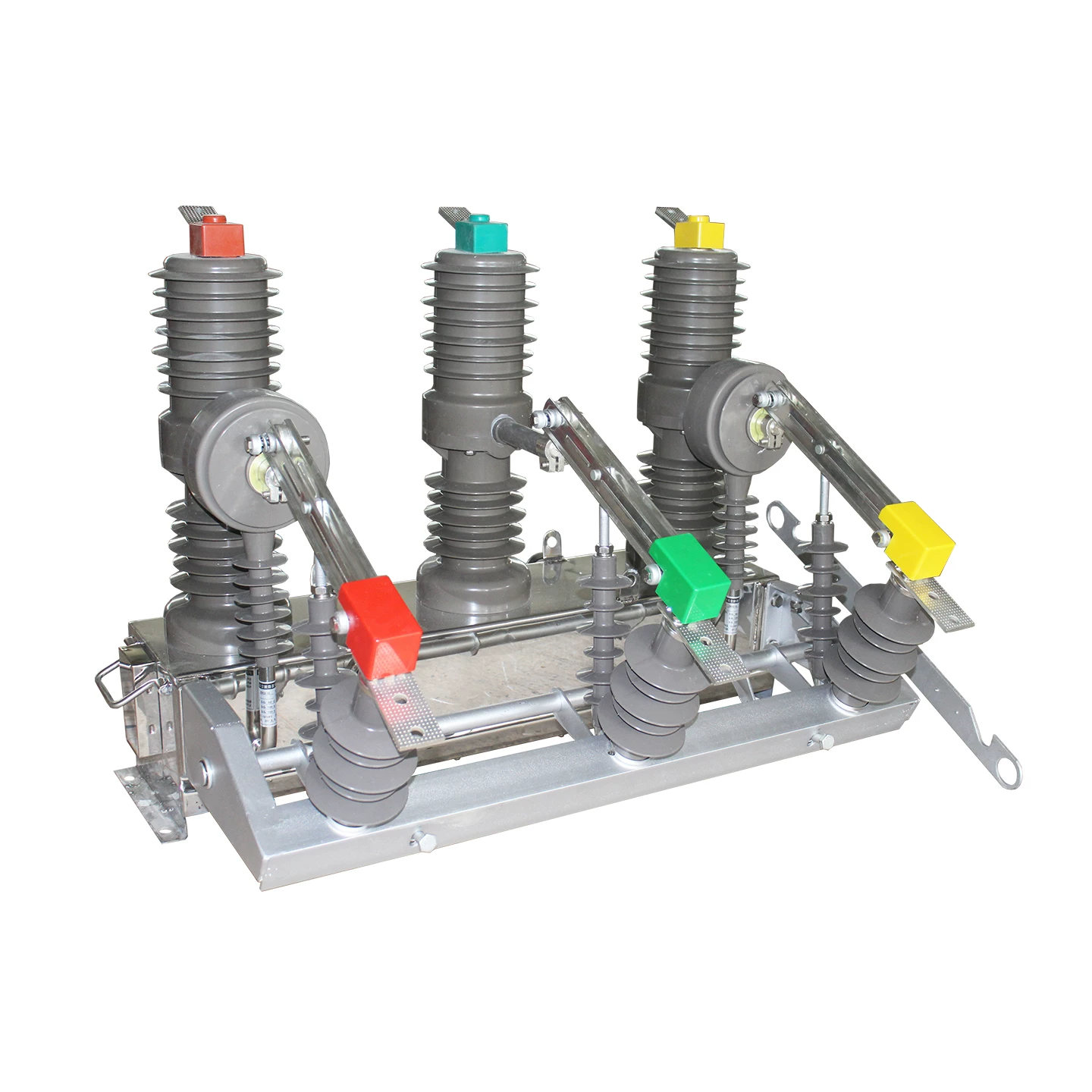
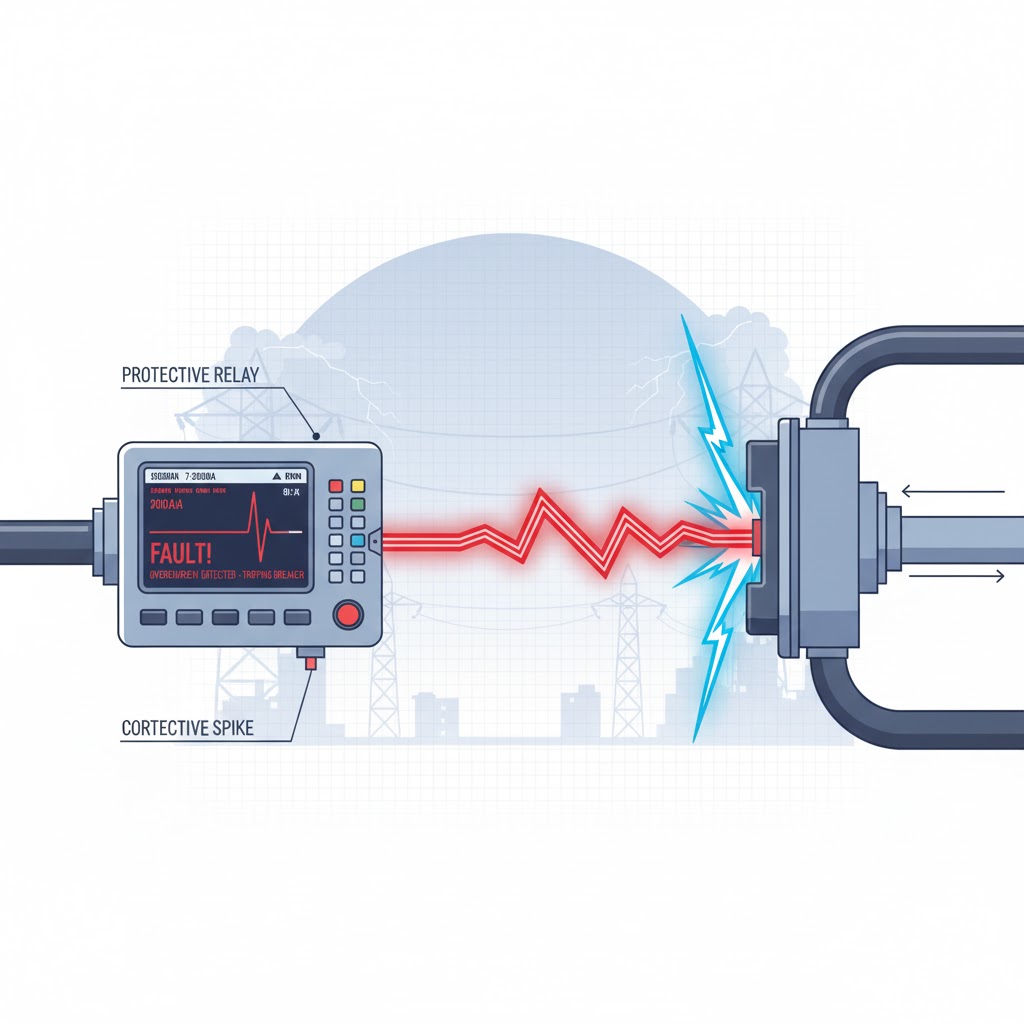
[3] Graphic depiction of system protection:
Show a protective relay panel with a digital display of the current spike
Red alert line to HV breaker illustrates trip action
Dynamic, urgency emphasized
Measurement vs. Protection CTs – Key Characteristics
| Function | Typical Application | Core Requirement | Accuracy Class | Transient Characteristic |
|---|---|---|---|---|
| Measurement | Energy meters, ammeters | Extreme accuracy near nominal current | 0.2S, 0.5 | Focus on steady-state accuracy; avoid premature saturation |
| Protection | Protective relays, fault recorders | Reliable signal under fault currents | 5P, 10P | High ALF; resistant to saturation |
Important: Never substitute protection CTs for metering CTs or vice versa.
Advanced Topic: Non-Conventional Current Transformers (NCITs)
Rogowski Coils
Air-core → no magnetic saturation
Output proportional to
Accurate for high-frequency transients and harmonics
Small, light, easy installation
Electronic CTs (ECTs)
Shunts or Hall sensors digitize current
Signal transmitted via fiber optics
High accuracy, wide dynamic range
Compliant with IEC 61850
Optical CTs
Based on the Faraday magneto-optic effect
Total electrical isolation → ultimate safety
Ideal for Ultra-High Voltage systems
[5] Futuristic digital substation concept:
Rogowski coils + optical fiber
Central server rack processes digitized data
Highlight clean, digital signal flow vs. traditional copper wiring
Modern, high-tech, blue/white light

Professional Engineering Considerations and Safety Practices
Critical CT Selection Parameters
Secondary Burden: Total VA of devices + cable < rated burden
Rated Current & Ratio: Must cover max load without exceeding 5A/1A secondary
Common Field Issues
1. Residual Magnetism: Demagnetize after open-circuit or DC surge
2. Polarity Errors: Incorrect P1/P2, S1/S2 → false trips or reversed metering
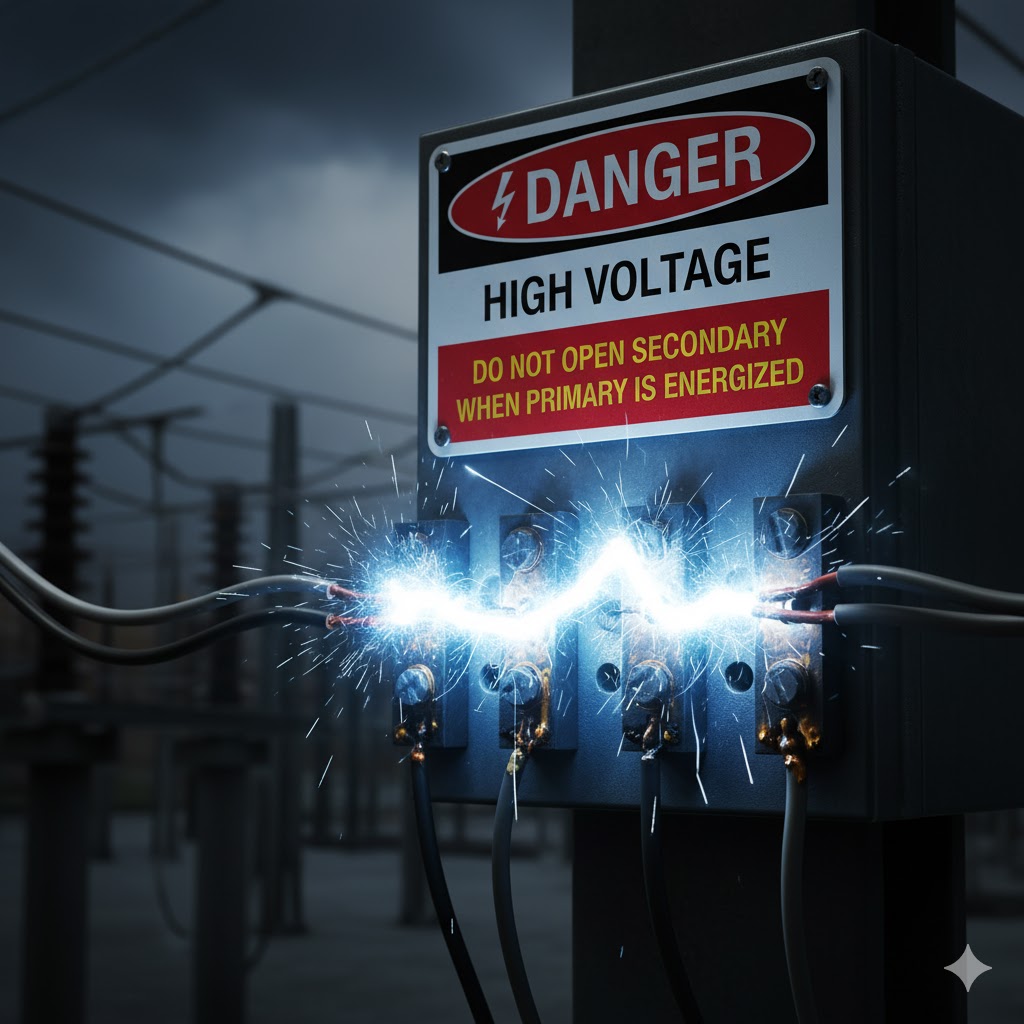
The Absolute Safety Rule: Never Open the Secondary
Open secondary → dangerously high voltage (kV to tens of kV)
Risks: personnel, insulation, fire, CT damage
Correct: Always short CT secondary before disconnecting instruments
[4] Dramatic safety warning illustration:
Close-up of CT secondary with electric arc
Bold “Danger High Voltage” sign
Emphasize hazard to equipment & personnel
Note: Short-circuiting the CT secondary is normal operation, not a fault.
Conclusion
The CT is more than a scaling device: it is the data interface and protective gateway of modern power systems.
Metering → ensures commercial fairness
Protection → rapid fault isolation
NCITs are rising for UHV and digital substations, but traditional electromagnetic CTs remain dominant for MV/LV systems.
Mastering CT principles, selection, structure, and safety procedures is essential for long-term grid stability.
FAQ
Q1: Why can’t metering CTs and protection CTs be interchanged?
A: Metering CT → linearity & accuracy at normal load; protection CT → saturation resistance at high fault currents. Using incorrectly → inaccurate measurement or failed protection.
Q2: Why must CT secondary be grounded?
A: Prevents potential rise from insulation failure or inductive coupling. Single-point grounding ensures personnel safety and protects low-voltage devices.
Q3: What is “Rated Secondary Burden”?
A: Max VA load CT can supply. Overload → saturation, ratio errors, distorted signals.
Q4: How to detect CT saturation?
A: Distorted meter readings, flickering pointers, persistent relay errors. Confirm via excitation characteristic test.
Q5: Biggest technical advantage of Rogowski Coil?
A: Complete immunity to magnetic saturation → accurate measurement of high transient currents.