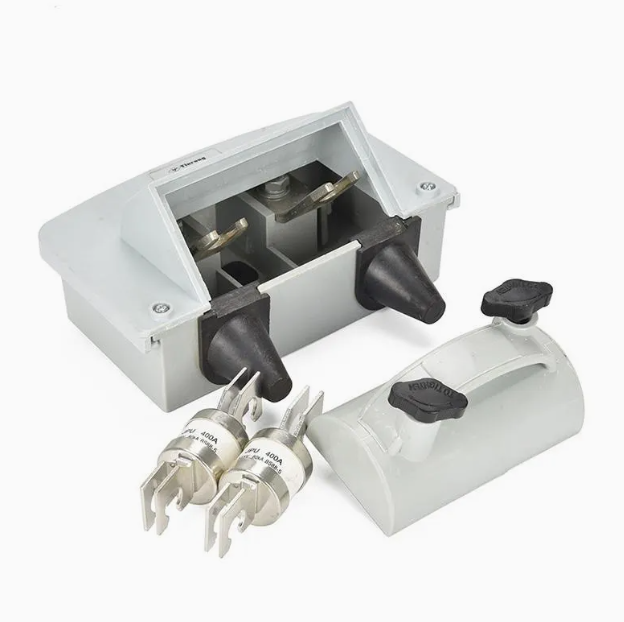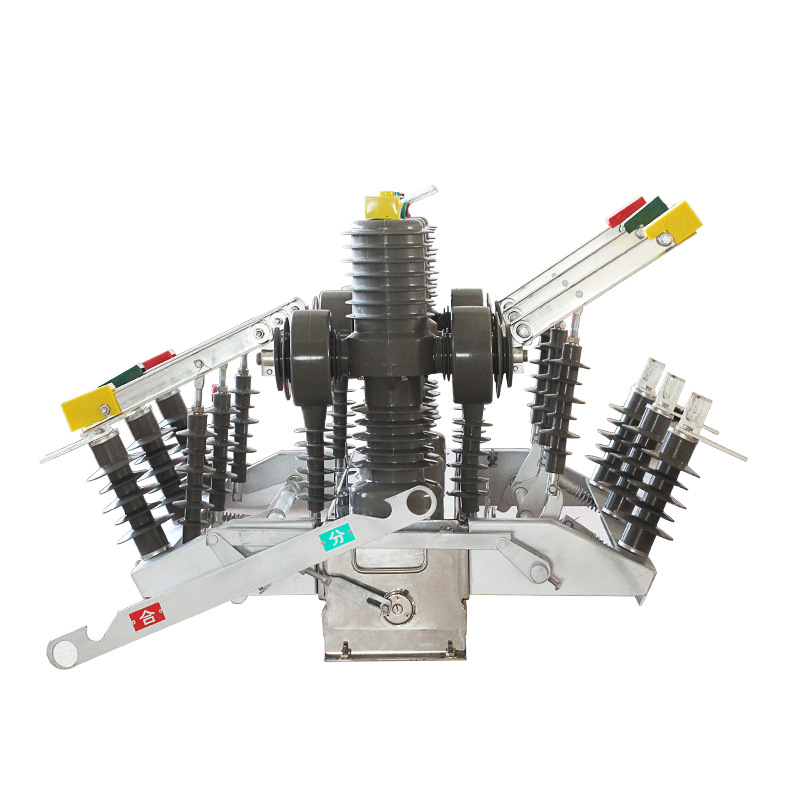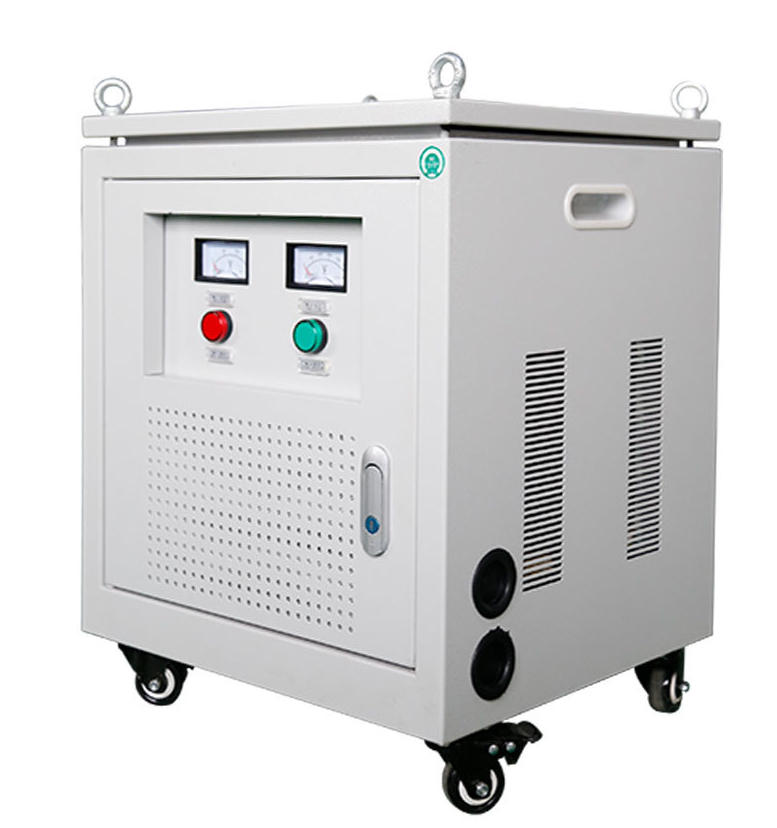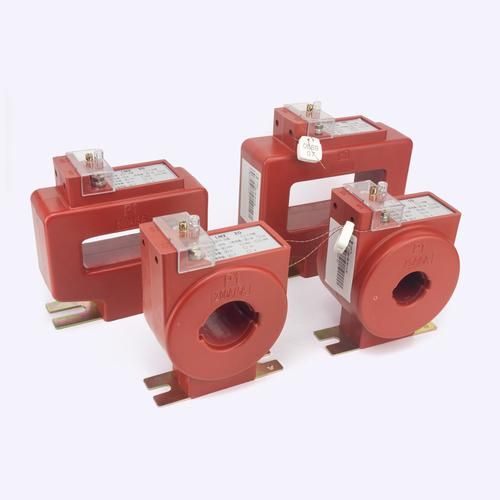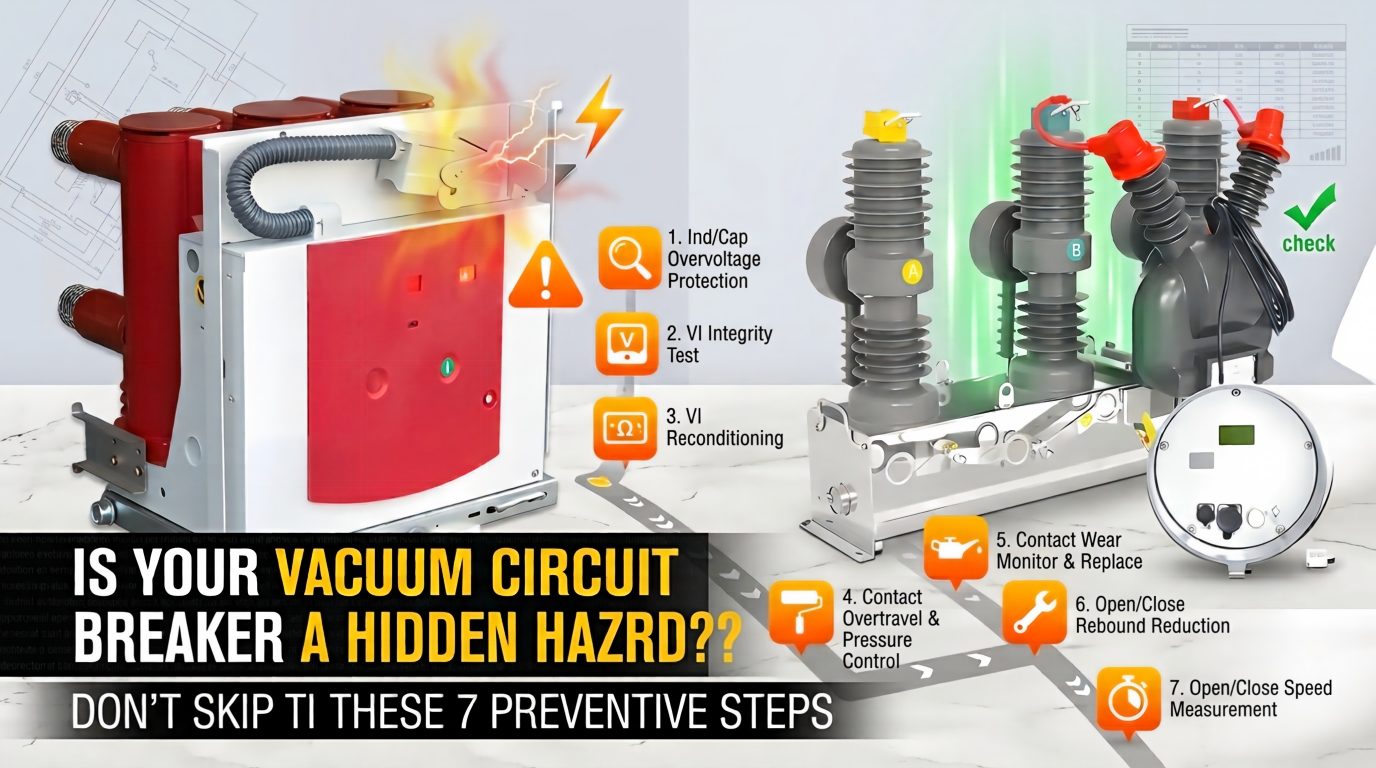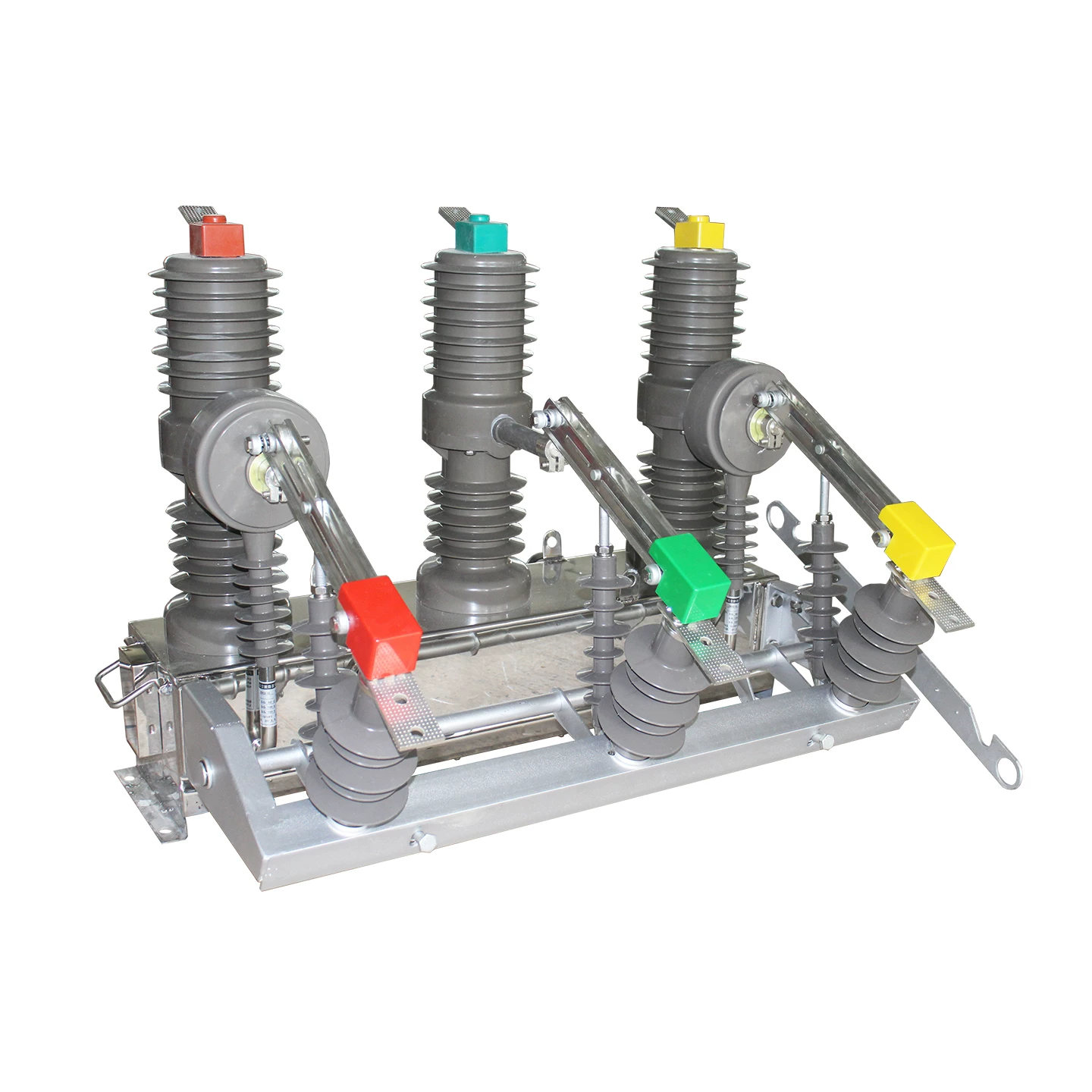
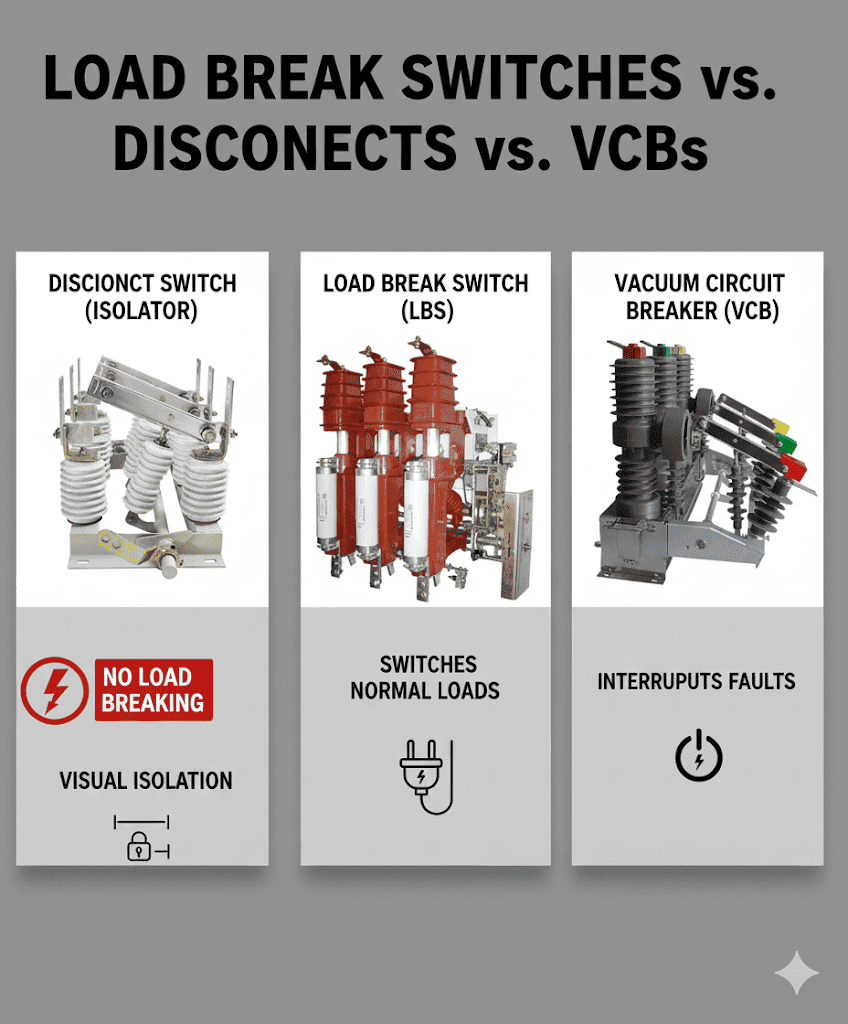
The Load Break Switch (), the Disconnect Switch (Isolator), and the Vacuum Circuit Breaker () hold distinct and non-interchangeable roles within any electrical power system.
A disconnect switch's primary function is to provide safe, visible isolation when no current is flowing through the circuit.
The load break switch is engineered to safely interrupt and close normal working and manageable overload currents, but it lacks the capacity to clear severe short-circuit faults.
The vacuum circuit breaker stands alone as the high-capacity protective device, capable of both switching regular loads and reliably interrupting massive fault currents.
The Crucial Role of Switching Devices
Switching devices from the foundation of safety and reliability in modern power infrastructure.
They are the executors responsible for directing power flow, segmenting circuits, and rapidly isolating damaged sections upon fault detection.
Engineers must master the specific functional boundaries, operational limitations, and protective ratings of these three devices.
Misapplication or confusion regarding these roles is not merely an operational inconvenience; it is a critical safety failure that can lead to catastrophic equipment destruction, system-wide blackouts, and devastating arc flash events endangering human life.
This article will move beyond basic definitions, adopting a detailed electrical engineer’s perspective to analyze the key technical specifications and real-world application boundaries of disconnects, LBSs, and VCBs.
We will use international standards and practical interlocking requirements to provide an authoritative selection guide rooted in sound engineering principles.
II. Disconnect Switches (Isolators): Isolation and Safety Assurance
Core Function and Design Intent
The disconnect switch, often referred to as an isolator or safety blade, is fundamentally a pure isolating device.
Its singular, most critical function is to provide a clear, visually verifiable air gap in the circuit.
This physical separation is the essential last line of defense and the legal basis for personnel to confirm that equipment is completely de-energized, making maintenance possible.
Operational Constraints and Safety Protocol
The operation of a disconnect switch is subject to the most severe limitation in the entire switchgear family.
It must be operated only when the circuit is de-energized (no-load).
This is because disconnects are structured for isolation, not for arc quenching, meaning they lack the specialized mechanisms required to safely extinguish an electric arc.
Attempting to open or close the disconnect while even minor current is flowing (such as cable charging current or transformer excitation current) will immediately draw a sustained, highly energetic arc.
This uncontrolled arc will rapidly vaporize the contact material, causing severe damage to the switch itself.
It poses a catastrophic danger to nearby personnel due to intense heat radiation and flying molten debris.
Therefore, the disconnect switch's operation is always preceded by a circuit breaker clearing all current from the line, ensuring a zero-current condition before isolation begins.
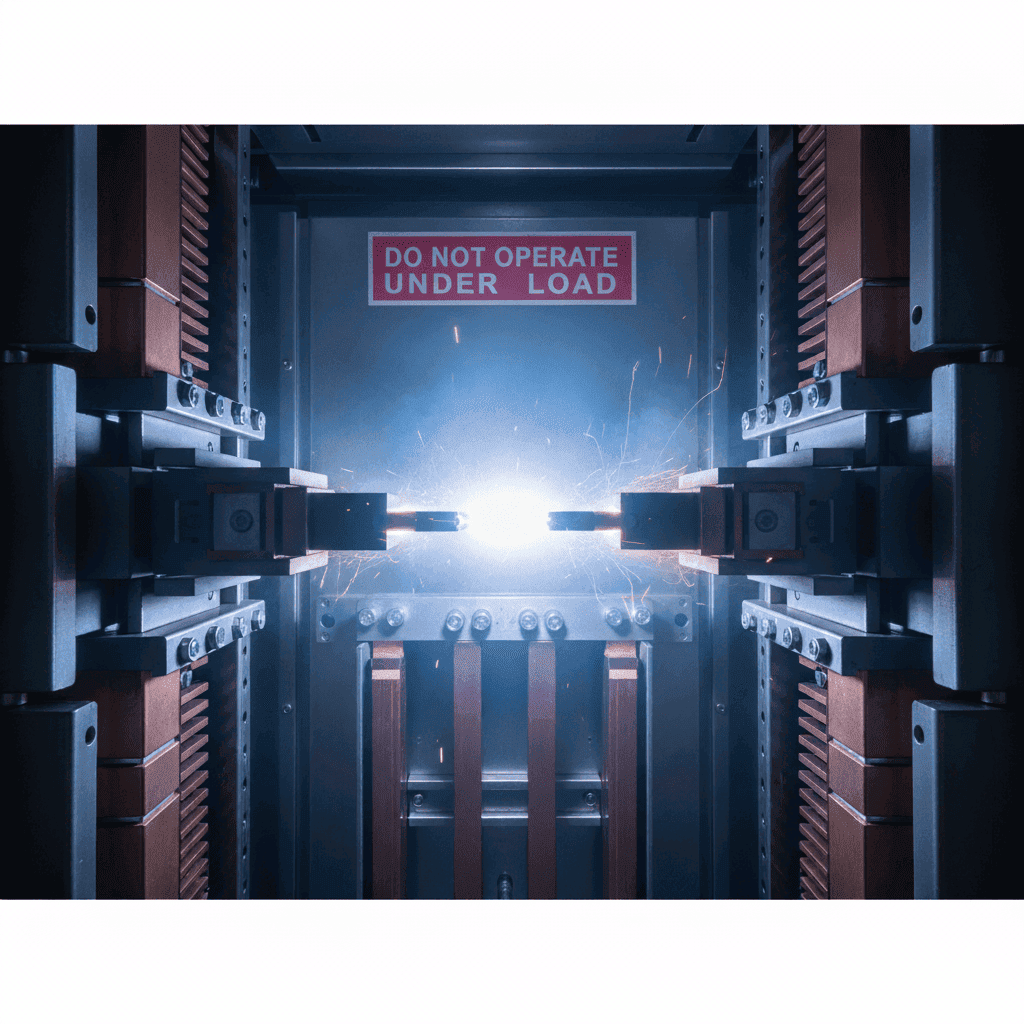
Note: The core value of a disconnect switch is the "visible physical break"; it serves as a safety indicator and a mandatory element in Lockout/Tagout procedures, not as a load-control device.
Typical Application Scenarios
The disconnect switch's application is clearly defined and focused primarily on safety isolation before maintenance.
They are typically installed on both sides of a circuit breaker, a transformer, or a bus section.
This arrangement ensures that after the circuit breaker has opened to clear the load or fault current, the disconnect can be safely pulled to provide a final, visible, and double-secure separation from all potential power sources.
In complex, interconnected bus systems, disconnect switches are also vital for safe bus sectioning and transfer switching procedures, ensuring every step of the network reconfiguration is executed under pre-established, safe protocols.
Their role is strictly sequential and entirely dependent on the primary interrupting device (the VCB) operating first.
III. Load Break Switches (LBS): Load Control and Sectionalizing
Primary Function and Current Switching Capability
The Load Break Switch () was engineered to address the critical functional gap left by the disconnect switch: the inability to operate under load.
The LBS is a medium-control device specifically designed to safely carry and switch normal system operating currents.
Crucially, the LBS is also rated to safely interrupt and close manageable overload currents, typically within two to three times its nominal current rating.
This functionality makes the LBS an excellent tool for sectionalizing circuits and enabling flexible load transfer operations within a distribution network.
Its utility lies in controlling segments of the power grid without the complexity or cost of a full circuit breaker setup.
Core Mechanism: Limited Arc Quenching Capability
To achieve its load-switching functionality, the LBS must incorporate a limited arc-quenching mechanism near its contacts.
These mechanisms may include fast-acting snap-action contacts, puffers using compressed air, or small amounts of SF6 gas or rudimentary vacuum or oil-assisted systems to extinguish the arc.
While effective for clearing arcs produced by normal load currents, the capacity and duration limits of these systems are vastly inferior to those found in a dedicated circuit breaker.
This "limited capacity" is the central concept for understanding the LBS's functional boundary and its necessary dependence on external protection devices.
The mechanism is designed for a routine, controlled interruption, not an explosive fault condition.
The Protection Boundary: Zero Short-Circuit Interruption
The definitive limitation of the LBS is its absolute inability to interrupt short-circuit fault currents.
Short-circuit faults generate enormous current magnitudes (often dozens of times the normal current) that rise at an extremely fast rate, creating immense thermal and mechanical stress on the contacts.
The LBS's structural integrity and arc-quenching system are simply not designed to survive this kind of energy discharge.
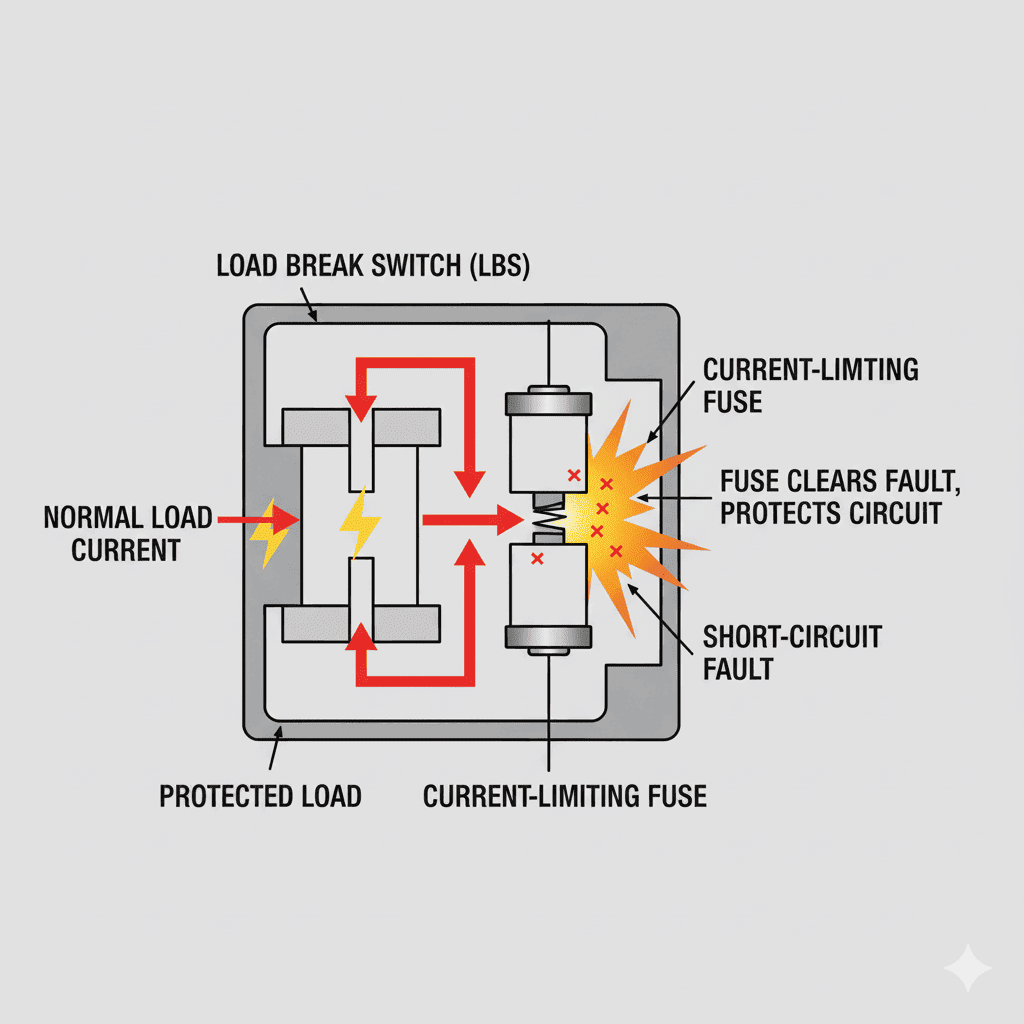
Consequently, in the fault-clearing hierarchy, the LBS must remain closed and immediately rely on an upstream or a cooperating fuse to clear the fault.
If the LBS were to attempt to open under a short-circuit, the resulting arc would severely damage the contacts, leading to catastrophic equipment failure, thermal runaway, and potential switchgear enclosure rupture.
Note: The greatest operational value of the LBS is "load switching" and "sectionalizing"; its greatest technical restriction is its "zero short-circuit breaking capacity."
Typical Application Scenarios
The LBS is the core component of Ring Main Units (RMUs) in power distribution networks, where it is used extensively for feeder sectionalizing.
This allows maintenance crews to quickly isolate a faulted segment of the ring while restoring power through an alternative path, dramatically improving system reliability and service continuity.
Furthermore, the LBS is commonly utilized in a combination unit, the + Fuse, to protect low-demand branch lines or smaller transformers.
This configuration offers a cost-effective and functionally viable protection solution.
IV. Vacuum Circuit Breakers (VCBs): Fault Interruption and High-Capacity Protection
Primary Function: Comprehensive Protection and Interruption
The Vacuum Circuit Breaker () is the primary protective device in the power system switchgear hierarchy, operating as the undisputed "master" of fault clearing.
The VCB’s comprehensive role is irreplaceable: it must safely carry and switch normal load current while possessing the inherent capability to reliably interrupt currents during overload, short-circuit, and other severe fault conditions.
Its high-speed operation and massive breaking capacity are central to maintaining system stability and integrity.
Core Mechanism: Vacuum Interrupter Technology
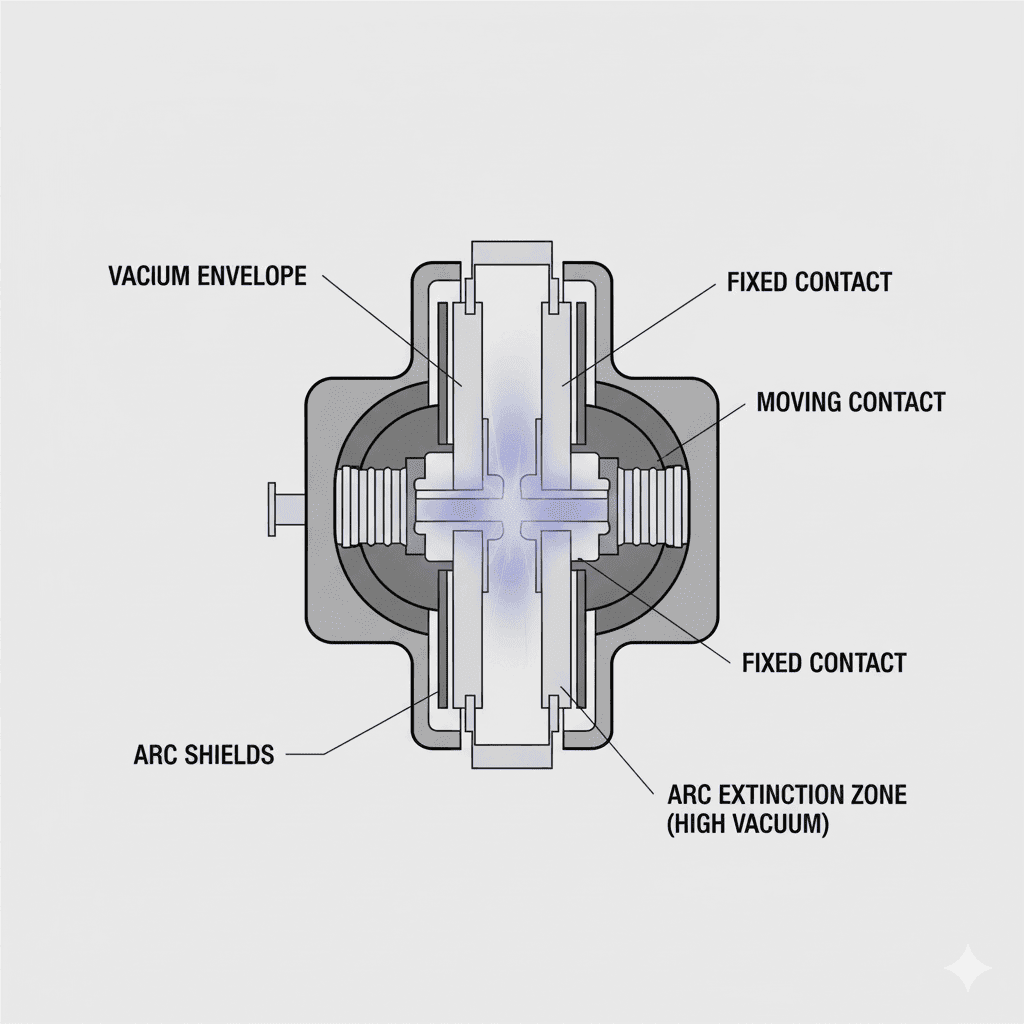
The VCB’s technical foundation lies within its vacuum interrupter chamber.
This chamber maintains an ultra-high vacuum environment, typically below 10−4 Pascals, which provides exceptional dielectric strength.
When the contacts separate inside this vacuum, the arc plasma dissipates rapidly into the vacuum space.
The dielectric strength across the separating contacts is restored extremely quickly at the current's natural zero-crossing point.
This mechanism enables the VCB to achieve arc extinction in as little as half a power-frequency cycle (approximately 8 to 10 milliseconds), minimizing the duration of the fault and the resulting damage to the system.
The speed and efficiency of this process are key to the VCB’s superior reliability and protective capability.
Key Advantage: High Breaking Capacity
The VCB’s Rated Short-Circuit Breaking Capacity () is the fundamental factor that differentiates it from the LBS.
The VCB is engineered to safely interrupt massive fault currents, often rated up to tens of kiloamperes, and is designed to do so repeatedly throughout its operational life.
This combination of high capacity and durability makes the VCB the only suitable device for protecting main busbars, generator outputs, and critical high-voltage feeders within power utility substations.
Tip: The most direct standard for differentiating a VCB from an LBS is simple: if the device is required to operate under a short-circuit fault condition, the only permissible choice is the VCB.
Typical Application Scenarios
VCBs are indispensable in high-voltage switchgear assemblies, Gas-Insulated Switchgear (GIS), and as generator circuit breakers.
They are seamlessly integrated with complex numerical protection relay systems, enabling them to diagnose faults, trip, and isolate the affected circuit within milliseconds, guaranteeing the high reliability demanded by modern power grids.
Their robust design ensures long-term performance in the most critical power system applications.
V. Standard Compliance and Key Rated Parameters (The Engineer's View)
For any practicing electrical engineer, the device name is secondary.
The rated parameters defined by standards like IEC 62271 or IEEE C37 are the sole measure of capability and the basis for regulatory compliance.
We must interpret these values based on the physical realities they represent.
V.I. Quantifying Interruption vs. Withstand Capabilities
The technical boundaries of these three devices are quantified by standardized tests focusing on two core abilities: "Interruption" and "Withstand."
Misunderstanding these two concepts is the root cause of many protection failures.
VCB’s Core Metric: Breaking Capacity (Icu / Ics)
(Ultimate Short-Circuit Breaking Current): This is the maximum fault current the VCB can safely interrupt. Standards require that the VCB, after clearing Icu, must maintain mechanical and dielectric integrity, even if it is not immediately required to carry load afterward; this is the device's absolute safety baseline.
(Rated Short-Circuit Breaking Current): This is the current that the VCB can interrupt reliably and subsequently continue carrying its rated current. ICS represents the VCB's design endurance level and is a more demanding measure of high reliability than Icu.
LBS and Disconnects Core Metric: Rated Withstand Current
(Short-Time Withstand Current): This is the LBS's most crucial parameter, defining the maximum short-circuit current it can safely carry for a short duration (typically 1s or 3s), without attempting to interrupt it. This value guarantees that the LBS structure can hold together while an upstream VCB or fuse clears the fault.
(Peak Withstand Current): Ipk measures the mechanical and thermal stability of the contacts to withstand the instantaneous peak of the short-circuit current (which can be 2.55 times the Irms value). This parameter is vital for disconnects and LBSs, ensuring the contacts are not violently blown open by the massive electromagnetic forces of the initial fault current surge.
(Making Capacity): ICM specifically rates the VCB's ability to safely close onto an existing fault condition. This is a critical safety feature that ensures the VCB can withstand the initial current peak upon closing into a shorted bus, a capability that is explicitly and fundamentally absent in both LBSs and disconnects.
Note: The VCB’s core capability is quantified by (Interruption), whereas the LBS’s core capacity is defined by (Withstand). This difference in parameter focus defines their respective functional roles in the power system.
V.II. Mandatory Requirements from International Standards
IEC and IEEE standards rigorously separate the concepts of "Interrupting" and "Isolating."
The circuit breaker satisfies the interrupting requirement, making it safe for fault operation.
The disconnect switch only satisfies the isolating requirement, mandating operation only under zero-current conditions.
Any design attempt to force an LBS or disconnect to perform short-circuit interruption is a direct violation of engineering standards and an unacceptable compromise on system safety.
VI. Mandatory Safety Interlocking and Protection Coordination (Practical Detail)
In switchgear design, interlocking is the foundational safety technology that enforces correct operational sequence, neutralizing human error.
This is a core competency for any practicing electrical engineer.
VI.I. The VCB-Disconnect "Open-Before-Isolate" Interlocking Logic
This is a critical element of safety procedures worldwide (often referred to within the Chinese "Five-Prevention" concept), designed specifically to ensure personnel safety.
Logic Core: The core logic dictates that the disconnect switch is prohibited from operating while the circuit breaker is closed (i.e., when current is flowing). This is a non-negotiable safety rule.
Mandatory Enforcement: This interlocking is physically implemented using mechanical key interlocks, electrical solenoid locks, or programmable logic. The mechanism ensures that the disconnect's operating handle or mechanism is physically blocked until the VCB has confirmed its own open position and its status light verifies the circuit is dead.
Safety Significance: This logic guarantees that the disconnect switch is never operated under load, thereby physically eliminating the risk of arc flash and serving as the final, mandatory layer of personnel safety protection.
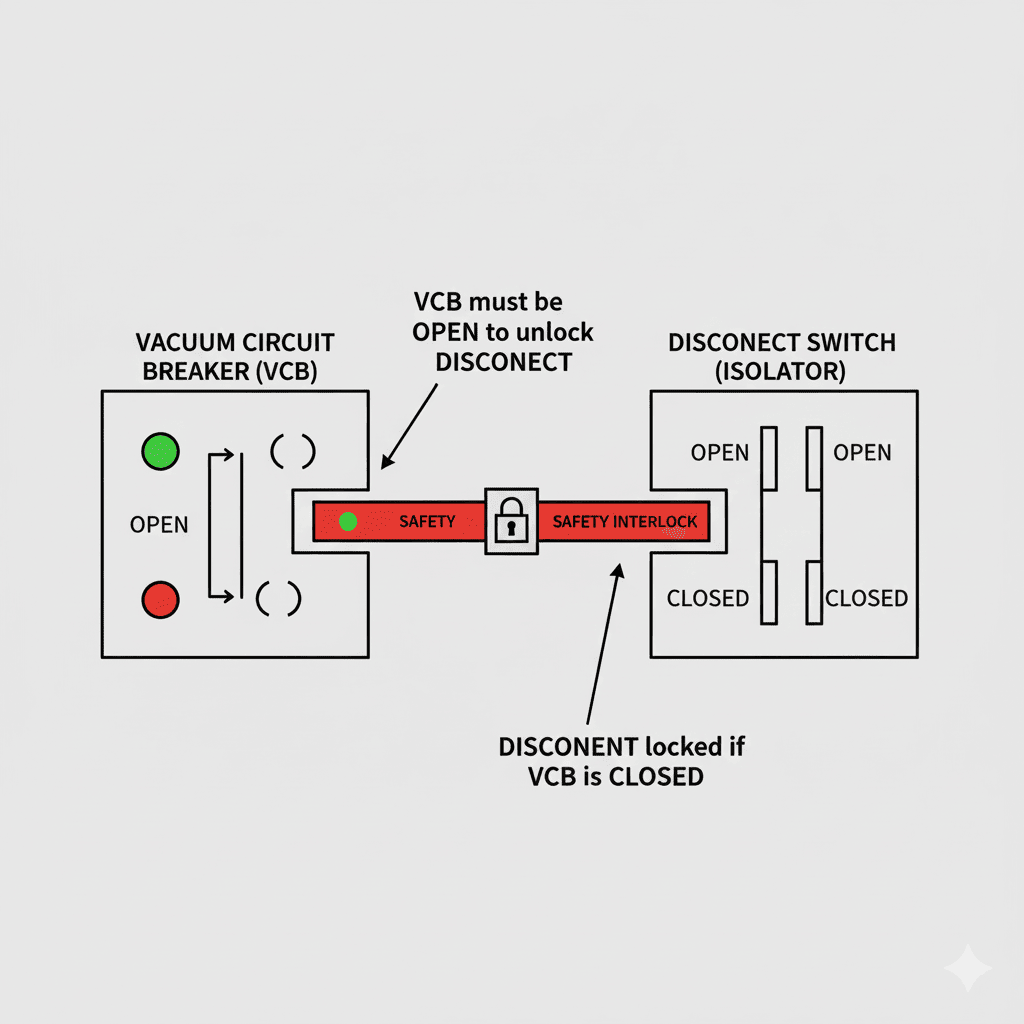
Tip: The rule is "Open-Before-Isolate": "First use the Circuit Breaker to open the circuit, then pull the Disconnect Switch." Any violation of this sequential order will either be prevented by the interlock or result in a severe arcing fault.
VI.II. Protection Coordination Between the LBS and Fuses
Because the LBS lacks intrinsic short-circuit breaking capability, it must be paired with a High-Voltage Current-Limiting Fuse to form a reliable composite protection unit in distribution networks.
Coordination Principle: The fuse's time-current () characteristic curve must be precisely coordinated with the LBS’s short-time withstand current () characteristic.
Timing Requirement: For all short-circuit fault current levels, the fuse’s clearing time must be faster than the LBS’s specified short-time withstand duration (typically 1s or 3s). This ensures the fuse melts and clears the fault before the enormous energy surge can physically damage the LBS body itself.
Practical Value: The fuse provides a low-cost, reliable mechanism for fault interruption, while the LBS provides the necessary function of flexible load switching. This combination achieves an optimal balance of functionality and cost-effectiveness in 10kV to 35kV distribution applications.
VII. Core Comparison: Function, Capacity, and Medium (Summary Table)
VIII. Engineering Selection Guide: When to Choose Which Device
The professional selection process must be driven by a precise risk assessment of the system.
It must adhere to the functional boundaries of the equipment. Choosing a device based on cost alone is unacceptable.
Selection Principle One: Is Short-Circuit Fault Interruption Required?
This is the paramount decision point in the selection process.
If the circuit is located in a high-fault-current zone (such as near a main substation bus) and requires the capability to clear short-circuit faults, then a Vacuum Circuit Breaker must be used.
In any application demanding high-capacity fault interruption and integrated protection, the VCB is the only compliant choice.
If the upstream protection already handles the fault clearing, proceed to the next principle.
Selection Principle Two: Is a Visible Isolation Point Necessary?
If the objective is to provide visible, verifiable safety isolation for maintenance and inspection to satisfy personnel safety and regulatory requirements, then a Disconnect Switch must be installed, often on both sides of the VCB.
No switch or circuit breaker can legally or safely substitute for the visible physical break provided by a certified disconnect switch.
Selection Principle Three: Is Frequent Load Switching and Sectionalizing Required?
If the primary requirement is simply to frequently switch normal operating loads or perform circuit sectionalizing within the distribution network.
And the short-circuit protection is guaranteed by an upstream device (VCB or fuse), then the Load Break Switch () is the optimal choice.
The LBS provides the best balance of functionality-to-cost for distribution voltage levels (10kV to 35kV).
IX. Total Life Cycle Cost (LCC) and Maintenance Comparison
A successful electrical design must account not only for initial functionality but also for the asset's Total Life Cycle Cost () and long-term operational efficiency.
These three devices exhibit significant differences in maintenance requirements and economic profiles.
IX.I. Maintenance Complexity and Cost Profile
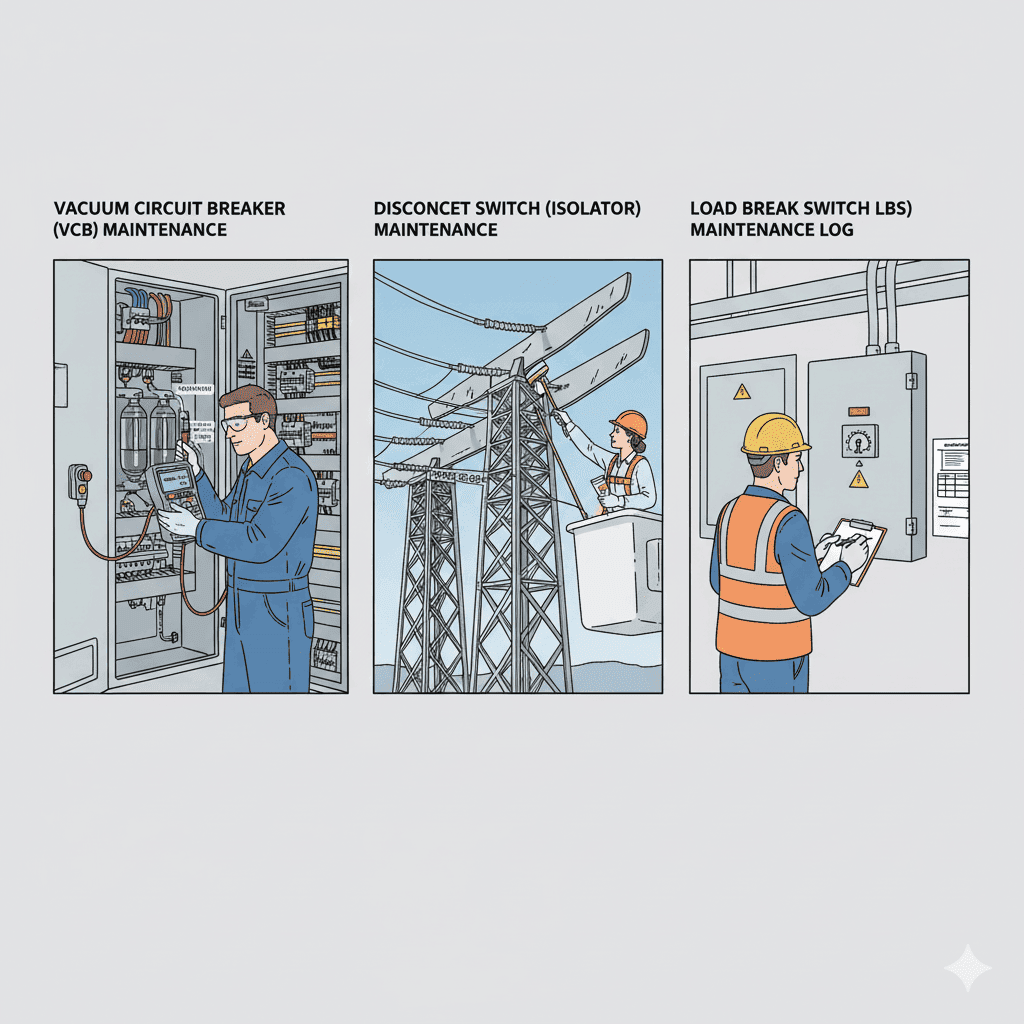
VCB: The initial cost is the highest of the three devices. The core maintenance focus is on monitoring the wear of the vacuum interrupter contacts and maintaining the integrity of the spring operating mechanism. This work often requires highly accurate, specialized instrumentation for vacuum integrity testing and contact timing measurements. Although the maintenance cost per event is higher, the maintenance interval is long due to a high design operational life (often tens of thousands of operations).
LBS/Disconnects: The initial cost is the lowest. The primary maintenance involves cleaning and lubricating the contacts, as well as inspecting the mechanical reliability of the operating mechanisms, particularly for outdoor disconnect switches, which require regular insulator cleaning to prevent flashover due to contamination. The maintenance work is simpler and cheaper per intervention but may need to be performed more frequently, especially in harsh or polluted environments.
IX.II. Failure Rates and Reliability Considerations
VCB: While structurally the most complex, the VCB’s reliable arc-quenching capability is the main guarantee of system integrity. A VCB failure can lead to catastrophic system downtime, meaning its required reliability is paramount and its maintenance procedures are the most rigorous.
LBS: The primary failure risk for an LBS centers on short-circuit coordination failure, where the fuse fails to clear the fault fast enough, resulting in damage to the LBS body itself. When properly coordinated and selected, the LBS offers good operational reliability, representing a balanced solution between economy and performance.
Disconnects: Failure risks are primarily associated with human error (operating under load) or long-term issues, such as increased contact resistance due to oxidation. The reliability of the external interlocking mechanism is the single most critical factor determining a disconnect switch's overall safety rating.
Note: The LCC advantage of the VCB lies in its long operational life and low fault rate; the LCC advantage of the Disconnect/LBS lies in its low initial cost and simpler routine maintenance.
X. Conclusion: The Hierarchy of Switching Devices
The disconnect switch, the load break switch, and the vacuum circuit breaker form an unbreakable functional hierarchy within the electrical grid.
The disconnect switch provides the lowest-tier function of safety isolation, the LBS handles the intermediate task of load control, and the VCB provides the highest tier of comprehensive fault protection.
These three devices are not substitutes for one another; they are synergistic components engineered to work together through sophisticated interlocking mechanisms.
Engineers must ensure every device operates within its specified boundary through precise parameter selection and strict adherence to interlock logic, which is the only way to build an economical, efficient, and compliant high-reliability power network.
XI. Frequently Asked Questions (FAQ)
Q1: Why can't I use a Load Break Switch (LBS) to replace a VCB for protecting a small transformer?
A: The core reason lies in the difference in interrupting capacity. The LBS's rated short-time withstand current (Icw) is vastly inferior to the VCB's rated short-circuit breaking current (Ics). A transformer internal short-circuit fault can generate tens of thousands of amperes instantly, and if an LBS is used, it will be destroyed by the extreme thermal and electromagnetic forces generated by the fault current, failing to clear the circuit and escalating the incident.
Q2: Can the operating sequence of the disconnect switch and the circuit breaker be reversed during system switching?
A: Absolutely not. The operating sequence must rigorously follow the "Open-Before-Isolate" interlock principle. The correct procedure is always to first use the circuit breaker to interrupt the load and ensure a zero-current condition, and only then operate the disconnect switch to provide the visible isolation. Reversing this sequence will result in the disconnect switch drawing a high-energy arc, leading to a catastrophic failure and severe safety hazard.
Q3: How do I use the VCB's nameplate parameters to confirm it meets my system's fault requirements?
A: You must focus on the Ics (Rated Short-Circuit Breaking Current) and your system’s calculated maximum three-phase short-circuit current at the installation point. You must ensure that the VCB’s Ics rating is greater than or equal to the calculated maximum short-circuit current value. If the Ics is lower, the breaker may fail to safely clear the fault, risking explosion or contact welding.
Q4: What risks are associated with increased contact resistance in a disconnect switch?
A: Over the long term, contact resistance in disconnect switches can increase due to oxidation or inadequate contact pressure. This leads to two primary risks: first, power loss and heating, where the excessive heat accelerates insulation degradation; and second, increased voltage drop, which degrades power quality. Therefore, routine maintenance must include the use of a micro-ohmmeter to monitor and record the disconnect switch's contact resistance.
Q5: When using an LBS with fuses, how do I prevent the LBS from remaining partially energized after a fuse blows?
A: Modern LBS-fuse combinations typically employ a striker pin mechanism integrated into the fuse. When the fuse element melts and clears the fault, the striker pin is forcibly ejected, mechanically triggering a trip mechanism on the LBS itself. This critical design ensures that when any one fuse clears, the LBS automatically trips open all three phases, preventing damaging single-phasing conditions and maintaining operational integrity.