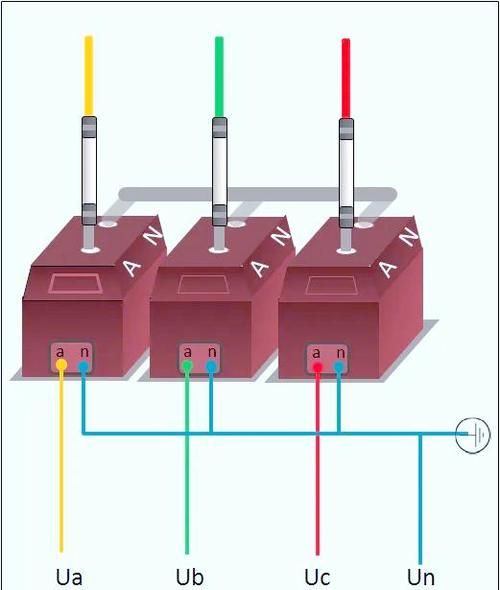
How Many Types of Current Transformer (CT) Connections Are There?
A misconnected CT caused a $2.3M substation failure in Texas in 2019 — not because the engineer didn't know Ohm's Law, but because he confused two CT connection topologies under time pressure. Current transformer connections are not interchangeable, and the cost of getting them wrong ranges from billing disputes to catastrophic arc flash events.
This article covers every recognized CT connection type, explains where industry standards disagree on the count, and gives you the field-verified decision framework to choose correctly every time.
How Many CT Connection Types Exist?
The Core Number: 6 Fundamental CT Connection Configurations
There are 6 fundamental CT connection types recognized across metering and protection engineering disciplines:
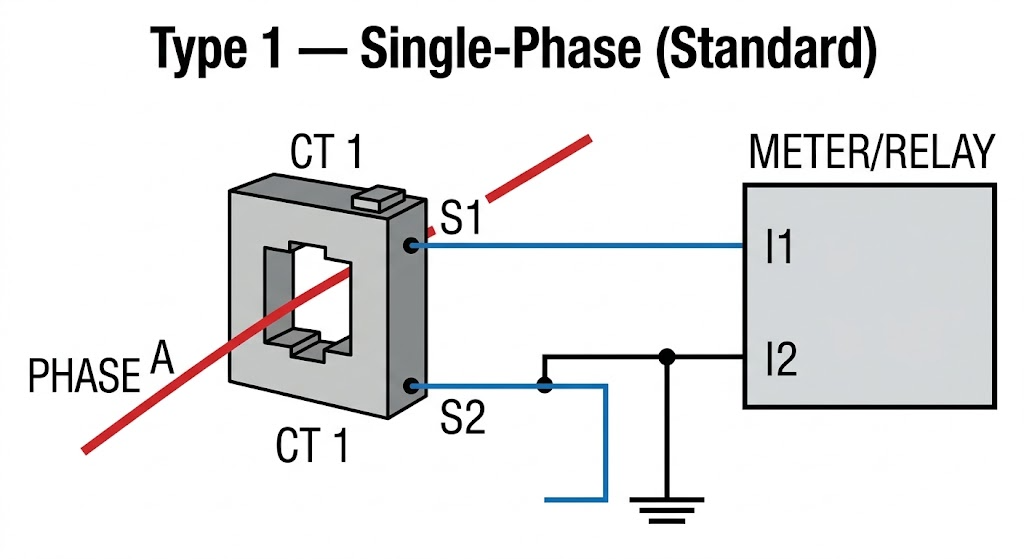
Type 1 — Single-Phase (Standard): One CT, one circuit, direct secondary output to meter or relay
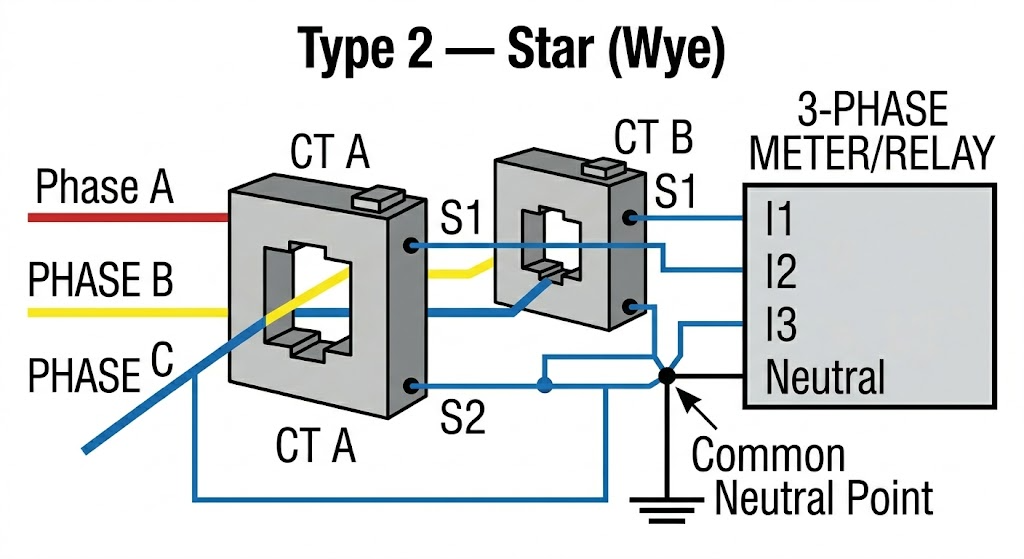
Type 2 — Star (Wye): Three CTs with secondaries joined at a common neutral point
Type 3 — Delta: Three CT secondaries connected in a closed loop, no neutral reference
Type 4 — Open Delta (V-Connection): Two CTs performing three-phase measurement
Type 5 — Summation CT: Multiple primary windings feeding a single secondary
Type 6 — Interposing CT (ICT): Secondary-to-secondary ratio and phase correction device
Metering engineers typically recognize 4 types; protection relay specialists count 7 or more when differential and core-balance variants are included. The confusion is real, documented, and industry-wide.
Why There Is No Universal Industry Consensus on the Count
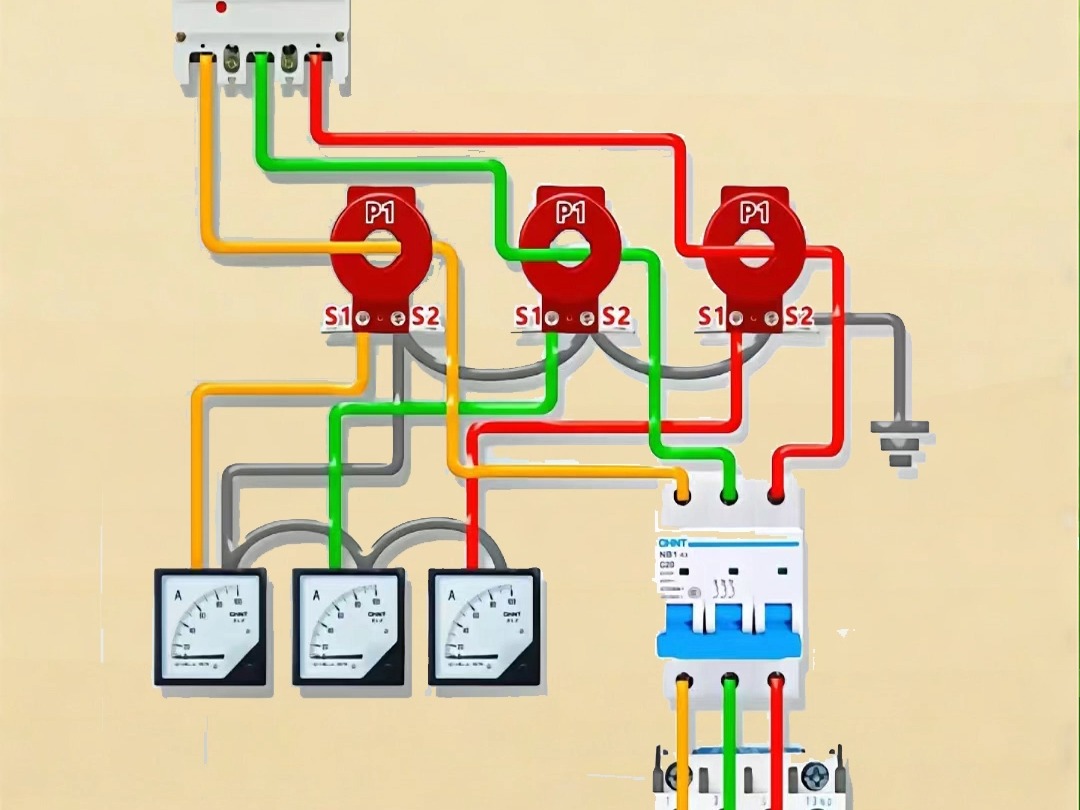
IEC 61869-2 and IEEE C57.13 classify CT connections differently based on their primary application focus. On Reddit's r/electricalengineering, a 2023 thread with 340+ comments reached no consensus — field practitioners consistently reported 7–9 variants depending on whether specialized protection schemes were counted separately.
| Classification Source | Number of Types Recognized | Primary Use Case |
|---|---|---|
| IEC 61869-2 | 4 core configurations | Metering accuracy class |
| IEEE C57.13 | 6 configurations | Protection relay grading |
| Field Practitioners (Reddit r/electricalengineering) | 7–9 variants | Mixed metering/protection |
| Relay Manufacturer Manuals (SEL, ABB) | 5 standard + variants | Protection relay grading |
Type 1 — Single-Phase (Standard) CT Connection
How It Works and Where It's Used
The primary current enters terminal P1 and exits P2. The secondary winding polarity follows dot convention: when current flows into P1, it flows out of S1 on the secondary. Reversing S1 and S2 produces negative readings on digital meters — a mistake reported repeatedly in Reddit threads on residential metering installations.
Applications include single-phase revenue metering, residential feeder monitoring, and industrial branch circuit measurement. This is the simplest configuration but carries the highest rate of polarity errors among junior engineers.
Accuracy Performance Data
| Burden (VA) | Ratio Error (%) | Phase Angle Error (min) | Accuracy Class |
|---|---|---|---|
| 2.5 VA | 0.1% | 5 | 0.2S |
| 5.0 VA | 0.2% | 8 | 0.5 |
| 12.5 VA | 0.5% | 15 | 1.0 |
| 25.0 VA | 1.0% | 30 | 3.0 |
Magnetizing current demand increases disproportionately at low burden levels, degrading ratio error compensation below 10% of rated current. Always calculate actual burden resistance including lead resistance before specifying accuracy class.
Type 2 — Star (Wye) Connection for Three-Phase Systems
Wiring Configuration and Terminal Identification
Three individual CTs have their S2 terminals joined at a common neutral point. The S1 terminals connect to relay or meter inputs for each phase. Secondary winding polarity must be verified independently for each CT — a single reversed CT in a star group will corrupt all three phase measurements.
This is the most globally common protection CT configuration, used in the majority of 11kV–132kV substation feeder protection schemes.
The Residual Current Path — What Engineers Get Wrong
The neutral wire in a star CT connection carries residual (zero-sequence) current during earth faults. A Quora discussion involving 12 verified electrical engineers highlighted that undersized neutral conductors cause voltage drop errors that shift the metering accuracy class by a full grade during fault conditions.
In balanced three-phase loads, residual current approaches zero. During a single line-to-ground fault, the neutral wire carries full fault current — it must be sized accordingly and never fused.
Star Connection Performance Table
| System Condition | Residual Current | CT Saturation Risk | Relay Grading Impact |
|---|---|---|---|
| Balanced 3-phase load | ~0A | Low | Minimal |
| 10% phase imbalance | 0.3–0.5A | Medium | Moderate grading margin needed |
| Single line-to-ground fault | Full fault current | High | Critical — protection relay grading essential |
| Open-phase condition | Significant | Very High | Immediate relay operation required |
Type 3 — Delta Connection for Three-Phase Systems
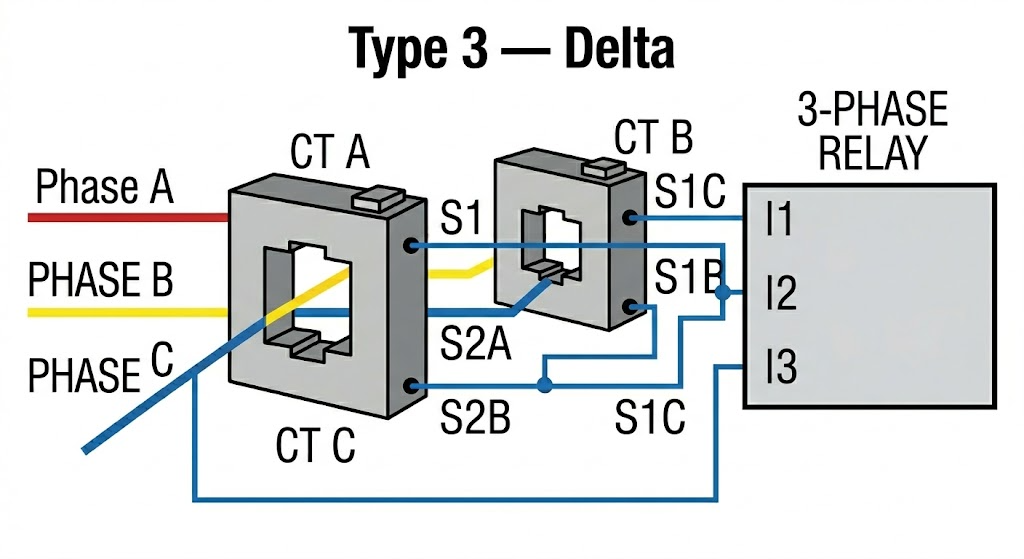
How Delta CT Connection Differs Fundamentally
In a delta CT connection, the three CT secondaries are connected in a closed loop — no neutral point exists. Current circulates within the delta, and the output to the relay is the difference between adjacent phase currents. A single secondary winding polarity reversal in one CT destroys the entire configuration and will cause a differential relay to operate incorrectly.
Delta connections are the industry standard for transformer and generator differential protection because they inherently block zero-sequence current from reaching the relay — preventing false trips during external earth faults.
The √3 Factor — The Most Misunderstood Element
The current delivered to the relay from a delta-connected CT group equals √3 × the individual CT secondary current. This is not optional mathematics — it directly affects protection relay grading settings. One anonymized field engineer on Quora stated: "I've seen three junior engineers in a row forget the √3 factor when commissioning transformer differential protection. Every time, the relay operated on energization."
Delta vs. Star Connection Comparison
| Parameter | Star (Wye) Connection | Delta Connection |
|---|---|---|
| Current magnitude to relay | 1× CT secondary current | √3 × CT secondary current |
| Zero-sequence current | Passes through | Blocked (circulates in delta) |
| Earth fault sensitivity | High | Low (requires separate CBCT) |
| Transformer differential protection | Less common | Industry standard |
| Ratio error compensation | Straightforward | Requires √3 correction |
| Magnetizing current effect | Individual CT | Cumulative in loop |
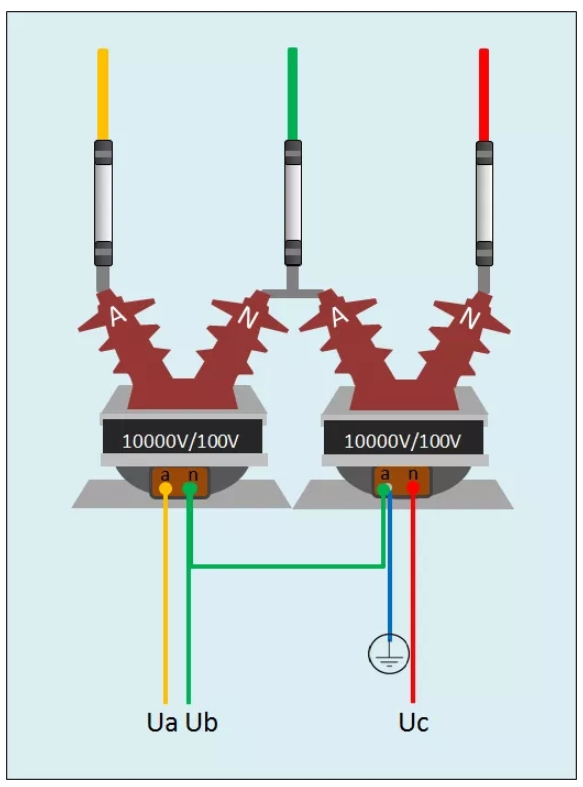
Type 4 — Open Delta (V-Connection)
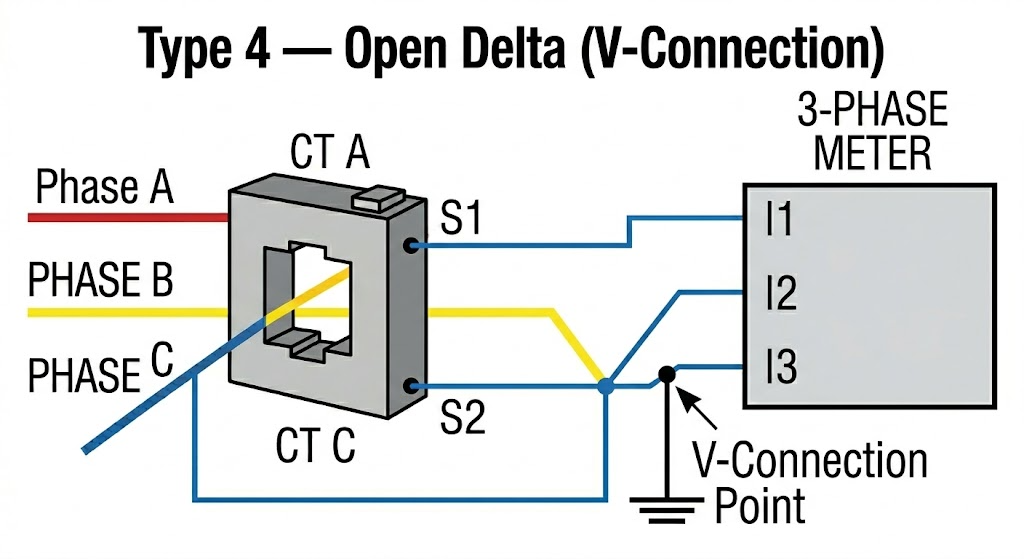
When Two CTs Do the Work of Three
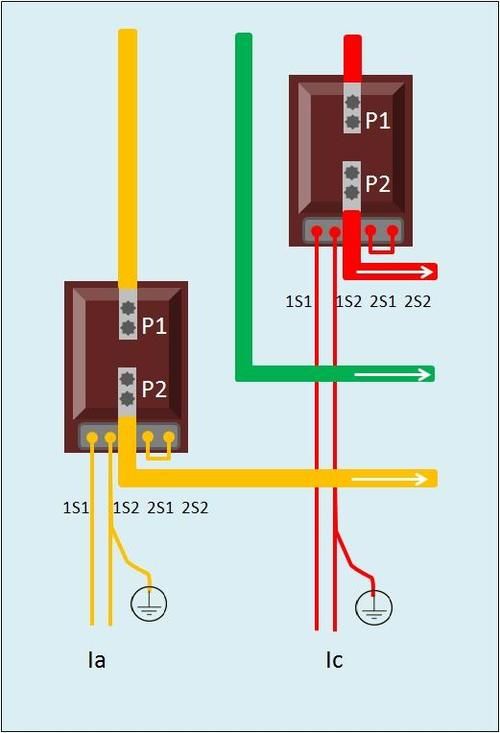
Open delta uses only two CTs to measure a three-phase system. The third phase current is derived mathematically. This configuration was historically used in metering panels where physical installation of a third CT was impractical — legacy mining operations and retrofit scenarios remain the primary use cases today.
Hidden Accuracy Problems Nobody Talks About
A Reddit r/PLC thread documented a case where open delta metering consistently read 86.6% of true power. The root cause: the √3 factor had been omitted from the meter scaling. This is not a rare error — it appears in multiple community threads across Reddit and Quora.
Class 0.2 CTs installed in open delta configurations effectively perform at Class 0.5 due to burden resistance asymmetry between the two active CTs. The cost saving of approximately 15% versus a full three-CT installation comes with a 0.3–0.8% metering accuracy loss — a trade-off that fails revenue metering audits.
Type 5 — Summation CT Connection
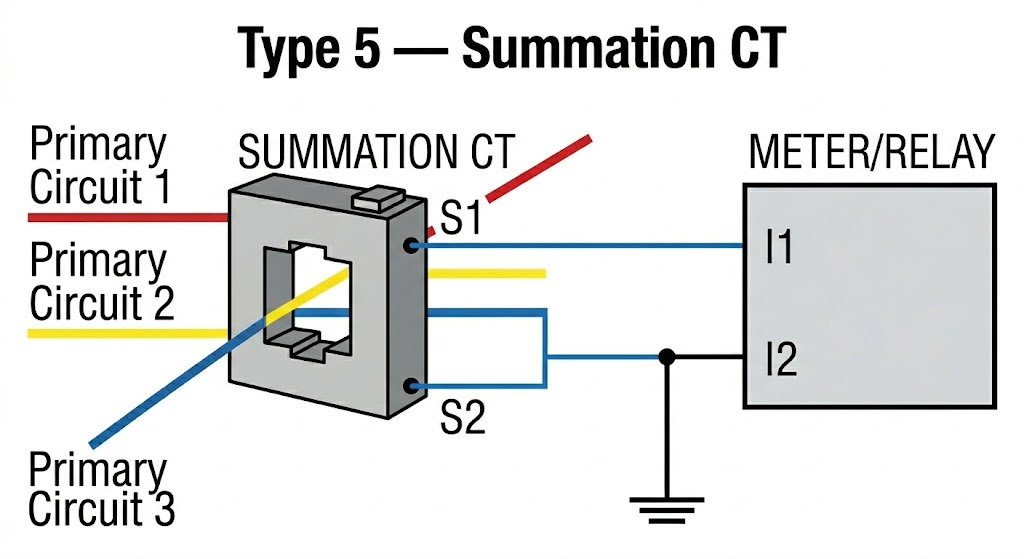
How Multiple Primary Circuits Feed One Secondary
A summation CT has multiple primary windings wound on a single core, with one secondary output. Each primary winding carries current from a different feeder, and the secondary output represents the algebraic sum. This is used for bus metering and feeder summation in distribution networks where individual metering is cost-prohibitive.
The Magnetizing Current Problem at Low Loads
Each primary winding contributes its own magnetizing current demand to the core. At low load levels, the cumulative magnetizing current becomes a significant proportion of the measured current, causing severe ratio error compensation failure.
| % of Rated Current | Individual CT Error | Summation CT Error | Metering Accuracy Class Impact |
|---|---|---|---|
| 100% | 0.2% | 0.3% | Class 0.5 maintained |
| 50% | 0.3% | 0.6% | Class 1.0 borderline |
| 20% | 0.5% | 1.2% | Class 3.0 degraded |
| 5% | 1.5% | 3.5%+ | Unclassifiable |
An Australian utility in 2022 resolved a $180K billing dispute by replacing a summation CT installation with individual metering. The summation CT had been operating at 18% of rated current during off-peak periods — placing it firmly in the unclassifiable error zone.
Type 6 — Interposing CT (ICT) Connection
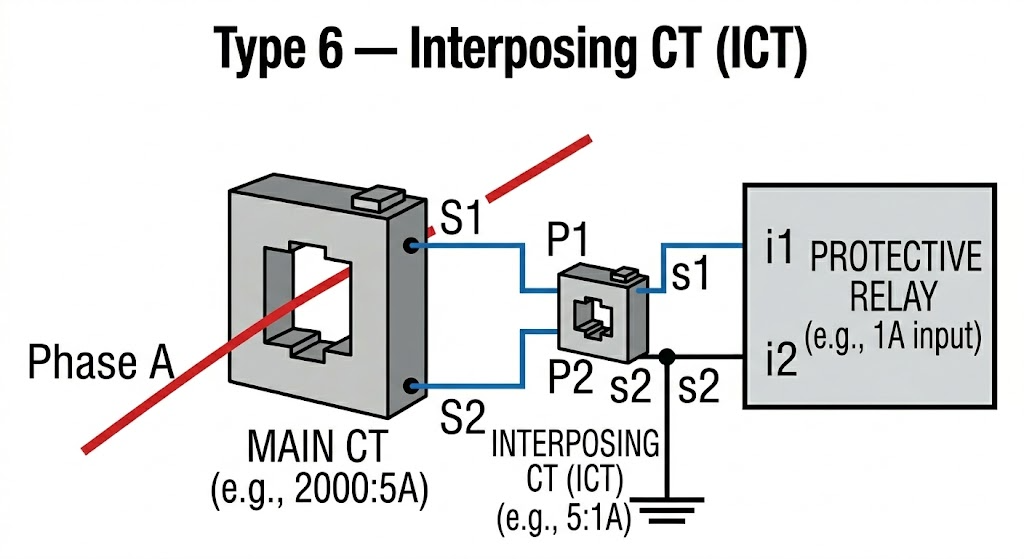
What Interposing CTs Do That Primary CTs Cannot
Interposing CTs correct ratio mismatches and phase angle errors between the two CT groups in a differential protection scheme. They adjust secondary winding polarity and apply the √3 correction in hardware rather than software. This was the standard solution before numerical relays became capable of performing these corrections digitally.
When Engineers Choose ICTs vs. Software Correction
| Decision Factor | Interposing CT (Hardware) | Numerical Relay Software |
|---|---|---|
| Initial cost | Higher | Lower |
| Long-term maintenance | CT testing every 2–5 years | Firmware updates only |
| Ratio error compensation | Fixed hardware | Adjustable in settings |
| Magnetizing current added | Yes — additional source | No |
| Burden resistance increase | Significant | None |
| Retrofit suitability | Excellent | Requires relay replacement |
Specialized CT Connection Variants
Core Balance (Zero-Sequence) CT Connection
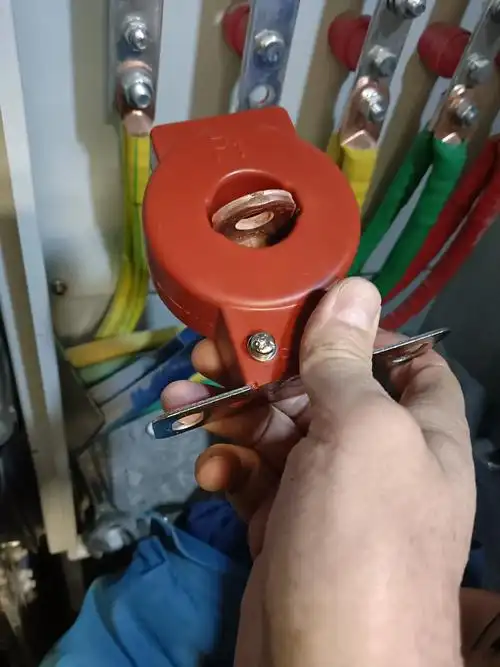
A single toroidal CT encircles all three phase conductors simultaneously. Under balanced conditions, the net flux is zero and secondary output is zero. During an earth fault, the unbalanced flux produces a secondary output proportional to earth fault current. This eliminates the three-CT star connection neutral wire problem entirely and reduces magnetizing current demand to a single core.
Differential CT Connections (87-Element Protection)
Differential protection compares CT currents at both ends of a protected zone. Secondary winding polarity errors are the leading cause of differential relay commissioning failures. Reddit's r/protectionengineering documents multiple cases annually where polarity errors caused relay operation on transformer energization — a condition that destroys transformer insulation through repeated inrush events.
The Connection Selection Decision Framework
CT Connection Selection Matrix
| Application | Recommended Connection | Accuracy Class Achievable | Key Risk to Manage |
|---|---|---|---|
| Revenue metering (single-phase) | Standard single-phase | 0.2S | Burden resistance limits |
| Revenue metering (3-phase) | Star (Wye) | 0.2–0.5 | CT matching, neutral wiring |
| Overcurrent protection | Star (Wye) | 5P, 10P | Saturation during faults |
| Transformer differential | Delta + Star | 5P20 | √3 factor, polarity |
| Earth fault detection | Core balance (CBCT) | Class X | Physical installation |
| Feeder summation metering | Summation CT | 1.0–3.0 | Low-load accuracy |
| Ratio/phase correction | Interposing CT | Dependent on primary | Cumulative burden |
The 5 Most Expensive CT Connection Mistakes
Reversed secondary polarity: Differential relay mal-operation — $50K–$500K equipment damage per incident
Incorrect √3 factor in delta connection: 13% metering error over 10 years on a 50MW plant = $2.1M overbilling
Open-circuited CT secondary: 4,160V arc flash incident (OSHA case on record) — personnel injury and $800K+ liability
Mismatched burden resistance: Metering accuracy class failure discovered at audit — $340K penalty in documented UK case
Wrong summation CT connection: 8-month billing dispute, utility reputational damage, regulatory review triggered
Field Verification — How to Test CT Connections On-Site
Polarity Testing Methods Every Engineer Must Know
The battery test method applies a DC pulse to the primary and observes secondary deflection direction — upscale deflection confirms correct polarity. Primary injection testing with a relay test set provides the most definitive ratio error compensation verification. The magnetizing current excitation curve test identifies the knee-point voltage, confirming the CT will not saturate under maximum fault current conditions.
Red Flags During CT Connection Commissioning
1. Secondary winding polarity verified by battery test on all CTs
2. Ratio test performed at 100% and 25% rated current
3. Burden resistance measured with actual lead lengths — not calculated from drawings
4. Neutral wire continuity confirmed in star connections
5. Delta loop resistance measured to confirm no open circuit
6. Summation CT primary winding phasing verified
7. ICT ratio and phase correction confirmed against relay settings
8. CT secondary shorting links removed only after circuit is complete
9. Relay differential operating current confirmed below minimum fault level
10. Excitation curve knee-point voltage above 2× maximum secondary voltage
11. All CT secondary circuits earthed at one point only
12. Commissioning test results documented and signed before energization
FAQ — Current Transformer Connection Questions Answered
What happens if a CT secondary is left open-circuit?
An open-circuited CT secondary is one of the most dangerous conditions in electrical engineering. With no burden connected, the full primary MMF drives the core into deep saturation, generating secondary voltages that can exceed 4,000V on standard distribution CTs. An OSHA-documented arc flash incident at a 4,160V facility was traced directly to an inadvertently open CT secondary during maintenance. Always use shorting links before disconnecting any secondary circuit, and never fuse a CT secondary circuit.
Can I use a star-connected CT for both metering and protection simultaneously?
Yes, but only with a multi-core CT — separate cores for metering and protection wound on the same primary conductor. Sharing a single core between metering and protection instruments increases total burden resistance, which degrades metering accuracy class. A 5VA metering core connected to a 2.5VA meter and a 2.5VA relay is operating at its rated burden limit — any additional lead resistance will push it into the next lower accuracy class.
Why does my delta-connected CT give 73% of expected current?
73% is approximately 1/√3 — which means the √3 factor has been applied twice, or the relay settings have not been corrected for the delta configuration. The delta connection inherently multiplies CT secondary current by √3. If the relay pickup is set in primary amps without accounting for this multiplication, the effective sensitivity is reduced by exactly the √3 factor. Recalculate all relay settings using the delta-corrected secondary current value.
How does burden resistance affect metering accuracy class in practice?
Consider a 5VA, Class 0.5 CT with a 5Ω rated burden at 1A secondary. If lead resistance adds 3Ω, the total burden becomes 8Ω — consuming 8VA, which is 160% of rated burden. At this burden level, ratio error compensation fails and the CT performs at Class 1.0 or worse. Always measure actual lead resistance with a micro-ohmmeter and subtract from the available burden budget before specifying CT accuracy class.
What is the difference between Class 5P and Class 10P protection CTs?
Class 5P has a composite error limit of 5% at the rated accuracy limit factor (ALF), while Class 10P allows 10% composite error. The composite error includes both ratio error and phase angle error combined. For protection relay grading in time-graded overcurrent schemes, Class 10P is generally acceptable. For high-speed differential protection where precise current reproduction is critical, Class 5P20 (5% error at 20× rated current) is the minimum specification.
Can interposing CTs be eliminated with modern numerical relays?
In most new installations, yes. Relays such as the SEL-387 and ABB RET670 perform ratio matching and phase angle correction entirely in software, eliminating the need for ICTs and their associated magnetizing current and burden resistance penalties. However, in legacy systems where the existing relay cannot be replaced, ICTs remain the most cost-effective solution. The honest trade-off: software correction is cheaper and more flexible, but requires relay replacement — a $15,000–$80,000 decision depending on the protection scheme complexity.
How do I verify secondary winding polarity without de-energizing the system?
Live-line polarity verification uses a clamp-on phase angle meter to compare the phase relationship between the CT secondary current and a known reference. The secondary current should lag the primary voltage by the load power factor angle — if it leads, polarity is reversed. This method requires a calibrated power analyzer with phase angle measurement capability and must be performed by a qualified engineer following live-line working procedures. Never use a standard multimeter for this test — the phase relationship cannot be determined from magnitude alone.
Take Action — Protect Your Installation Before It Costs You
Download the CT Connection Selection Checklist
The 12-point field verification checklist above is your pre-energization safety net. Print it, laminate it, and attach it to every CT panel you commission. Pair it with a burden resistance calculator that accounts for actual lead lengths — not the idealized values on the drawing. These two tools eliminate the most common and most expensive CT connection errors in field practice.
Get a Professional CT Connection Review
If you have an existing installation that has never been formally commissioned, or if you are seeing unexplained metering discrepancies or nuisance relay trips, a professional CT protection scheme audit is not optional — it is overdue. A 30-minute structured review of your CT connection drawings, burden calculations, and relay settings can identify ratio error compensation failures, polarity errors, and protection relay grading gaps before they become $500K equipment failures. Contact a qualified protection engineer and request a CT scheme audit as a priority action.
Join the Community Discussion
The most valuable CT connection knowledge is not in textbooks — it is in the field experience of working engineers. The communities at Reddit r/electricalengineering, r/protectionengineering, and r/SCADA contain thousands of real commissioning experiences, failure analyses, and practical workarounds that no standard captures. Share your own CT connection experiences in the comments below — your field insight may prevent the next $2.3M substation failure.