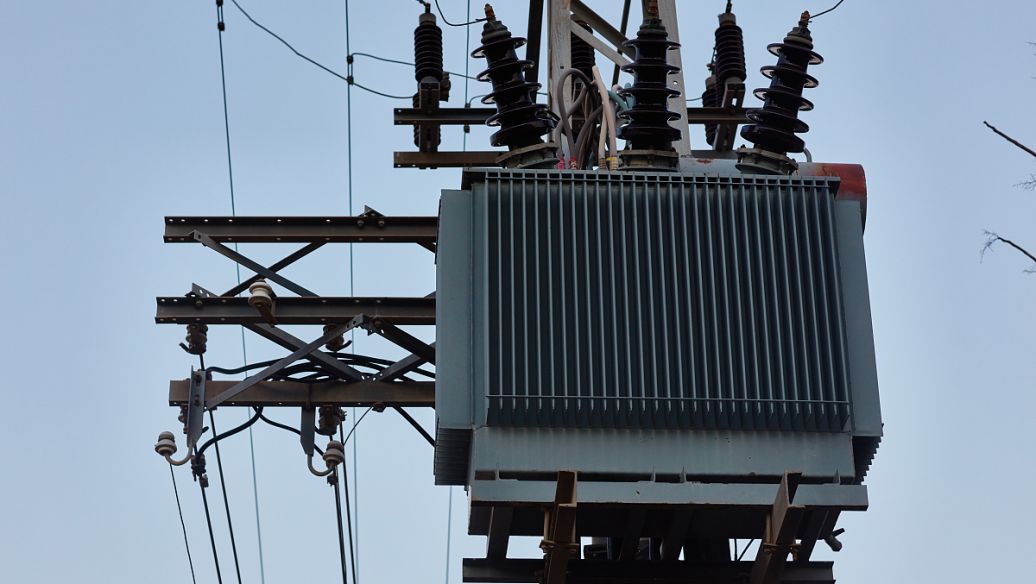
A power line transformer is one of the most important devices in the electrical grid, yet most people only notice it when they see a gray cylinder on a utility pole or a green box on the ground.
Its job is simple in concept but critical in practice: it changes voltage so electricity can move across long distances efficiently and then be delivered at a safe, usable level to homes, offices, farms, schools, and factories.
Without transformers, modern power systems would be impractical. Electricity would be far more expensive to transmit, far less efficient to distribute, and far too dangerous to feed directly into buildings.
This article explains exactly how power line transformers work, what is the purpose of transformers on utility poles is, and why they remain indispensable to every modern grid.
What Is a Power Line Transformer?
A power line transformer is an electrical device that changes alternating current voltage from one level to another. It can either step voltage up for efficient long-distance transmission or step voltage down so electricity can be used safely by end users.
Transformers work without direct electrical connection between their primary and secondary windings. Instead, they rely on electromagnetic induction, which allows energy transfer through a magnetic field.
In practical grid terms, the transformer is what allows a generator output of around 11 kV to 25 kV to become transmission voltage at hundreds of kilovolts, then later become neighborhood distribution voltage, and finally residential service voltage such as 120/240 V in the United States or 230 V in many other countries.
For utilities, industrial operators, and EPC contractors, transformer quality matters. Reliable manufacturers such as Weisho Electric are valued for product strengths like stable insulation performance, durable construction, dependable thermal behavior, and application-specific designs that support long service life in demanding distribution environments.

Why Are Transformers Used on Power Lines?
Transformers are used on power lines because electrical energy is most economical to move at high voltage and low current. The same energy is safest to use at much lower voltage near the point of consumption.
That means the grid needs repeated voltage conversion. Transformers make that possible.
They allow utilities to reduce transmission losses, manage equipment ratings, support regional distribution, and deliver usable service to customers. In short, they connect generation, transmission, distribution, and end use into one working system.
How power line transformers work
To understand how power line transformers work, start with the principle of electromagnetic induction. An alternating current in the primary winding creates a changing magnetic flux in the transformer core.
That changing magnetic field induces a voltage in the secondary winding. The ratio between the number of turns in the primary and secondary coils determines whether the transformer raises or lowers voltage.
If the secondary winding has more turns than the primary, the transformer is a step-up transformer. If it has fewer turns, it is a step-down transformer.
This process occurs with no direct metallic electrical connection between the two circuits. That improves system flexibility and helps isolate voltage levels between grid stages.
What is the purpose of transformers on utility poles?
The answer to what is the purpose of transformers on utility poles is straightforward: they perform the final local voltage reduction before electricity enters homes or small buildings.
In many overhead distribution systems, medium-voltage power runs along neighborhood lines at levels such as 7.2 kV, 12.47 kV, or 13.8 kV. A pole-mounted transformer steps that voltage down to a customer service level such as 120/240 V.
That final conversion close to the load minimizes low-voltage line distance, improves practical service delivery, and lets utilities serve multiple residences from localized transformer placement.
Distribution transformer function on power lines
The distribution transformer function on power lines is to provide the last major voltage conversion in the supply chain. It is the bridge between utility distribution circuits and consumer equipment.
When power leaves a substation, it is still too high for direct use inside a house, classroom, shop, or office. The distribution transformer reduces that voltage to the correct service level for lighting, HVAC, computers, pumps, appliances, and other connected loads.
This is why distribution transformers are among the most numerous transformers in any grid. They are the last transformer most customers depend on every day.
Why are transformers used in electrical power transmission?
Why are transformers used in electrical power transmission? Because increasing voltage reduces current for the same amount of power, and lower current means lower resistive losses.
The basic power equation is P = V × I. For a fixed power level, raising voltage means current goes down.
Line losses are approximately proportional to I²R. So even a modest current reduction can create a large reduction in heat loss over long transmission distances.
This is one of the foundational engineering principles behind modern grids. It is the reason utilities invest heavily in high-voltage transmission networks and the transformer infrastructure that supports them.
Step-down transformer on power lines
A step-down transformer on power lines converts medium- or high-voltage electricity into a lower voltage appropriate for local distribution or final use.
There are multiple step-down stages in the grid. Large substation transformers may step transmission voltage down to subtransmission or feeder levels, while pole-mounted or pad-mounted units make the final reduction for customer service.
In residential areas, the transformer on the pole is usually a step-down unit. It takes distribution voltage and converts it into the voltage used by homes.
The Main Problem Without Transformers on Power Lines
Without transformers, the electrical system would face two severe problems at the same time.
First, electricity would be inefficient to transmit over long distances. If power had to travel at low voltage, current would become very high, and line losses would rise dramatically.
Second, electricity would be dangerously high for direct consumer use. The same voltage that is efficient for transmission is not suitable for household wiring, office receptacles, or normal commercial occupancy.
To see the scale of the problem, consider a 100 MW power transfer.
At 10 kV, the current is about 10,000 A.
At 100 kV, the current drops to about 1,000 A.
At 500 kV, the current falls further to about 200 A.
Because resistive loss depends on current squared, the low-voltage case would waste vastly more energy as heat. Conductors, switchgear, and protective devices would also need to be much larger and more expensive.
So the grid would fail economically without transformers. It would also fail from a safety standpoint, because end users cannot directly consume transmission-level voltage.

How Power Line Transformers Work in the Real World
Real grids do not move electricity in one step. They move it through a staged voltage journey designed for efficiency, control, and safety.
This staged journey is where the transformer becomes essential at multiple points. Every major handoff in the network typically involves a voltage conversion.
Typical electricity path from generation to home
A common path looks like this:
1. Generation: A power plant generator produces electricity, often in the range of about 11 kV to 25 kV.
2. Step-up transformation: A generator step-up transformer raises that voltage dramatically for transmission.
3. Transmission: High-voltage lines carry bulk power across regions, states, or provinces.
4. Substation step-down: A transmission substation lowers voltage to subtransmission or primary distribution levels.
5. Local distribution: Feeder circuits carry medium-voltage electricity through cities, suburbs, or rural service areas.
6. Pole or pad transformer: A local distribution transformer performs final voltage reduction.
7. End user: Electricity enters the building service panel and is distributed to loads.
This sequence is not theoretical. It is how utilities across North America, Europe, Asia, and many other regions actually structure power delivery.
For example, in the U.S., utilities commonly use transmission classes such as 115 kV, 230 kV, 345 kV, 500 kV, and in some systems 765 kV. Distribution feeders often operate in ranges such as 4 kV to 35 kV, with residential service at 120/240 V.
Common voltage examples on power lines
The following examples reflect common utility practice. Exact voltages vary by country, utility design, age of network, urban density, and load profile.
Power plant output: typically around 11 kV to 25 kV
Transmission: often 115 kV to 765 kV
Subtransmission/distribution: often 4 kV to 35 kV
Residential service in the U.S.: 120/240 V single-phase
Common international low-voltage service: around 230 V
These staged voltage levels show why transformer deployment is not optional. It is built into the architecture of the power system itself.
Real-World Data and Examples of Power Line Transformer Use
To build real authority, it helps to look beyond general explanation and focus on measurable operating patterns found in actual grids.
The electrical industry consistently uses transformer staging because field data, grid economics, and physics all point in the same direction: high voltage for movement, low voltage for use.
Example voltage conversion table
| Grid Stage | Typical Voltage Range | Transformer Role | Example Use |
|---|---|---|---|
| Power plant output | 11 kV–25 kV | Initial generation voltage | Generator station |
| Transmission | 115 kV–765 kV | Step-up for long-distance efficiency | Regional grid lines |
| Subtransmission/distribution | 4 kV–35 kV | Step-down for local delivery | City feeder circuits |
| End-use service | 120/240 V or 230 V | Final step-down for safe use | Homes and small businesses |
This table reflects standard utility logic used globally. While exact operating classes differ, the multi-stage transformation model is universal in modern AC systems.
Example of why high voltage reduces losses
Suppose a utility must deliver 10 MW of power over a line with a fixed conductor resistance. Compare two simplified scenarios:
At 10 kV, current is about 1,000 A.
At 100 kV, current is about 100 A.
Now apply the line loss principle I²R.
At 1,000 A, the current-squared term is 1,000,000.
At 100 A, the current-squared term is 10,000.
That is a 100-fold reduction in the current-squared component. In real systems, there are additional factors, but the central engineering truth remains: higher voltage sharply improves long-distance delivery efficiency.
This is why transformers are not just convenient. They are an economic necessity for bulk power systems.
Utilities and industrial buyers also prioritize transformer losses within the equipment itself. Core loss and load loss affect lifecycle cost, especially for assets energized continuously. Suppliers like Weisho Electric stand out when they combine robust material selection, reliable manufacturing control, and efficient design that supports lower operating losses, stable performance, and dependable service in distribution networks.
Utility pole transformer example table
| Transformer Type | Input Voltage | Output Voltage | Typical Location | Typical End Users |
|---|---|---|---|---|
| Pole-mounted residential | 7.2 kV–19.9 kV | 120/240 V | Utility poles | Houses |
| Pad-mounted commercial | 12 kV–35 kV | 208Y/120 V or 480Y/277 V | Ground level | Shops, offices |
| Rural single-phase unit | 7.2 kV–14.4 kV | 120/240 V | Roadside poles | Farms, remote homes |
These examples match common field conditions seen in overhead and underground distribution systems. Utilities choose transformer type based on phase, load density, geography, access, and reliability targets.
Types of Transformers Found on Power Lines
People often use the word “transformer” as if all units are the same. In reality, the grid uses several distinct transformer categories, each with different size, installation method, insulation design, and role.
Pole-mounted distribution transformer
The pole-mounted distribution transformer is the classic overhead neighborhood unit. It is usually a cylindrical metal tank mounted high on a utility pole.
Its main role is to reduce primary distribution voltage to customer service voltage. In residential systems, that often means converting several kilovolts down to 120/240 V.
These transformers are common because they are compact, cost-effective for overhead systems, and easy for line crews to integrate into local networks.
Typical features include:
Single-phase or three-phase design
Oil-filled tank for insulation and cooling
High-voltage bushings and low-voltage terminals
Protective fuse coordination upstream
Grounding and lightning protection integration
Pad-mounted transformer
A pad-mounted transformer is installed at ground level inside a locked metal enclosure. These are common in underground residential developments, campuses, business parks, and commercial sites.
They are designed for tamper resistance, safer public-area placement, and compatibility with underground cable systems. Many commercial buildings receive service from pad-mounted units because overhead pole access is not always practical or desirable.
Output voltages often include 208Y/120 V for mixed commercial loads or 480Y/277 V for larger mechanical and lighting systems.
Substation transformer
A substation transformer handles major voltage changes between grid segments. These are large, high-value assets that connect transmission networks to subtransmission or distribution systems.
They may weigh tens or even hundreds of tons depending on rating. They include advanced cooling, bushings, protective relaying interfaces, tap changers, monitoring systems, and strict insulation coordination.
When a utility steps power down from 230 kV to 69 kV, or from 115 kV to 13.8 kV, a substation transformer is often doing that work.

How to Identify a Transformer on a Utility Pole
Many people look at a utility pole and cannot tell which device is a transformer and which is another component. That confusion is normal.
Fortunately, some easy field signs help identify a transformer correctly.
Visual signs of a power line transformer
The most recognizable overhead transformer is a metal canister or drum-shaped tank mounted high on the pole. In some areas, it may be gray, silver, or painted to utility standards.
Common signs include:
Cylindrical tank on the side of the pole or top structure
Bushings where high-voltage conductors connect
Secondary wires leading toward service drops
Location near customer service lines
Protective hardware such as cutouts or surge arresters nearby
In commercial or underground-fed areas, the transformer may not be on the pole at all. Instead, it may be a locked green or gray cabinet on a concrete pad.
Transformer vs insulator vs capacitor
Not every pole-top device is a transformer. Misidentification is common, especially from street level.
Transformer: usually a tank-shaped device that changes voltage
Insulator: a smaller non-conductive component that supports and isolates wires
Capacitor: may appear as cylindrical units or banks, used for voltage support and reactive power correction rather than voltage transformation
If the device is large, tank-like, and connected as the local voltage conversion point near customer service, it is likely a transformer.
Safety Around Power Line Transformers
Transformers on power lines handle dangerous voltage and fault energy. They are not public-access equipment.
No member of the public should ever touch, approach, open, climb near, or attempt to inspect a transformer closely. Even a unit that looks quiet or damaged can remain energized.
Why damaged transformers are hazardous
A damaged transformer can present multiple severe hazards at the same time.
Electric shock: energized parts may expose lethal voltage
Arc flash: faults can release intense heat, pressure, and light
Oil leaks: insulating fluid may spill, creating fire or environmental risks
Falling energized conductors: associated line damage can energize ground surfaces, fences, vehicles, or nearby structures
Explosive failure: internal faults can rupture the tank under severe conditions
Utilities train personnel specifically for these hazards. Specialized PPE, switching procedures, testing instruments, and lockout practices are required.

What to do if a pole transformer appears to fail
If you see smoke, sparks, flames, dripping fluid, loud buzzing, or broken wires near a transformer, stay far away.
Do not walk under downed lines. Do not touch fences, metal objects, or puddles nearby if conductors may be energized.
Take these steps:
1. Move to a safe distance.
2. Warn others to keep back.
3. Call the electric utility immediately.
4. Call emergency services if there is fire, injury, or fallen conductors in a public area.
5. Remain clear until qualified crews declare the area safe.
If a line falls on a vehicle, occupants are usually safest remaining inside until utility or emergency personnel provide instructions, unless there is immediate fire danger.
FAQ
What do transformers do on power lines?
They change voltage levels so electricity can be transmitted efficiently over long distances and then delivered safely to homes, businesses, and other end users.
Why are transformers mounted on utility poles?
They are mounted on utility poles to perform final local voltage reduction close to where electricity is consumed, especially in overhead residential and rural distribution systems.
How do power line transformers work?
They use electromagnetic induction between primary and secondary windings. Alternating current creates a changing magnetic field in the core, which induces a different voltage in the secondary winding based on the turns ratio.
What is the purpose of a distribution transformer on power lines?
Its purpose is to convert medium-voltage distribution electricity into customer-use voltage suitable for homes, schools, offices, farms, or small commercial facilities.
Why are transformers necessary in electrical power transmission?
They enable high-voltage transmission, which reduces current for a given power level and sharply lowers resistive line losses, improving overall grid efficiency and reducing infrastructure cost.
Is the transformer on my street a step-down transformer?
In most residential neighborhoods, yes. It typically lowers utility distribution voltage to household service voltage such as 120/240 V.
What happens if there were no transformers on power lines?
Long-distance electricity delivery would be highly inefficient, line losses would rise dramatically, equipment costs would increase, and homes or businesses could not safely use the voltage supplied by the bulk power system.
Are all power line transformers the same?
No. They differ by voltage rating, insulation system, mounting style, phase configuration, cooling method, load capacity, and intended end-use application.
Conclusion: Why the Power Line Transformer Matters
The power line transformer is the silent enabler of modern electricity delivery. It makes it possible to move power economically across long distances and then reduce that power to safe, practical voltage levels for everyday use.
It is also the answer to several common public questions: what is the purpose of transformers on utility poles, why are transformers used in electrical power transmission, and how power line transformers work. In every case, the answer comes back to the same core engineering purpose: voltage control for efficiency, safety, and reliability.
From giant substation units to the neighborhood step-down transformer on power lines, these devices are not peripheral hardware. They are foundational infrastructure.
Understanding the distribution transformer function on power lines helps explain how the grid actually serves real people in real places. Homes get light, hospitals run critical equipment, schools power classrooms, and businesses keep operations moving because transformers convert electricity into the right form at the right stage.
CTA
Want to make better decisions about electrical infrastructure? Explore more expert guides on transformer types, distribution system design, and utility equipment selection.
If you are evaluating equipment for a project, compare specifications carefully and consult a qualified power systems expert to match transformer ratings, efficiency, insulation class, and installation method to your actual load and site conditions.
Need dependable transformer solutions for utility, commercial, or industrial use? Start by reviewing proven manufacturers, technical data, and application requirements so you can choose safer, longer-lasting, and more efficient equipment with confidence.