The old way to buy vacuum interrupters was to compare a datasheet, a nameplate rating and a unit price. A better way is to check the contact alloy, helium leak rate, bellows life and serial traceability before you place the PO. Two interrupters with the same rating can look identical when they arrive, but the cheaper one may lose vacuum within 3–8 years. This guide shows how to identify qualified vacuum interrupters with checks you can write into your RFQ.
A qualified vacuum interrupter is the sealed switching chamber inside a vacuum circuit breaker (VCB). It uses CuCr25 or CuCr50 contacts, is 100% helium leak tested to below 10⁻¹¹ Pa·m³/s, has bellows rated for at least 30,000 operations, and has a traceable serial number. If you buy VCBs or retrofit kits, check these four points before you look at price.
What Separates a Qualified Vacuum Interrupter from a Cheap Lookalike?
The difference between a qualified vacuum interrupter and a cheap lookalike is inside the unit. It comes down to contact material, vacuum sealing, the bellows and the electric-field design. Outside dimensions and nameplate ratings tell you almost nothing, because a lookalike can copy the housing exactly and still fail after a few faults or a few years in service.
For this comparison, tier-one means the mainstream manufacturers: Baoguang, Xuguang and Pinggao in China, plus imported brands such as Eaton, Meidensha and Schneider. The ordinary end of the market is small factories and low-cost white-label units.
Contact Material: CuCr25/CuCr50 vs Recycled or Low-Chromium Copper
CuCr is a copper-chromium alloy used for vacuum interrupter contacts. It is chosen because it resists arc erosion and keeps the chopping current low. Tier-one units use standard CuCr25 or CuCr50 that has been vacuum-melted to an even grain size. After a short-circuit interruption, these contacts erode evenly instead of welding or growing burrs. They are rated for 30–50 interruptions at full short-circuit capacity.
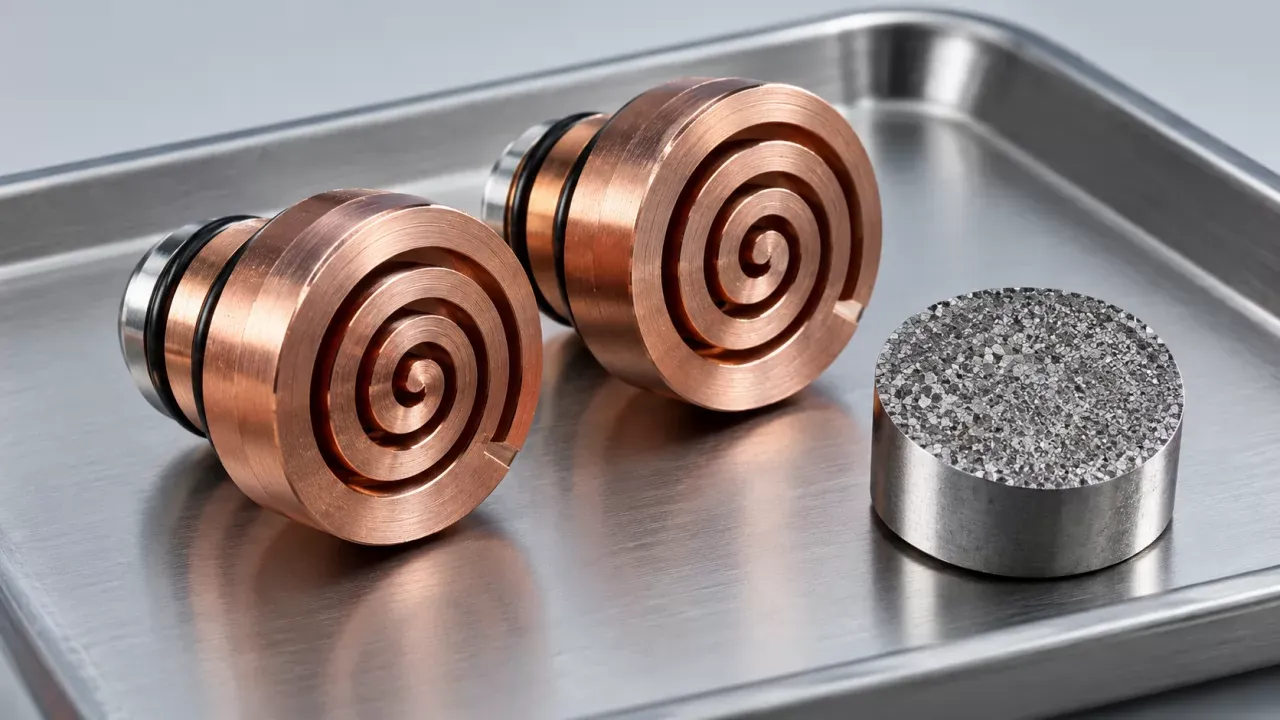
Some lower-tier units use recycled copper, a low chromium ratio or alloys with impurities. After one or two short-circuit faults the contact surface grows burrs, and chopping overvoltage rises. After repeated faults, these units can fail to open or the contacts can weld shut.
Vacuum Sealing and Leak Rate Over a 20-Year Design Life
Vacuum integrity decides how long the interrupter stays usable. Tier-one manufacturers seal units in Class 100 cleanrooms, use mature ceramic-to-metal metallization processes and helium-test every unit. The result is a leak rate below 10⁻¹¹ Pa·m³/s, factory vacuum better than 10⁻⁵ Pa and a design life of more than 20 years holding vacuum.
Weaker suppliers work in less clean conditions, simplify the brazing process and helium-test only samples, or skip the test. Their vacuum degrades slowly over 3–8 years. As vacuum falls, withstand voltage drops and partial discharge rises. The typical result in the middle or late part of service life is a sudden internal breakdown and an arc flash inside the switchgear.
Bellows, Shield and Ceramic: The Hidden Weak Points
The bellows is a thin stainless-steel sleeve that lets the moving contact travel while keeping the vacuum sealed. That makes it the weakest point of the dynamic seal. Tier-one bellows use fatigue-resistant stainless steel and are designed for at least 30,000 mechanical operations. Thin stamped bellows crack from fatigue under frequent switching, and once a bellows cracks, the vacuum is lost and the unit is scrap.
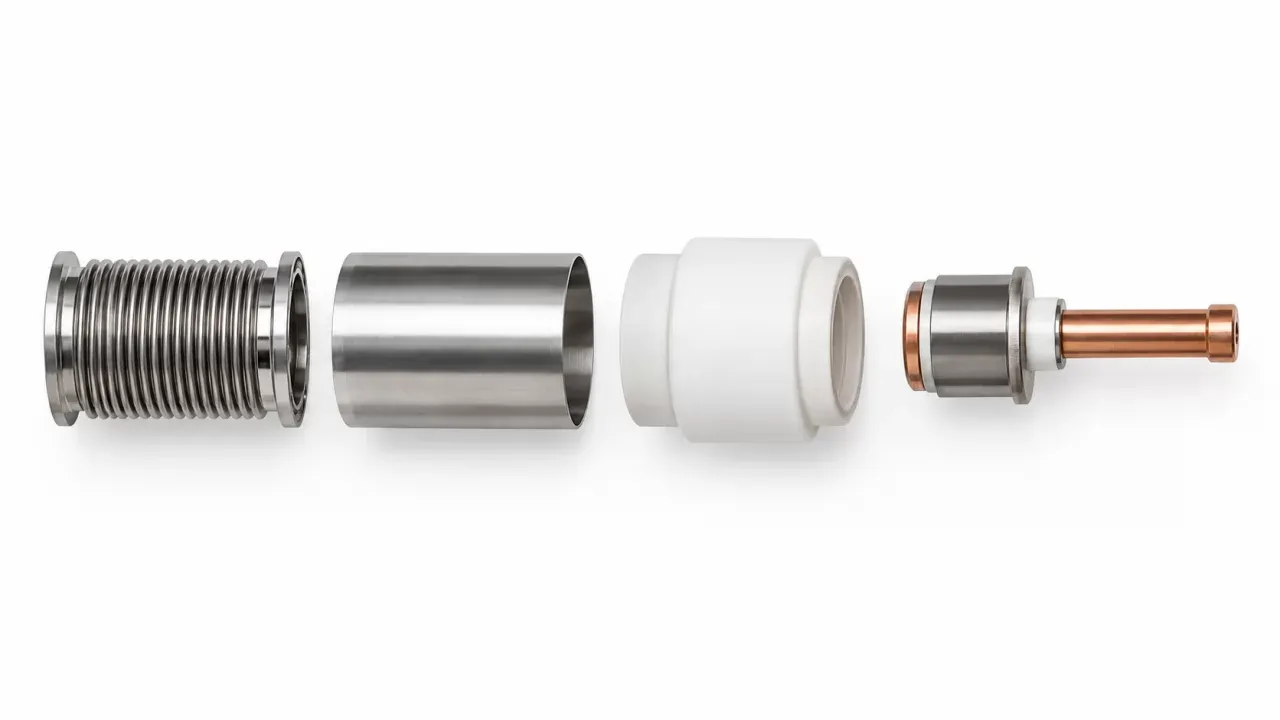
The shield and ceramic are the other weak points:
Shield design: Tier-one shields are optimized with electric-field simulation to contain metal vapour, and partial discharge (PD) is kept below 5 pC. Lookalikes copy the external shape and simplify the shield dimensions.
Ceramic envelope: Tier-one units use 95% alumina ceramic with strongly bonded metallization. This resists surface flashover and leaves wide margins above the GB standard requirements for lightning impulse and power-frequency withstand.
Harsh conditions: Designs with weak shields and high PD flash over more easily under overvoltage, humidity or high altitude.
What You Need Before Inspecting: Documents, Data and Test Access
Vacuum interrupter testing for circuit breakers starts with paperwork, not a test bench. Before you test any unit, get the supplier's type test reports, a serial list for the shipment and the material declarations. Also arrange access to a lab that can run high-voltage and partial discharge tests.
Type test reports: the full IEC or GB type test set, with the test lab named and the date of the most recent re-test.
Routine test records: production test data per serial number, including helium leak results.
Material declaration: contact alloy grade (CuCr25 or CuCr50), ceramic grade and bellows material.
Datasheet: rated voltage, rated short-circuit breaking current, number of full-rated breaking operations, mechanical life, contact gap and allowed contact erosion.
Test access: a power-frequency withstand test set, a PD measurement system and, if available, a magnetron-type vacuum tester. Use an in-house lab or a third-party inspection partner.
If a supplier cannot produce these documents before shipment, record that as a finding. Do not plan to sort it out after delivery.
How to Identify Qualified Vacuum Interrupters Step by Step
Run these six checks in order. Each one gives a pass or fail result you can write into the purchase contract and the QC/AQL plan. Documents come first because they are the cheapest to check. High-voltage tests come later and should only be run on units whose paperwork has already passed.
Verify the type test reports. Ask for complete IEC/GB type test reports covering breaking, dielectric, temperature-rise and mechanical tests. Make sure they are re-tested every year. A single report on one sample, dated years ago, is a fail.
Confirm serial-number traceability. Check that every unit carries a unique serial number. Pick a few serials at random and ask the supplier for the matching material batch and routine test records. Pass means the records come back complete and match the units.
Check the contact specification. Get written confirmation of the CuCr25 or CuCr50 grade and the rated number of full short-circuit interruptions. For tier-one units this is 30–50. A vague answer such as "copper-chromium" with no grade or count is a fail.
Test vacuum integrity. This is how to check vacuum interrupter vacuum integrity. First review the helium leak data, which should show below 10⁻¹¹ Pa·m³/s for each serial. Then run your own vacuum integrity test, either a magnetron-type vacuum measurement or a withstand test across the open contacts.
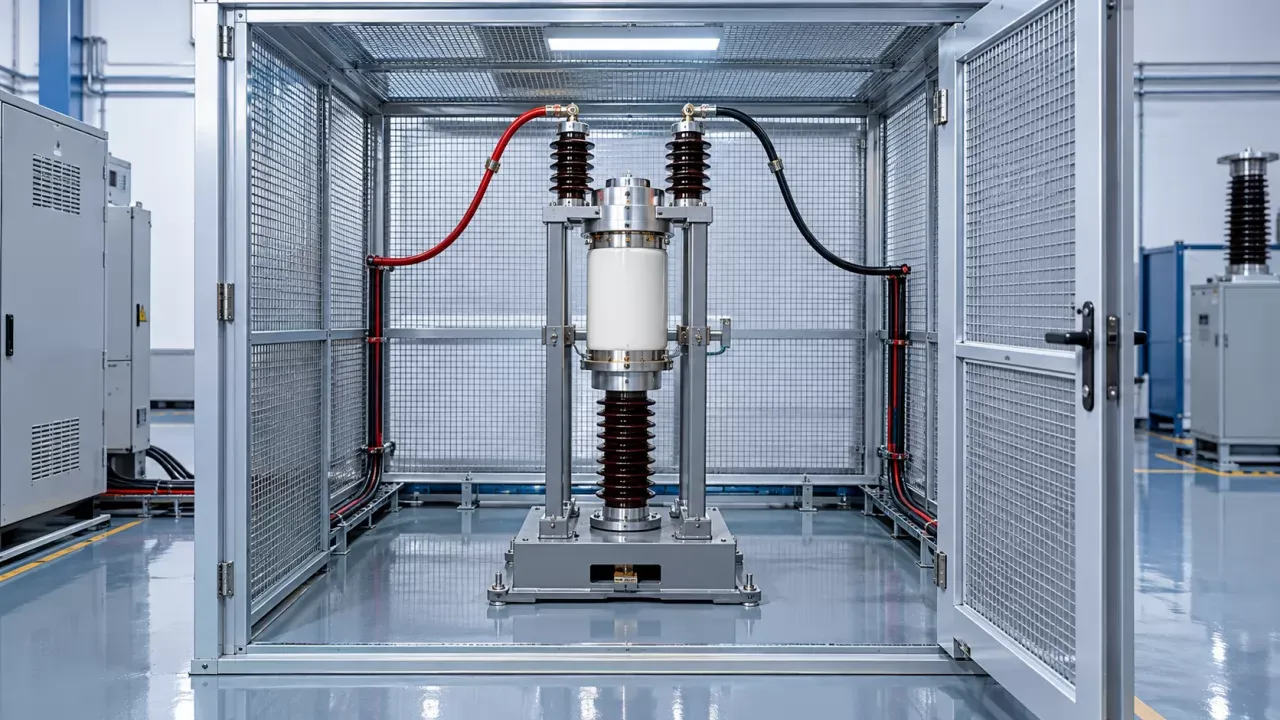
Measure dielectric margin and partial discharge. Run a power-frequency dielectric withstand test at the level the standard sets for the rated voltage, then measure PD against a limit below 5 pC. Caution: high-voltage tests must be done only by qualified personnel, with the unit isolated, discharged and properly grounded, and the test area cordoned off.
Confirm bellows life and batch consistency. Ask for a bellows mechanical life of at least 30,000 operations. The GB national standard requires 10,000. Then test several units from each batch and compare contact gap, withstand and PD results. Large spread within one batch points to loose process control.
Steps 4 and 5 do not damage the unit, but repeated withstand tests at full level put stress on the insulation. For incoming inspection, sample to your AQL plan and do not retest every unit at full voltage. Leave full-voltage testing of every unit to the manufacturer's routine tests, and audit their records.
Which Standards and Certificates Should a Vacuum Interrupter Carry?
A vacuum interrupter for medium-voltage switchgear should be tested against the IEC 62271 series. In China, the matching GB standards apply. The manufacturer should run an ISO 9001 quality management system. Every target market also has its own conformity rules, which you need to confirm separately.
IEC 62271-1: common specifications for high-voltage switchgear and controlgear. It covers ratings, dielectric tests and temperature rise.
IEC 62271-100: the standard for high-voltage alternating-current circuit breakers. It covers short-circuit making and breaking tests for the VCB the interrupter goes into.
GB/T 11022 and GB/T 1984: the Chinese national standards that correspond to the common specifications and AC circuit breaker requirements.
IEC 60270: the method for measuring partial discharge. Ask which method was used when a supplier quotes a PD figure.
IEC 60060-1: general definitions and test requirements for high-voltage test techniques.
ISO 9001: quality management system certification. Ask for the certificate number and scope, and check them with the issuing body.
A type test report proves the design. It does not prove that every production unit matches the design. That is why routine test records and serial traceability matter as much as the certificate.

Import requirements differ by country. Russia and other Eurasian Economic Union markets, for example, have their own conformity assessment rules. Confirm the documents your market needs with your importer or an accredited certification body before you sign the contract.
Common Sourcing Mistakes That Let Substandard Interrupters Through
Substandard vacuum interrupters usually get through because of paperwork shortcuts, not hidden defects. The costly mistakes are trusting one sample report, accepting matching dimensions as proof of equivalence, skipping helium leak evidence and taking units without serial numbers. All four can be caught before shipment.
Trusting a single sample type test. Many lower-tier suppliers type-test one sample and then sample production loosely. The report describes a unit you will never receive. Instead, ask for annual re-test evidence and routine test records linked to your serials.
Treating identical dimensions as equivalence. A lookalike can match the mounting dimensions of a Baoguang, Xuguang, Pinggao, Eaton, Meidensha or Schneider part while using different contact alloy and bellows inside. Instead, compare internal specs line by line: alloy grade, leak rate, bellows life and PD.
Skipping helium leak evidence. Vacuum loss takes years to show up, so a unit that passes at arrival can still fail in year five. Instead, require a helium leak result for each serial, below 10⁻¹¹ Pa·m³/s.
Accepting units with no serial numbers. Without traceability you cannot tell a bad batch from a site problem, and you cannot establish liability after a failure. Instead, reject unmarked units at incoming inspection.
If you resell to end users, these gaps come back to you as warranty claims and disputes with your customers. The price difference with a white-label unit rarely covers one failure in the field.
Vacuum Interrupter Quality Inspection Checklist for Incoming Shipments
A vacuum interrupter quality inspection checklist turns the buying specs into checks your QC team can run when a shipment arrives. Attach the checklist to the PO and the AQL plan so the supplier knows the acceptance criteria before production starts.
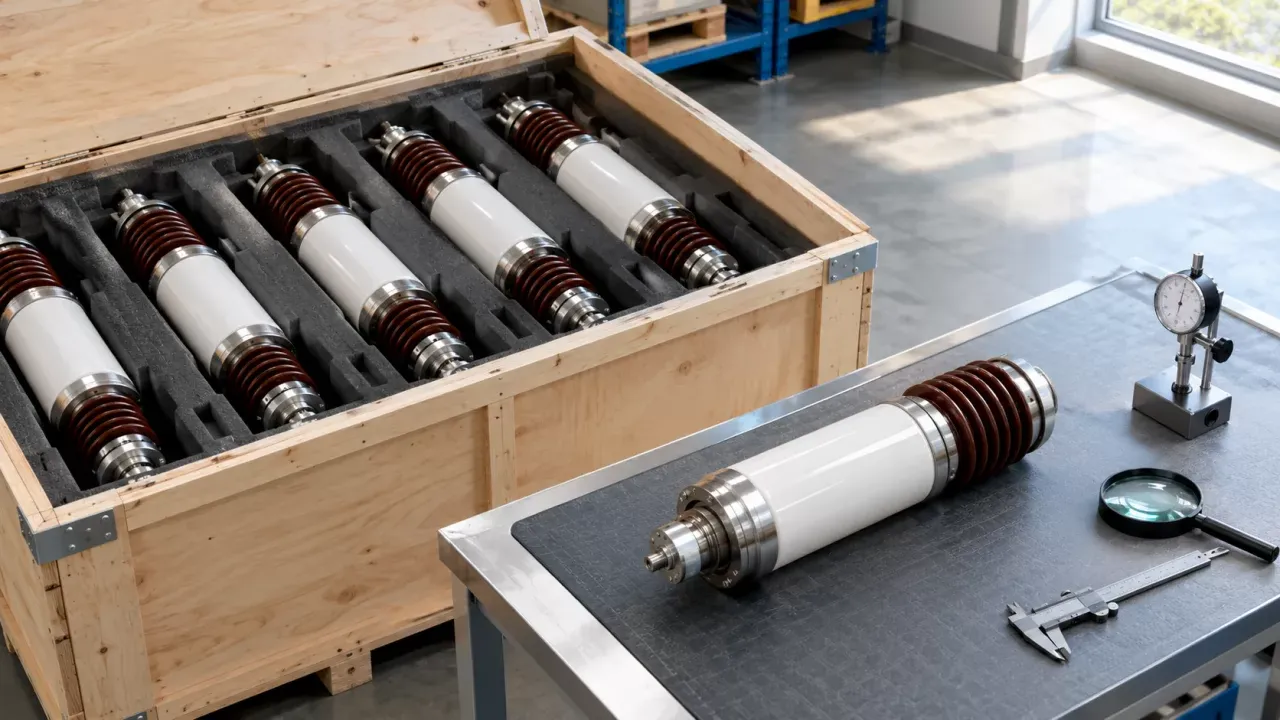
Match the packing list serials to the serials on the units and to the routine test records.
Confirm the type test report covers this model and has a current re-test date.
Check that the material declaration states CuCr25 or CuCr50 contacts.
Review the helium leak results for each serial against below 10⁻¹¹ Pa·m³/s.
Inspect the ceramic for chips, cracks or contamination, and the brazed seals for discoloration or gaps.
Measure the contact gap and record the erosion reference mark or baseline stroke for later comparison.
Run a vacuum integrity check on the AQL sample.
Record power-frequency withstand results and PD against a limit below 5 pC.
Compare results across the sample for spread within the batch.
Verify the packaging protects the ceramic and the moving stem from shock during transit.
Why Do Interrupters Fail in Service, and How Do You Trace the Cause?
Most vacuum interrupter failures in service trace back to three causes: slow vacuum loss, fatigue cracks in the bellows and contact erosion. To separate a defective batch from misuse, combine contact erosion measurement, periodic vacuum checks and serial-number records. Failures in only one site point to operating conditions. Failures across several sites point to the batch.
During medium voltage switchgear maintenance, measure contact wear against the baseline recorded at commissioning. Most manufacturers state an allowed erosion limit on the datasheet. Run a vacuum check at the interval the breaker manufacturer recommends. Log the operation count and the short-circuit faults cleared for each serial.
Then use the pattern to find the cause:
Vacuum loss with few operations: points to the seal or brazing process, so the cause sits with the manufacturer.
Vacuum loss after heavy switching: look for bellows fatigue and compare the operation count with the rated mechanical life.
Fast erosion after one or two faults: suggests an off-grade contact alloy.
Flashover in humid, high-altitude or overvoltage-prone sites: exposes weak shield and ceramic design, but also check whether surge protection and the altitude correction were specified correctly.
FAQ
How long should a qualified vacuum interrupter hold its vacuum?
More than 20 years. Tier-one units are designed to hold vacuum for over 20 years, with factory vacuum better than 10⁻⁵ Pa. Units with poor sealing can degrade noticeably within 3–8 years.
Can a field test confirm vacuum integrity without opening the breaker?
Yes, as an indication. A high-voltage withstand test across the open contacts, or a magnetron-type vacuum test, can show whether vacuum has been lost. Neither test measures the leak rate, which only the factory helium test confirms.
Is a sample type test report enough for bulk orders?
No. A sample report proves only the design. For bulk orders, ask for annual re-test evidence and routine test records for every serial number.
What PD level should you specify?
Below 5 pC. Tier-one manufacturers work to this benchmark. State the measurement method, such as IEC 60270, and the test voltage in your specification so the results can be compared across suppliers.
Next Step: Build These Checks into Your RFQ
Send your next RFQ with these specs listed: contact alloy grade, leak rate, factory vacuum, bellows life, PD limit, type test re-test dates and serial traceability. Ask each supplier to answer every line in writing, and compare their answers before you compare prices.