Three things go wrong when you choose the wrong breaker type. The breaker arrives and does not fit the cabinet you ordered. The tender is rejected because the owner's spec calls for draw-out units. Or a feeder stays dead for hours while a crew unbolts busbars to swap a failed fixed unit. Settling the movable vs fixed vacuum circuit breaker question early avoids all three.
Movable or Fixed VCB: Which One Should You Order?
The cabinet type usually decides which breaker you order. KYN28 mid-mounted switchgear takes a movable (draw-out) vacuum circuit breaker. HXGN and XGN fixed cabinets and ring main units take a fixed vacuum circuit breaker. After that, check the owner's spec and how critical the load is. Those two factors can push the choice toward draw-out, but they never override what the cabinet physically accepts.
A vacuum circuit breaker (VCB) is a medium voltage switching device. It interrupts current inside a sealed vacuum interrupter, so the arc goes out without oil or SF6 gas. Indoor VCBs come in two mechanical layouts, and those layouts drive almost every later decision: price, outage time, maintenance routine and whether the bid gets past technical evaluation.
Most RFQs that go wrong get the order of questions backwards. The buyer starts with ratings, current and breaking capacity, and only later finds out the end user's panel builder has already fixed the cabinet line. Ratings matter. They come second.
Here is the order that works in practice:
Cabinet first: KYN28 or KYN61 means draw-out. XGN, HXGN, a box substation or an RMU means fixed.
Spec second: if the owner or utility tender requires withdrawable breakers, the cabinet has to be a mid-mounted type. That decision sits with the panel design, not the breaker.
Load and budget third: where the cabinet could go either way at the design stage, critical loads justify draw-out and ordinary feeders usually don't.
For an importer or distributor stocking both types, this order also helps with inventory. Draw-out trucks follow the KYN28 project pipeline. Fixed units follow RMU and box substation volume, which tends to be steadier and more price-driven.
What Is the Real Difference Between a Withdrawable and a Fixed Type Vacuum Circuit Breaker?
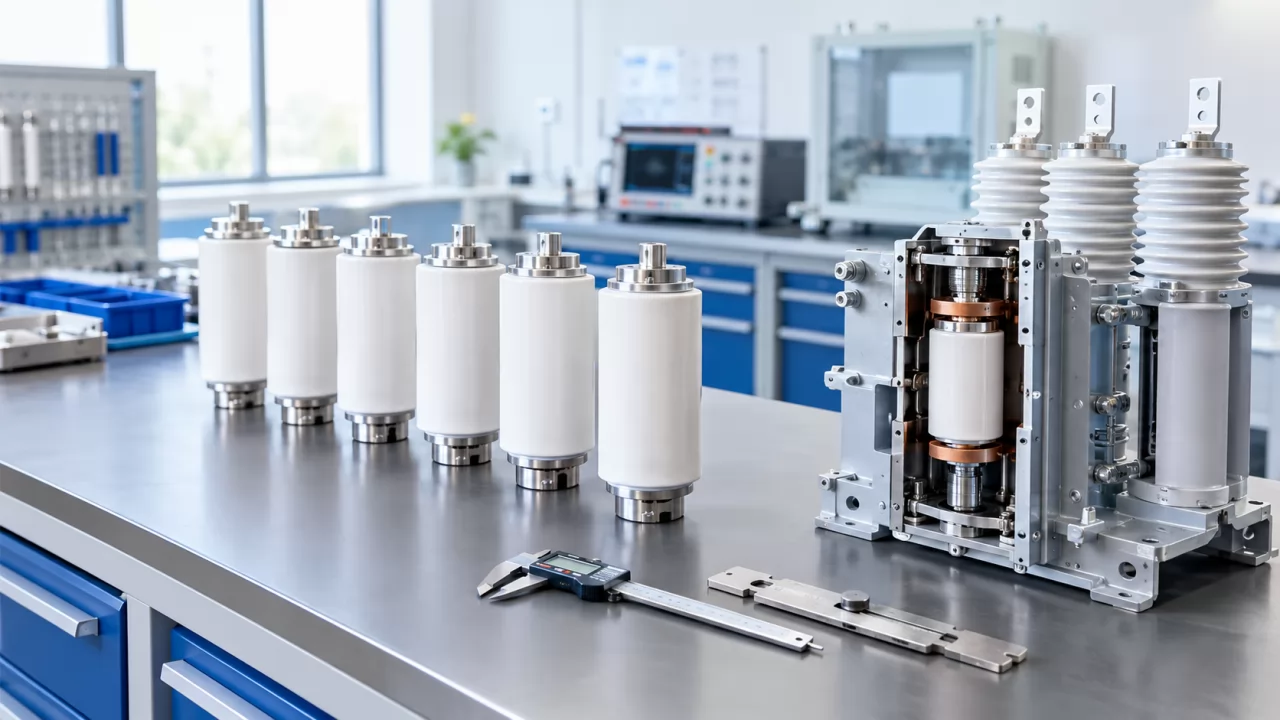
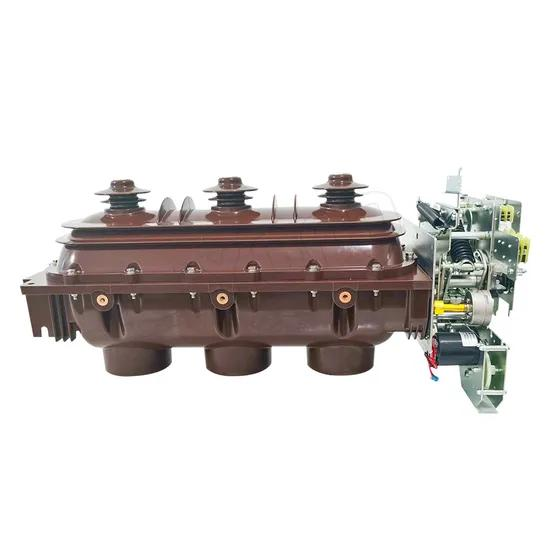
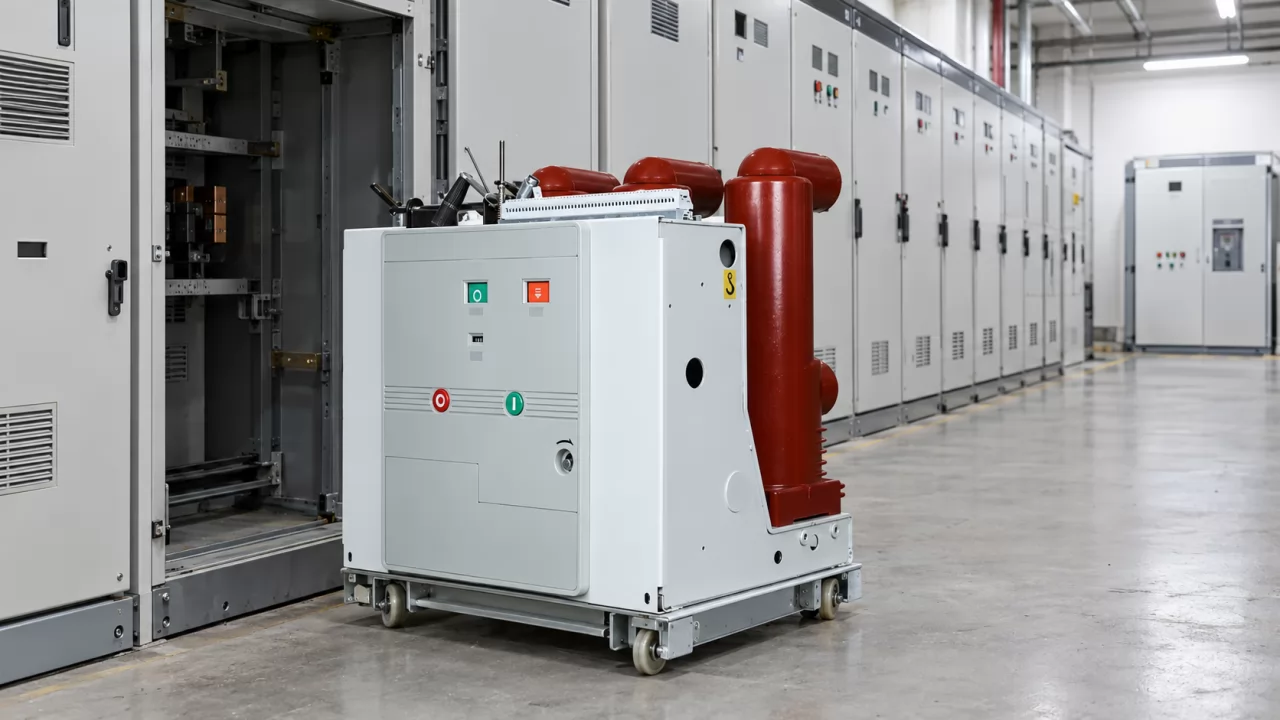
A withdrawable vacuum circuit breaker sits on a truck chassis that racks in and out of the cabinet. A fixed type vacuum circuit breaker is bolted straight into the cabinet and wired in permanently. In the trade, "movable" means the handcart or draw-out type. The mounting method sets how isolation, replacement and testing are done.
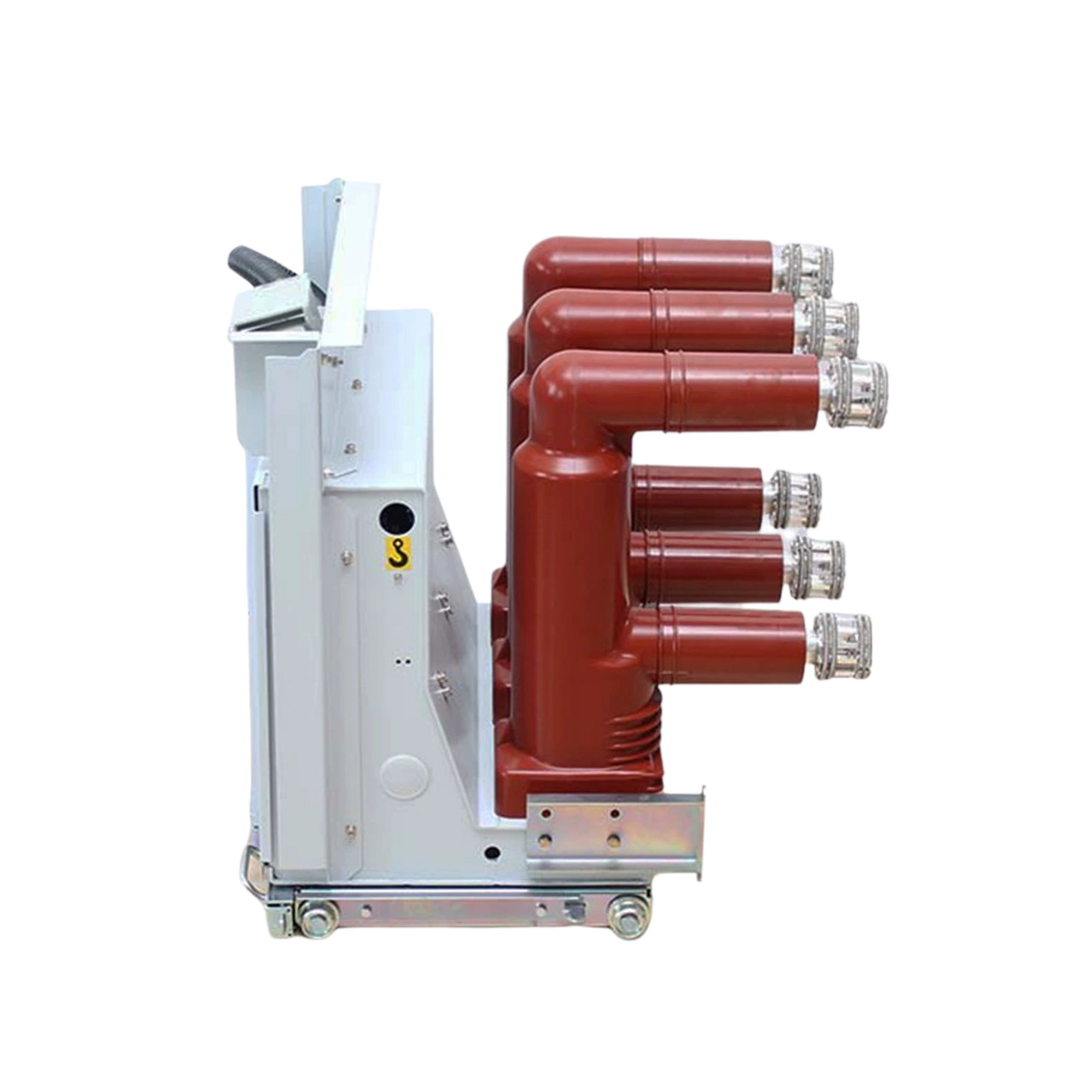
The interrupter and the spring operating mechanism are often similar between the two types from the same series. A spring operating mechanism is a stored-energy drive. It charges a spring, by motor or by hand, and releases it to close or open the contacts quickly. The real difference is everything around the breaker: how it connects to the primary circuit, how the secondary wiring reaches it, and how you get it out.
Draw-Out Truck: Test Position and Service Position
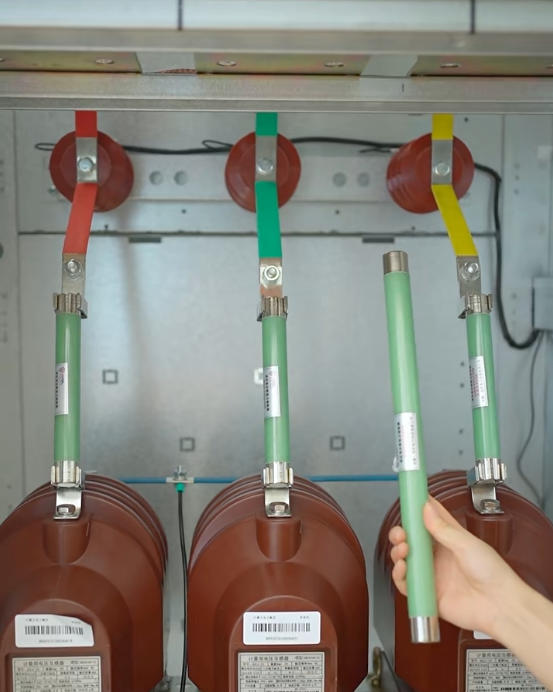
A draw-out truck has two defined positions. In the service position the breaker is racked fully in and connected to the busbar through its contact arms and tulip contacts. In the test position it is racked out far enough to separate from the primary circuit while the secondary circuits stay connected.
Racking out to the test position gives you a visible isolation point with no extra disconnector. In the test position the crew can operate the breaker, check the mechanism and confirm protection trips without energising the primary side. Secondary connections go through an aviation plug, a multi-pin connector that plugs in and out, so nobody touches the control wiring when the truck comes out.
Bolted Installation: Primary Busbar and Secondary Wiring Connected Directly
A fixed breaker connects directly to the copper busbar on the primary side and to the control wiring on the secondary side. There is no truck, no tulip contact interface and no racking mechanism.
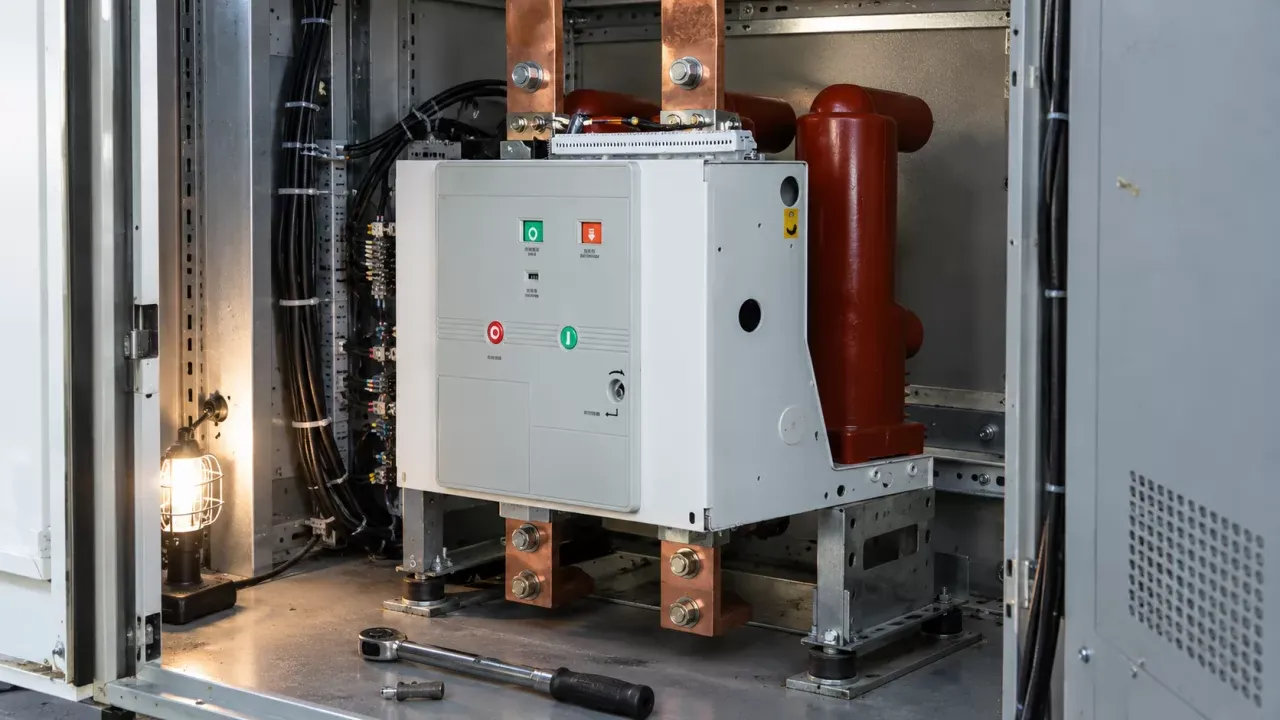
That simplicity costs you two things. A fixed breaker has no test position, and it has no isolation point of its own. To isolate it, the upstream supply has to be switched off and a separate disconnector opened, which is why fixed cabinets are designed with a disconnector in the circuit.
Movable vs Fixed Vacuum Circuit Breaker: Side-by-Side Comparison
Draw-out and fixed indoor VCBs differ on five practical points: which cabinet they fit, where the isolation point comes from, how long an outage lasts, what they cost and how much maintenance they need. The draw-out type wins on uptime and safety during service. The fixed type wins on price and simple daily upkeep.
| COMPARISON POINT | WITHDRAWABLE (DRAW-OUT) | FIXED TYPE |
|---|---|---|
| Matching cabinet | KYN28 mid-mounted cabinet | XGN/HXGN fixed cabinet, ring main unit |
| Isolation point for maintenance | Built in (rack out to test position) | Needs a separate disconnector |
| Outage duration on replacement | Short, a spare truck can be swapped in | Long, busbars and wiring must be removed |
| Cost | Higher | Lower |
| Maintenance workload | Fast replacement, but contacts need regular maintenance | Replacement is laborious, daily upkeep is simple |
In short, the extra cost of a draw-out breaker buys you a short outage and an isolation point you can see, and the fixed type saves money by putting the burden on whoever has to replace it.
Two rows need a closer look when you compare bids.
The cost row is not just the breaker price. A draw-out solution often comes with at least one spare truck per breaker rating on site, plus racking handles and a service trolley. A fixed solution is cheaper per unit, but the cabinet needs a disconnector, which is part of the panel cost and not the breaker's.
The maintenance row cuts both ways. Draw-out units are quick to swap, but they add a maintenance item: the tulip contacts and contact arms carry full load current through a sliding interface. Fixed units skip that item completely. The pain only shows up when something actually fails.
If the decision is still open after this table, the load and the spec will settle it. The physics of the two designs won't.
Indoor Vacuum Circuit Breaker Withdrawable Type: Strengths and Weak Points
The indoor vacuum circuit breaker withdrawable type gives you safer maintenance and shorter outages, because the truck has its own isolation point and spares can be swapped in quickly. The cost is a 15% to 30% higher price and more mechanical parts that can fail, and it only fits mid-mounted cabinets such as KYN28 and KYN61.
| ADVANTAGES | LIMITATIONS |
|---|---|
| Visible isolation point built in by racking to the test position | Costs 15% to 30% more than the fixed type |
| A spare truck can replace a faulty breaker quickly | Chassis truck, tulip contacts, contact arms and interlocks add failure points |
| Secondary circuits connect through an aviation plug, so no wiring is removed | Only fits mid-mounted cabinets such as KYN28 and KYN61 |
| Most common choice for O&M, retrofits and export projects | Tulip contacts need regular maintenance to prevent overheating |
Where the Draw-Out Design Earns Its Place
The draw-out truck is at its strongest on sites where an outage has a direct cost attached. At a plant main incomer, an hour of downtime stops the whole production line. With a spare truck on site, the repair turns into a swap. The faulty truck goes to the workshop, and the diagnosis happens there while the bus is back on load.
Export projects are the other strong area. Overseas owners tend to prefer withdrawable units, and many owner specs ask for them outright. For a distributor serving those markets, a draw-out range in stock is often what gets you onto the bidder list at all.
Where It Adds Cost and Risk
Every extra moving part is something to inspect. The chassis truck, the tulip contacts, the contact arms and the mechanical interlock are all extra failure points that a fixed unit simply doesn't have. A mechanical interlock is a set of rods, cams and locks. It stops unsafe operations, such as racking the truck while the breaker is closed or opening the cable compartment door while the earthing switch is open.
The tulip contact interface needs the most attention. If it is poorly aligned, worn or not tight enough, contact resistance goes up and that point runs hot under load. On incoming inspection, ask for the supplier's contact resistance test record and check the racking travel before you sign off.
Fixed Type Vacuum Circuit Breaker: Strengths and Weak Points
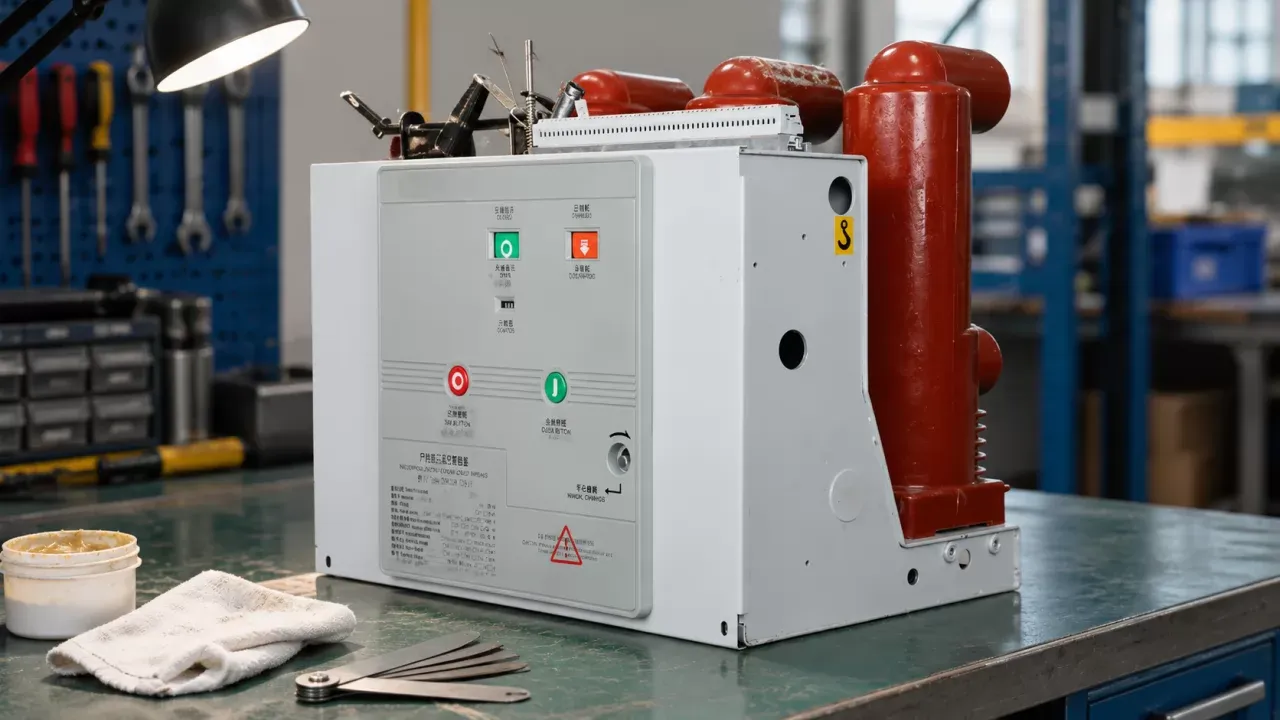
The fixed type vacuum circuit breaker is simpler, cheaper and more compact than the draw-out type. It has fewer parts, which means a lower failure rate and one less hot spot. The trade-off is maintenance: isolating or replacing a fixed breaker takes an upstream outage, an open disconnector and the removal of busbars and wiring.
Where the Fixed Design Wins
Fewer parts: there is no chassis truck, racking gear or truck interlock, so there are fewer parts to fail and fewer spares to stock.
Compact body: the smaller footprint suits XGN and HXGN fixed cabinets, box substations and ring main units, where panel width and depth are tight.
One less hot spot: with no tulip contacts there is no sliding high-current interface to overheat, so the primary connection is a bolted joint.
Lower price: on large-volume distribution projects such as residential networks and box substation rollouts, the per-unit saving adds up fast.
A ring main unit (RMU) is a compact, enclosed medium voltage switchgear unit used in loop-fed distribution networks. It usually combines load break switches with a circuit breaker or fuse-switch for the transformer feeder. RMUs are built around a fixed breaker, so the "which type" question doesn't come up there.
Where It Slows You Down
No built-in isolation: you need an upstream outage and an open disconnector before there is a safe isolation point.
Disruptive replacement: swapping the breaker means taking off the primary copper bars and disconnecting the secondary wiring, then putting everything back and re-torquing it.
No test position: mechanism and protection checks are done with the circuit de-energised and isolated, never on a racked-out truck.
None of this makes the fixed type a poor product. It makes it the right product for feeders where a longer, planned outage is acceptable.
How Long Does Maintenance Downtime Last With Each Type?
Maintenance downtime is short with a withdrawable breaker, because a spare truck replaces the faulty unit and the feeder goes back into service. With a fixed breaker it is long, because primary busbars and secondary wiring have to be taken apart and put back. Exact hours depend on site procedures, crew experience and permit-to-work rules.
Look at what each type demands on the day a breaker fails.
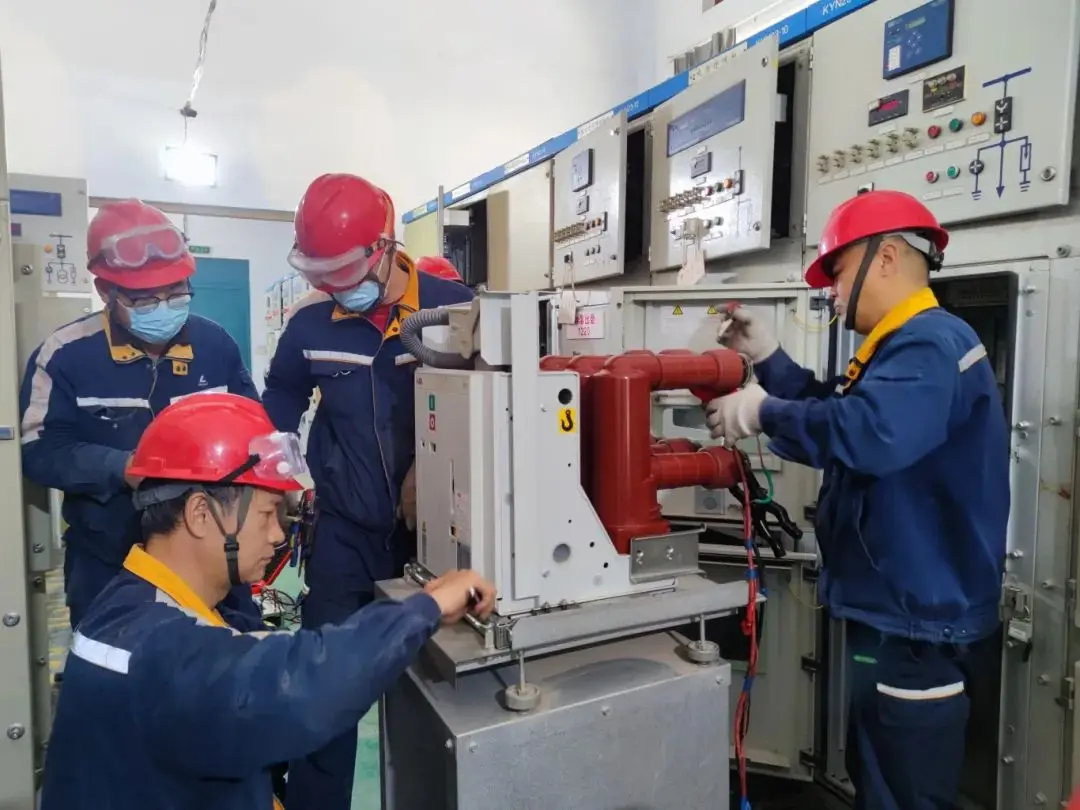
With a draw-out truck, the sequence is short. Open the breaker, rack it to the test position, unplug the aviation connector, withdraw the truck, put in the spare, plug in, rack in and close. Interlocks enforce the order. The work is procedural and can be trained, and most of it happens in front of a closed cabinet.
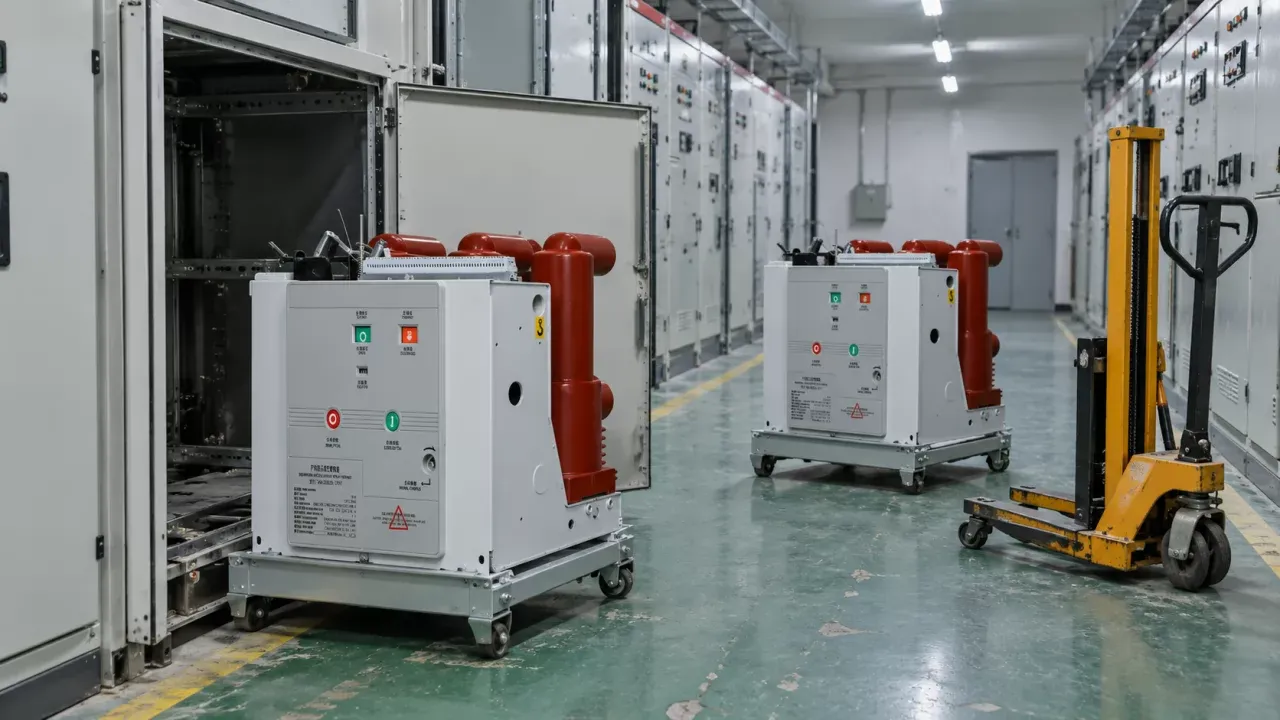
With a fixed breaker, the sequence is longer and has more steps:
Arrange an upstream outage, which may affect other feeders on the same section.
Open the disconnector and apply earthing to create the isolation point.
Remove the primary copper bar connections and label the secondary wiring.
Unbolt the breaker, fit the replacement and remake the bolted joints to the correct torque.
Reconnect and check the secondary circuits before re-energising.
The difference also shows up in who you need on site. Draw-out switchgear needs operators who understand interlocks and racking discipline, and someone who maintains the tulip contacts on a schedule. Fixed switchgear needs a crew who can safely do busbar work, torque joints and re-terminate control wiring, which is skilled work that some remote sites don't have locally.
Ask the end user which of those two crews they actually have. The answer often settles the question before price does.
How Much More Does a Withdrawable VCB Cost, and Is It Worth It?
A withdrawable VCB typically costs 15% to 30% more than a comparable fixed type. That extra cost pays off where outages are expensive or the owner's spec requires draw-out units. Where neither applies, the fixed type's lower price and simple day-to-day upkeep usually give the lower total cost.
Count total cost of ownership in four places, not one:
Purchase price: the breaker itself, where the 15% to 30% gap applies.
Spares: draw-out sites usually keep spare trucks, which is a capital cost the fixed type avoids. A fixed site may keep a spare breaker too, but it is cheaper and not always kept.
Planned maintenance: tulip contacts on draw-out units need regular maintenance, and the chassis truck and interlocks need periodic checks. Routine upkeep of a fixed unit is simpler.
Outage cost: this is the number that decides it. Ask the end user what an hour without that feeder costs them.
For a hospital, a data center or a plant main incomer, the outage line is large enough that the draw-out price gap looks small. For a residential distribution feeder, the outage line is small and the price gap is the biggest number on the sheet.
One more factor: on a tender where withdrawable units are mandatory, the price gap is not something you can choose to skip. It is the cost of qualifying. Comparing a fixed price against a draw-out requirement only produces a bid that gets disqualified.
Which Switchgear Accepts Which Breaker? Cabinet Compatibility Rules
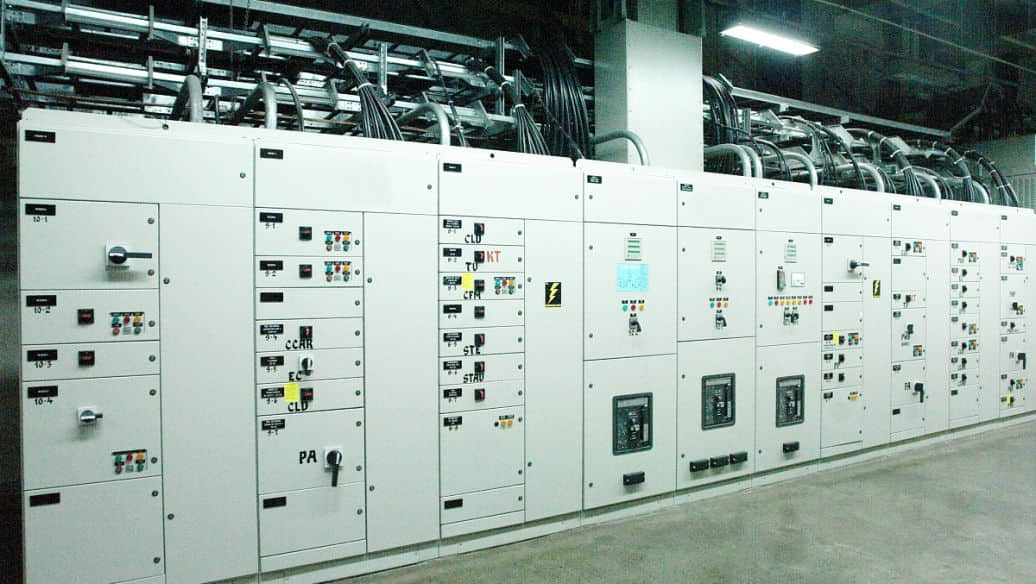
Switchgear compatibility is fixed by the cabinet design. Draw-out breakers fit KYN28 and KYN61 metal-clad mid-mounted switchgear. Fixed breakers fit XGN and HXGN cabinets, box substations and ring main units. A fixed cabinet cannot take a draw-out breaker, so confirm the cabinet before you compare prices.
Draw-out type: KYN28 / KYN61 metal-clad medium voltage switchgear
Fixed type: XGN / HXGN cabinets, box substations and ring main units
KYN28 metal-clad switchgear is a mid-mounted indoor switchgear line. The breaker truck sits in the middle compartment, with the busbar, cable and low-voltage compartments separated by metal partitions. The KYN28 family is usually built for the 12 kV class. Metal-enclosed switchgear of this kind is generally designed and type-tested to IEC 62271-200 or an equivalent national standard.
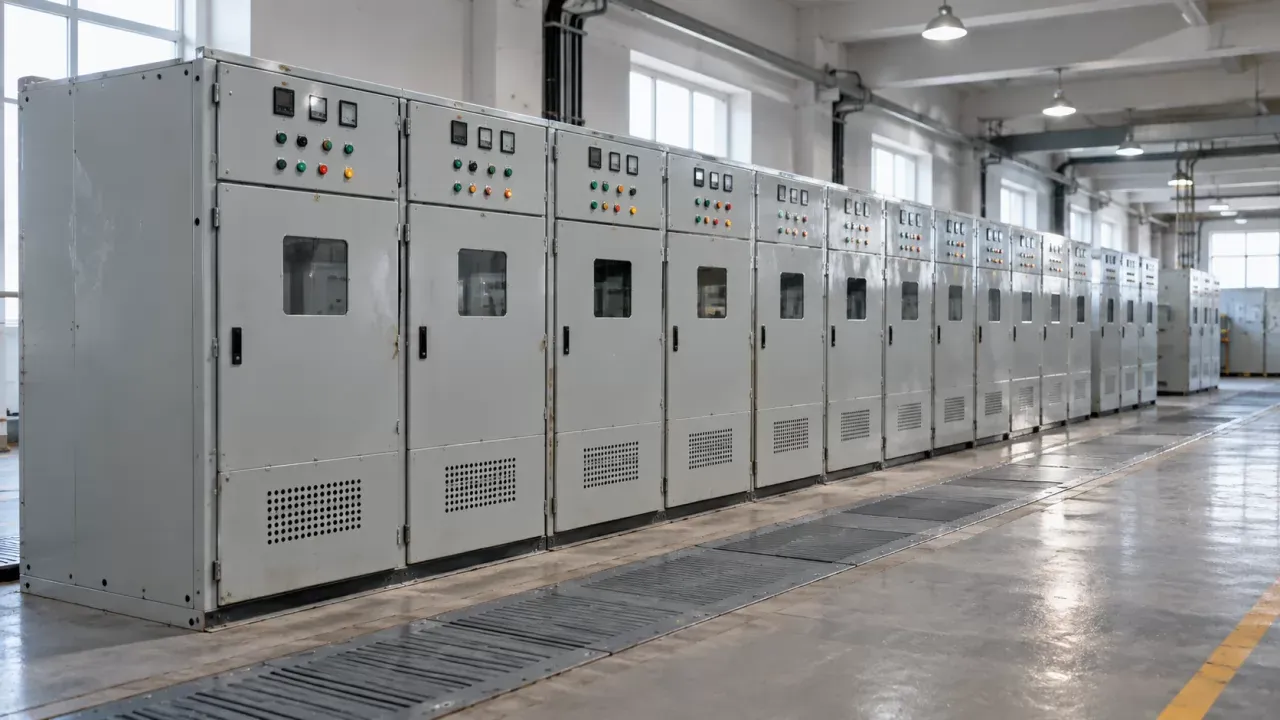
Compatibility goes beyond "draw-out fits KYN28". Within the same cabinet family, trucks vary by width, contact arm spacing, racking mechanism and interlock design between manufacturers. Before you order, confirm the following:
Truck dimensions and contact arm centres: they must match the cabinet's spout and shutter layout.
Interlock design: the breaker's interlock has to work with the cabinet's earthing switch, door and shutter interlocks.
Secondary plug pin-out: the aviation plug's pin assignment must match the cabinet's control wiring.
Ratings: rated voltage, rated current and short-circuit breaking current must match or exceed the panel's rated values.
For retrofits, ask for the existing cabinet's drawings or a photo of the nameplate and the truck compartment. Matching a replacement truck to an installed panel causes more trouble than any new-build order.
Which Is Better, Withdrawable or Fixed VCB for Switchgear in Your Project?
Which is better, withdrawable or fixed VCB for switchgear, depends on how critical the load is and what the owner's specification says. Critical loads and spec-driven projects such as utility tenders go draw-out. Ordinary distribution feeders, budget-limited projects and anything already designed around fixed cabinets go fixed. Neither type is better in general.
Substations, Main Incomers and Critical Loads
Substations and plant main incomers. Utility operators and plant engineering teams need incomer and bus-section breakers that can be isolated and replaced without a long shutdown. Look for KYN28-type draw-out trucks with spare trucks of matching rating, clear interlock documentation and a contact resistance record for each truck.
Data centers and hospitals. Facility owners and their EPC contractors need medium voltage feeders that come back fast after a fault, because each minute on standby generation is a risk. Look for spare-truck availability, compatibility between all trucks of the same rating, and a maintenance procedure the facility team can follow.
Utility tenders such as Saudi Electricity Company (SEC) projects. Contractors bidding on SEC and similar utility tenders need equipment that meets the utility's own technical specification, which often asks for withdrawable breakers. Look for documents that answer each clause of the spec, along with type test reports and the exact ratings in the tender schedule. Generic catalogue data won't get through evaluation.
Sites with frequent maintenance or an owner spec requiring withdrawable units. Industrial sites that switch large motors often, or owners whose engineering standard requires draw-out units, should go draw-out regardless of the price gap.
General Distribution Feeders, Box Substations and Residential Networks
Box substations and residential networks. Distribution utilities and developers rolling out many identical units need compact, low-cost breakers for loads where a planned outage is acceptable. Look for a fixed-type VCB sized for the XGN/HXGN cabinet or RMU, consistent dimensions across batches and stable lead times for repeat orders.
Budget-limited projects and fixed-cabinet designs. Where the cabinet is already a fixed type, the decision is made. Put the effort into ratings, mechanism endurance and QC on bolted joint surfaces.
Distributors working with Weisho Electric on mixed project lists tend to split their RFQs along these lines: one line for draw-out trucks tied to KYN28 incomers, one for fixed units going into RMUs and box substations. That way each quote comes back priced on the right basis.
Indoor VCB Selection Guide: Six Checks Before You Send the RFQ
This indoor VCB selection guide comes down to six checks: cabinet type, the owner's withdrawability requirement, how critical the load is, budget, the site's maintenance capability and the electrical ratings. Running all six before the RFQ goes out means the quoted breaker matches the panel and the spec on the first round, with no re-quoting.
Cabinet type: KYN28/KYN61 means draw-out, and XGN/HXGN/RMU means fixed. This check removes half the options straight away, so do it first.
Owner or tender spec on withdrawability: read the switchgear clause, not just the breaker datasheet requirements. A mandatory withdrawable requirement overrides any cost argument.
How critical the load is: incomers, bus sections and feeders to critical loads justify draw-out. Ordinary outgoing feeders rarely do.
Budget and the 15% to 30% price gap: include spare trucks in the draw-out figure and the disconnector in the fixed-cabinet figure, so you compare like with like.
The site's maintenance capability: a crew without busbar experience will struggle with fixed-unit replacements. A crew that skips contact maintenance will run into trouble with draw-out trucks.
Electrical ratings: confirm rated voltage, rated current, rated short-circuit breaking current, the type and control voltage of the spring operating mechanism, and compliance with IEC 62271-100 or the target market's equivalent standard.
Rated short-circuit breaking current is the highest symmetrical fault current the breaker is rated to interrupt at its rated voltage. It has to meet or exceed the prospective fault level at the point of installation. IEC 62271-100 is the international standard for alternating-current circuit breakers above 1 kV. It sets the ratings, the type tests and the routine tests a VCB is assessed against.
When you send these six points to a supplier such as Weisho Electric, include the single-line diagram. It shows the fault level, the incomer and feeder arrangement and the protection scheme on one page, and it clears up questions that would otherwise take three rounds of email.
Rule of thumb: let the cabinet decide the breaker type, let the spec confirm it, and only argue about price once those two agree.
FAQ
Can a draw-out VCB be installed in an XGN or HXGN fixed cabinet?
No. A draw-out VCB only fits mid-mounted cabinets such as KYN28 and KYN61, which have the truck compartment, guide rails and contact spouts it needs. XGN and HXGN fixed cabinets are built for a bolted breaker connected directly to the busbar.
Is a fixed type VCB less reliable than a withdrawable one?
No. A fixed type VCB has fewer parts and a lower failure rate, and it has no tulip contact interface to overheat. Its weak point is how slow and disruptive maintenance and replacement are, not how reliable it is in service.
Why do overseas owners often specify withdrawable breakers?
Overseas owners usually want a visible isolation point, quick replacement with a spare truck and short outages. Many utility and industrial engineering standards build those preferences in as a requirement for withdrawable switchgear on incomers and critical feeders.
What maintenance does a draw-out truck need that a fixed unit doesn't?
A draw-out truck needs regular maintenance of its tulip contacts, plus periodic checks of the chassis truck, racking mechanism and mechanical interlocks. A fixed unit has none of these parts, so its routine maintenance is simpler.
Do ring main units use fixed or withdrawable breakers?
Ring main units use fixed breakers. The RMU's compact enclosure is designed around a fixed unit, and there's no room or structure in it for a racking truck.
Key Takeaways
The cabinet type is the first and firmest filter when choosing between a movable and a fixed indoor VCB. KYN28 points to draw-out, and XGN, HXGN and ring main units point to fixed. After that, the owner's spec, how critical the load is and the budget only fine-tune a choice the cabinet has already narrowed.
KYN28 / KYN61: draw-out truck
XGN / HXGN / RMU / box substation: fixed breaker
Next, check the withdrawability clause in the owner's spec before you price anything.
Request a Quote Matched to Your Cabinet
A quote can only match your cabinet if the RFQ describes it. With your RFQ, send the cabinet type, the single-line diagram, the owner's spec and the required ratings. The breaker type and configuration can then be confirmed on the first round.
Send those four items with your project quantity and target market, and ask for a matching spec sheet.