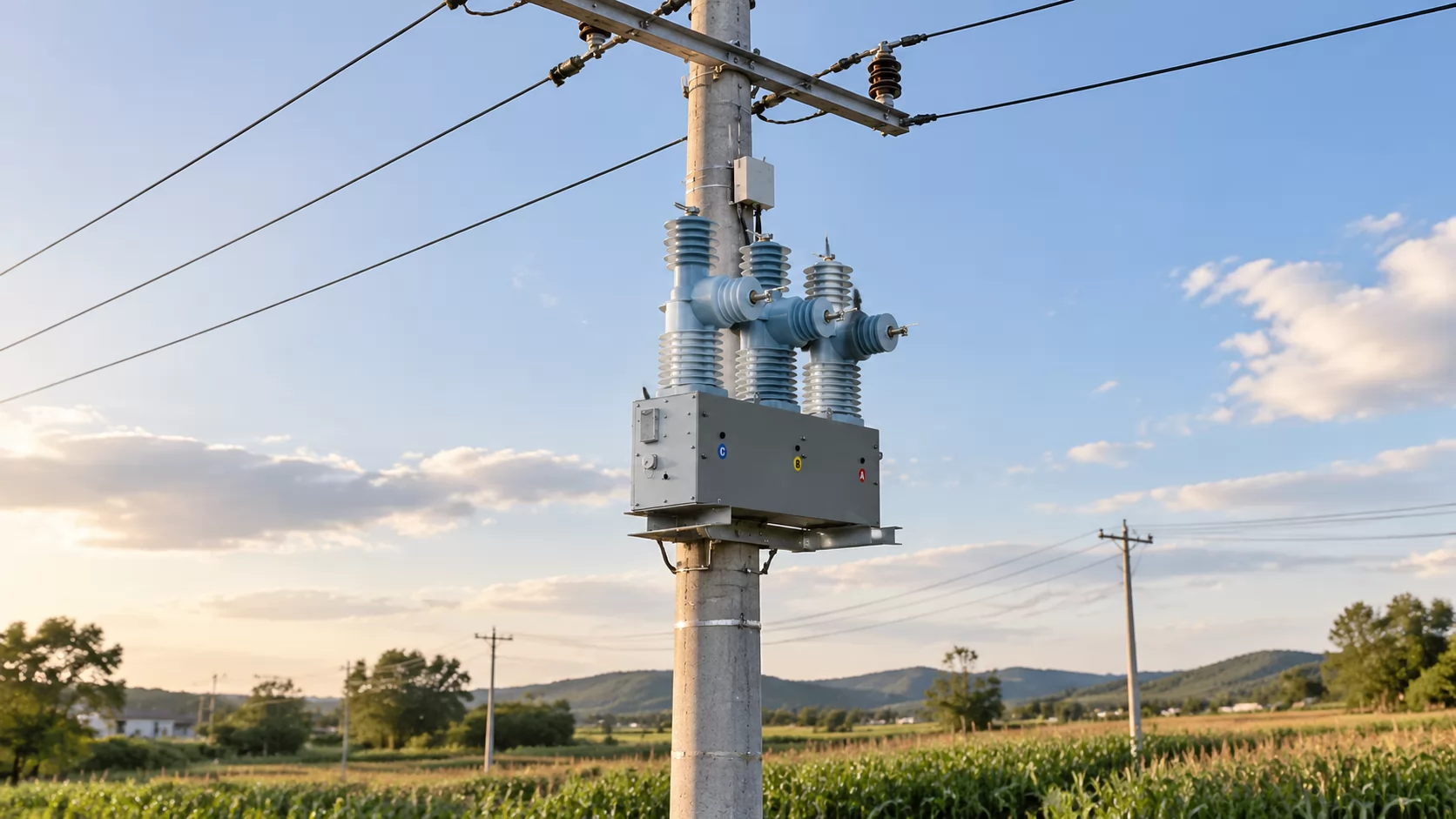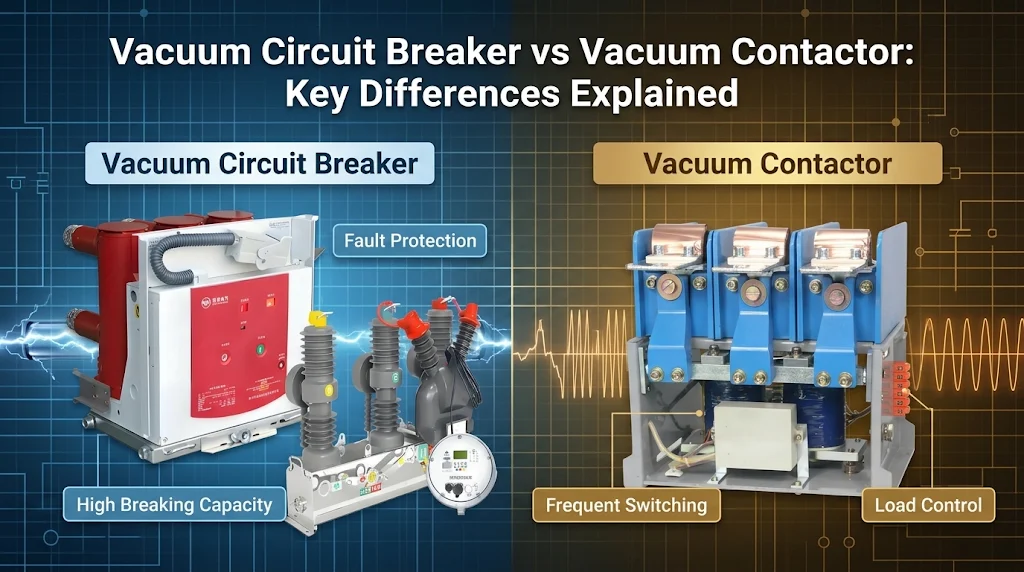
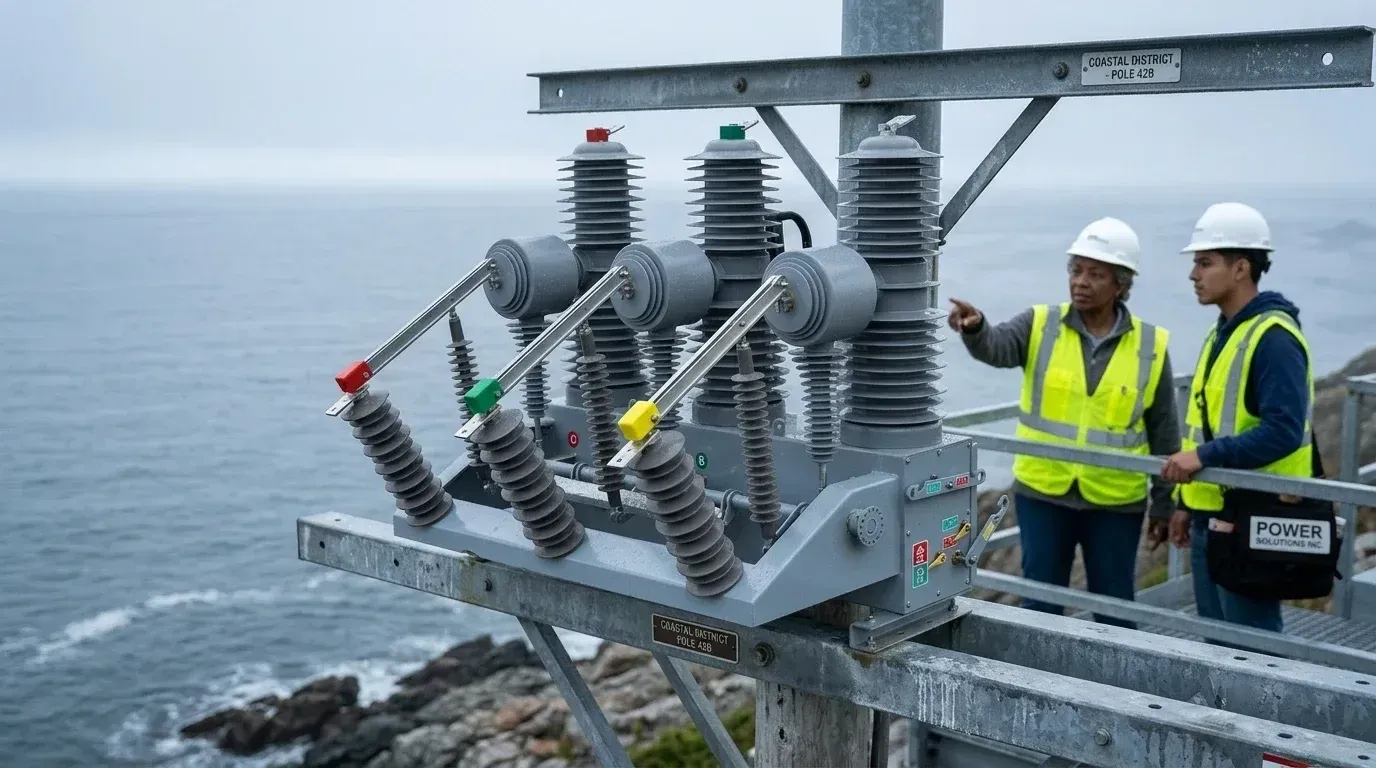
This guide is for engineers specifying an outdoor medium voltage vacuum circuit breaker in the 12 kV / 17.5 kV class for coastal, island, port or high-rainfall sites. The core point is simple: the sealed interrupter rarely fails, while the surrounding insulation, housing and secondary circuits often do.
An outdoor medium voltage vacuum circuit breaker for a humid or salt-laden site should be specified by exposure tier, not by model name. Match housing material, bushing insulation, heater control, ingress protection and salt spray test duration to the site's distance from the sea and its rainfall, then maintain it on a fixed inspection cycle.
Why Do Outdoor Medium Voltage Vacuum Circuit Breaker Units Fail in Coastal and Humid Sites?
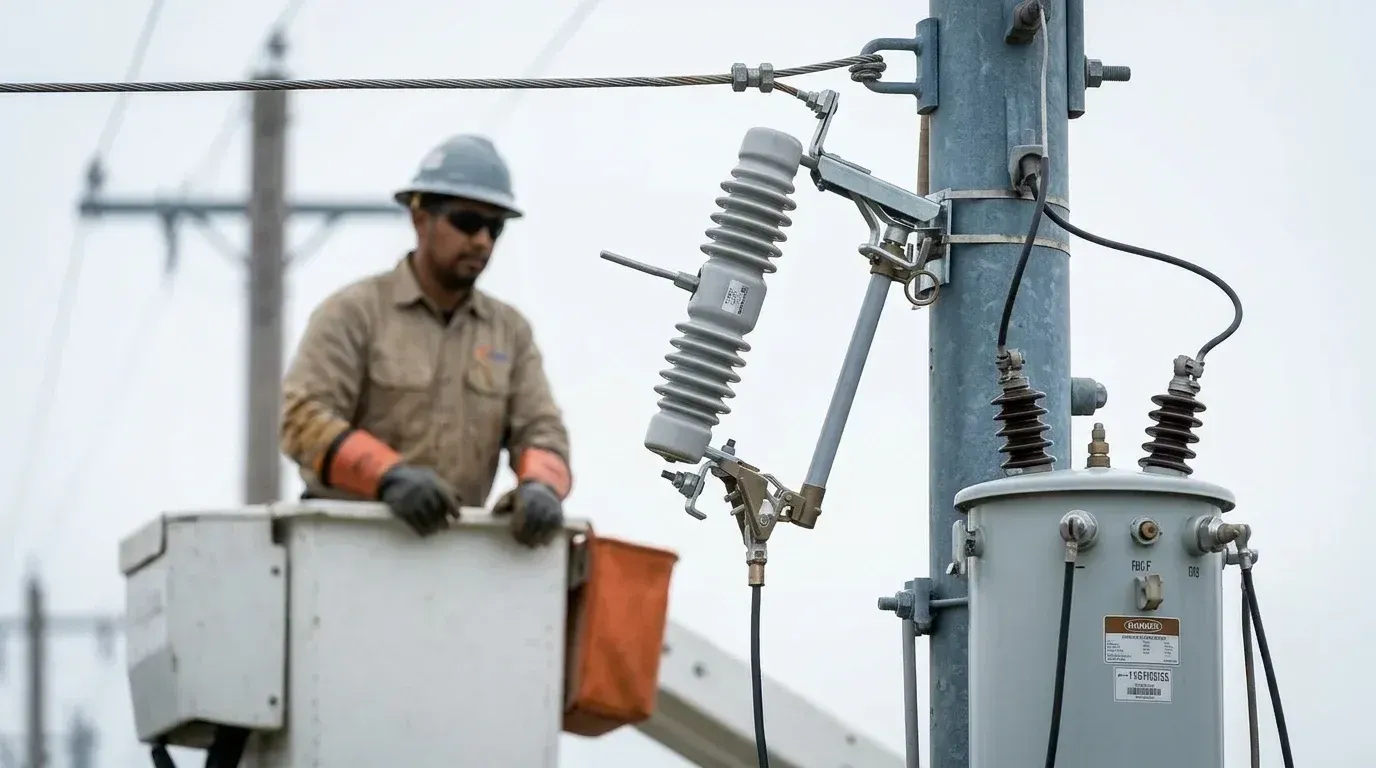
Consider a pole-mounted vacuum circuit breaker for coastal areas, installed on a harbour feeder. It looks sealed, it passed factory tests, and two winters later it refuses to open on command. The interrupter was fine. The vacuum bottle is sealed and moisture cannot reach the contacts, so failures originate outside it. Four mechanisms account for most of them.
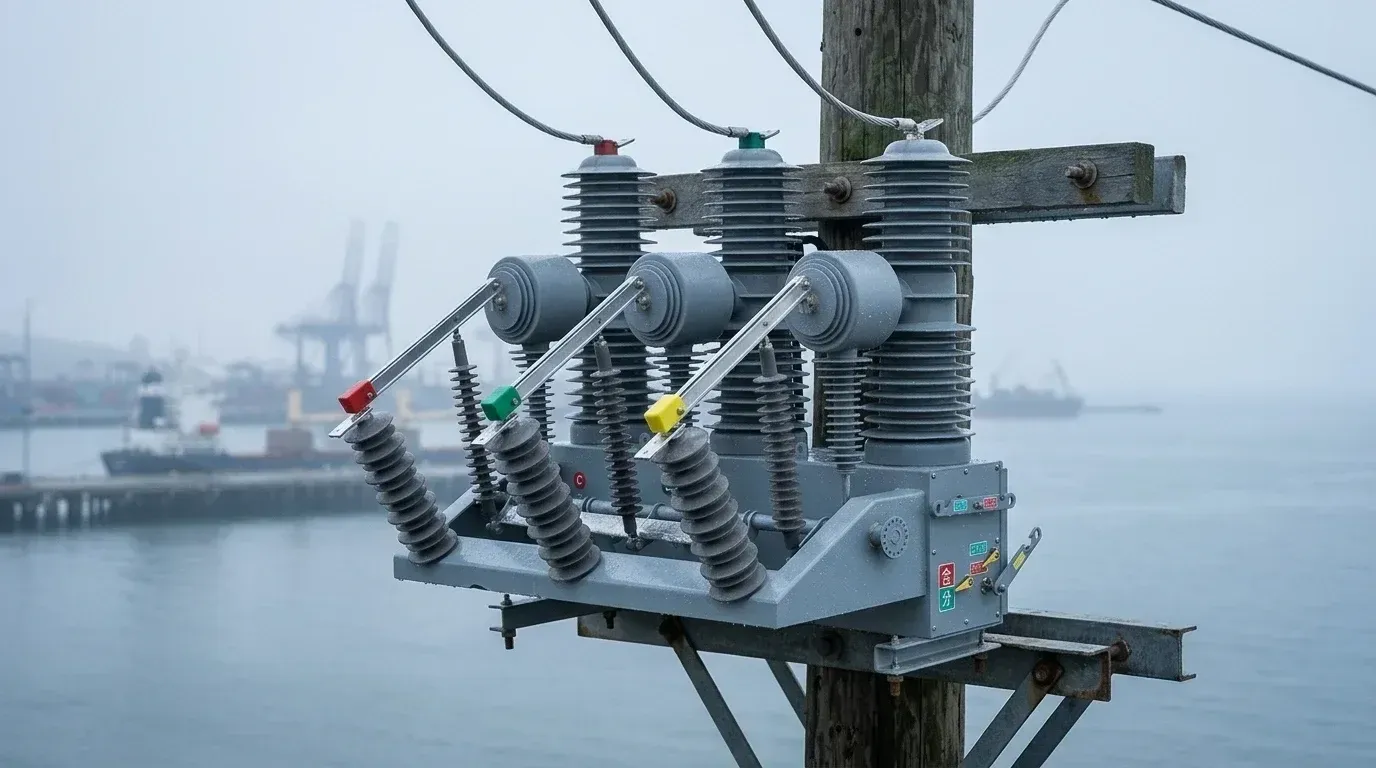
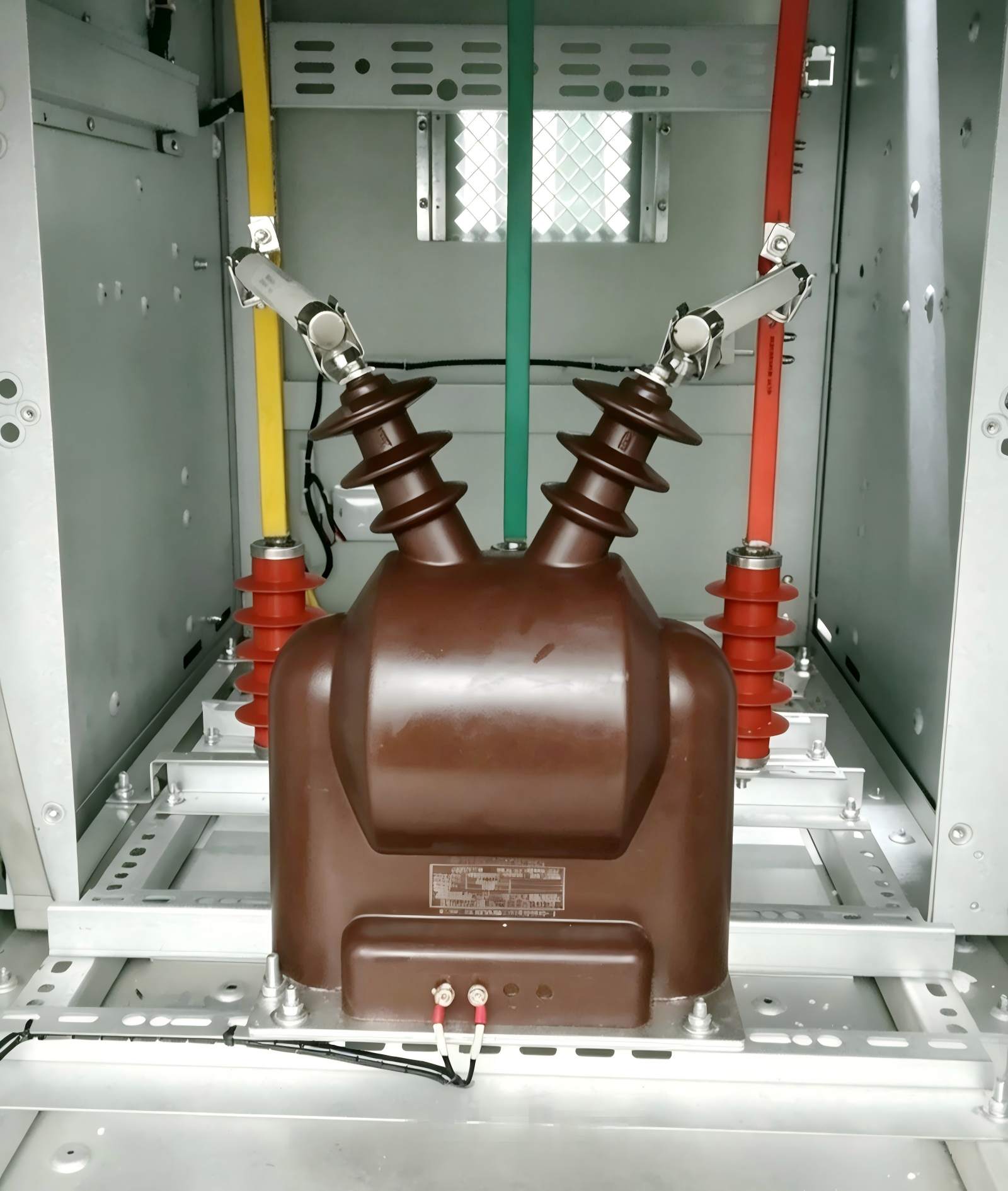
Internal condensation. A sealed housing heats during the day and cools at night. Water vapour in the trapped air condenses on the vacuum interrupter's external surface, insulating pull rods, secondary terminals and instrument transformers. The result is surface discharge, falling insulation resistance and, in the worst case, current transformer breakdown.
Chloride corrosion. Salt fog attacks metal enclosures, operating mechanisms, springs, fasteners and the conductive path. Corroded mechanisms stick, which shows up as failure to open or close and as degraded earthing continuity.
Silicone rubber aging and tracking. Long exposure to salt and ultraviolet light cracks, chalks and erodes bushing sheds, and leakage currents then carve tracking paths across the surface.
Water ingress into the secondary wiring chamber. Once seals age, rain and humid air get into control circuits and cause faults that are hard to trace.
These mechanisms interact. A corroded seal admits moisture, moisture feeds condensation, and condensation accelerates tracking. That is why a coastal specification has to treat the breaker as a system rather than a single component.
What Is an Outdoor VCB, and Why Is It the Usual Choice for Coastal Sites?
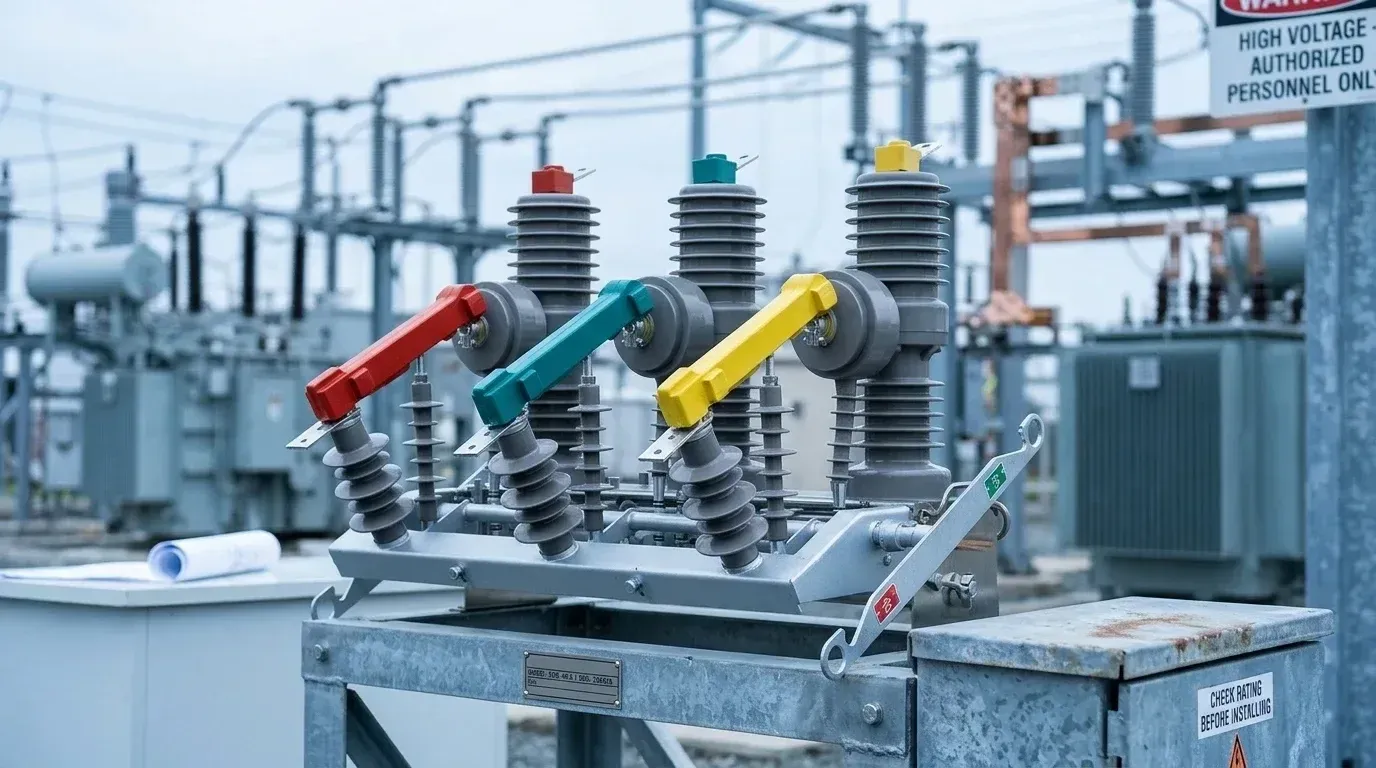
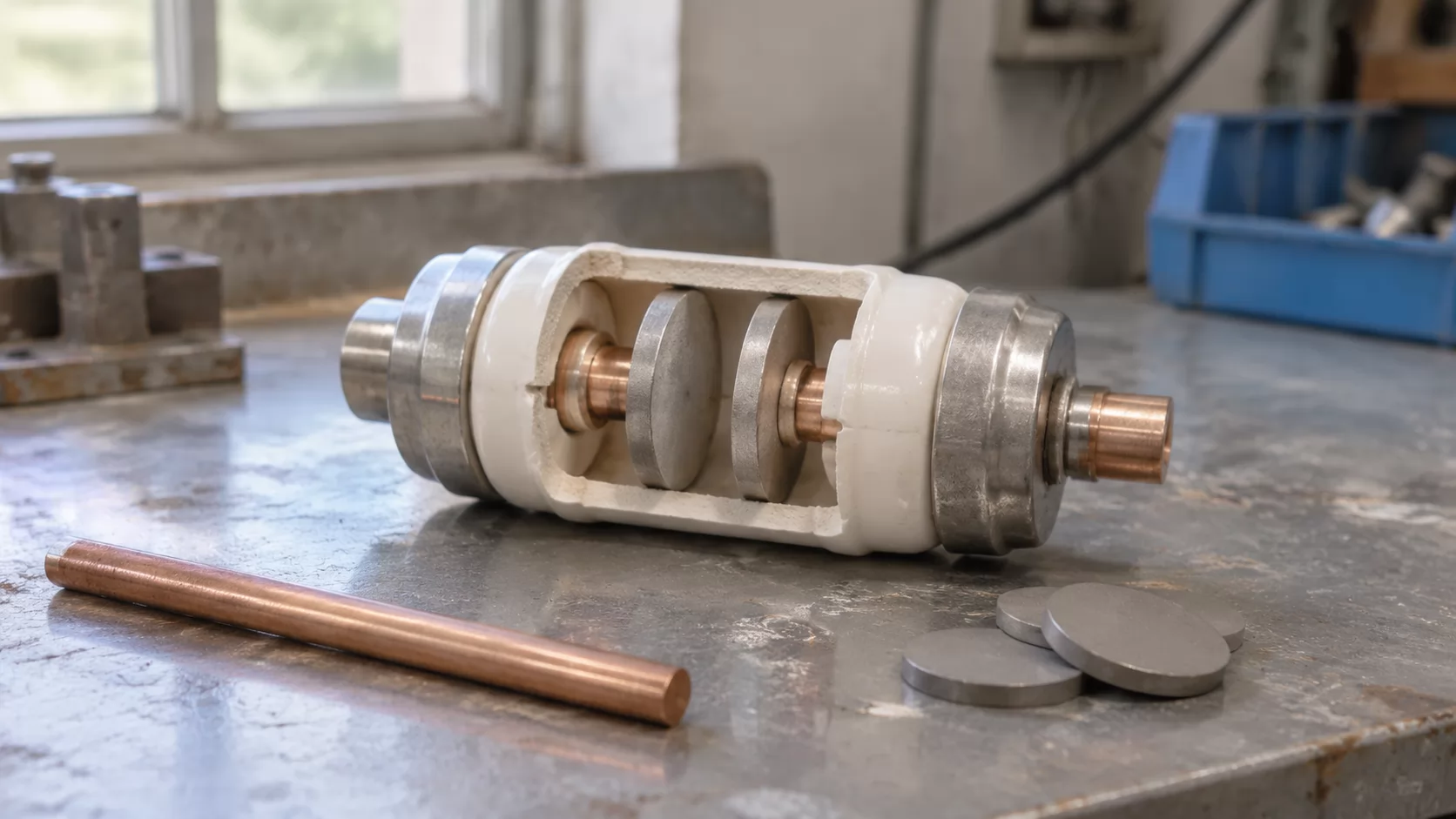
A vacuum circuit breaker (VCB) interrupts load and fault current by separating contacts inside a sealed vacuum bottle, with no arc-quenching gas or oil. An outdoor unit, typically pole-mounted or pad-mounted, isolates faulted sections of an overhead or cable feeder.
Because the arc burns in vacuum, it extinguishes at the first current zero with very little contact erosion. That gives long contact life and low routine maintenance, and it means no gas or oil handling at remote sites.
The practical point for a coastal site is where the exposure sits. Contamination cannot reach the contacts, but it can reach the bushings, mechanism, linkages and terminals.
That shifts the specification effort. Spend your attention on enclosure material, external insulation and the mechanism, since those are the parts that actually see the weather. Treating the VCB label as a guarantee of humidity tolerance is a common error, and a later section returns to it.
How to Prevent Condensation in Sealed Outdoor Breaker Housings
Condensation comes from day-night temperature swings inside a sealed enclosure, so how to prevent condensation in switchgear comes down to reducing the temperature difference between the inside and the outside. A heater paired with a humidity controller does exactly that. The approach works in the order below.
How condensation forms on the interrupter surroundings
During the day, the housing absorbs heat and the trapped air warms and holds more moisture. At night the surfaces cool faster than the air, and water settles on the coldest parts: insulating rods, secondary terminals and instrument transformers. That film lowers surface insulation resistance, invites partial and surface discharge, and over repeated cycles leaves tracking marks that become permanent.
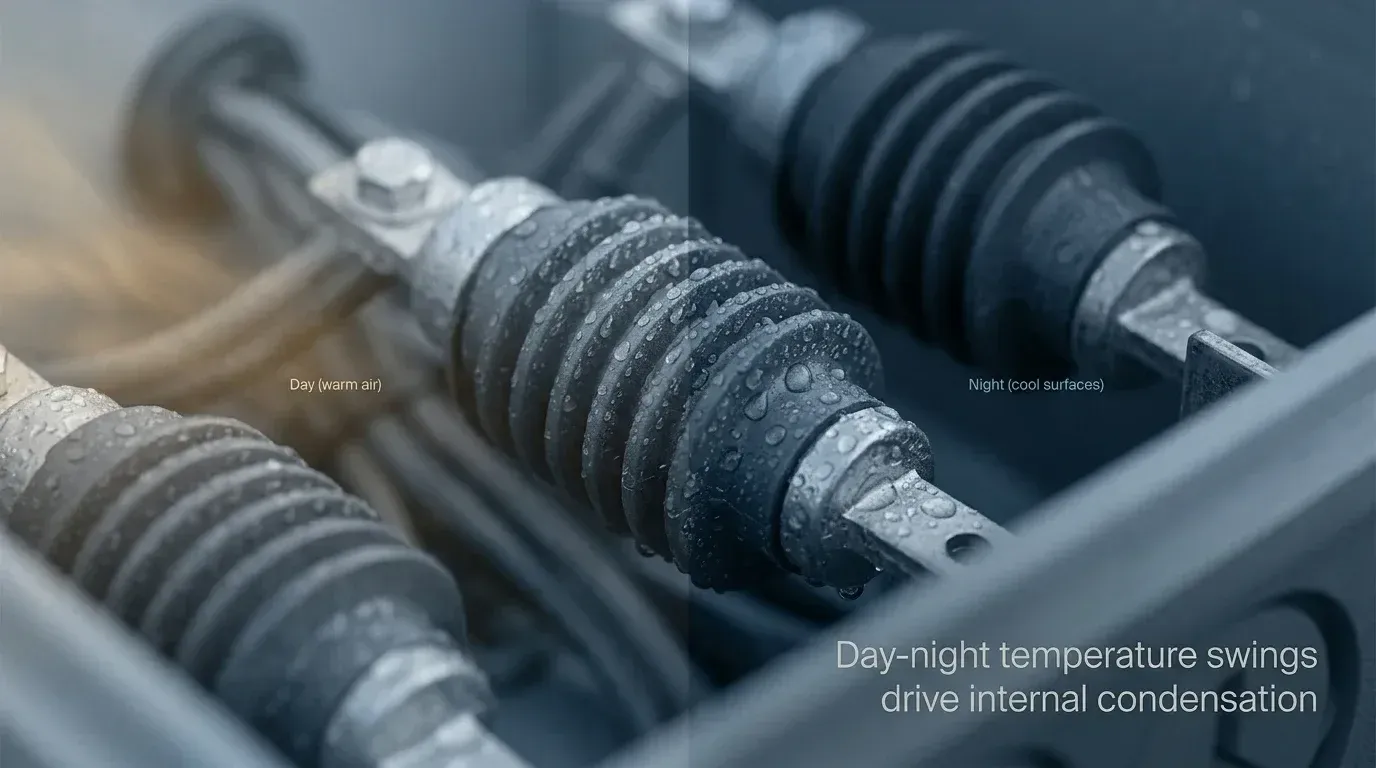
The vacuum bottle itself stays unaffected. The damage lands on everything around it.
Heater and humidistat control logic
The control logic is straightforward. A built-in temperature and humidity controller starts the heater when humidity rises above 65% RH or when temperature drops low, and stops it when humidity falls to 55% RH. The gap between the two thresholds prevents rapid cycling.
Do not leave heaters on continuously. Sustained heat inside the housing accelerates silicone rubber aging, so the heater should work as a conditioned response rather than a permanent load.
Semiconductor dehumidifiers are unsuitable for open-air housings, since they depend on a closed, controlled space. The goal is to keep internal surfaces slightly warmer than the dew point of the air around them.
Which Anti-Corrosion Measures Matter Most for Outdoor Breakers in High Humidity?
Housing material and fasteners come first, then the mechanism and the current path. When choosing anti-corrosion switchgear for high humidity, use 304 stainless steel for moderate exposure and 316 for strong salt fog, with 316L worth considering where welding is extensive. Epoxy-coated cast iron is acceptable only with a thick film and passivation pretreatment. Anti-corrosion performance is judged on these choices more than on any catalogue claim.
Ordinary powder coating is the weak option. On the coast it tends to blister and rust within one to two years, which is why the coating system, not just the base metal, deserves a line in the specification. Seals matter equally: use aging-resistant silicone gaskets, because common rubber hardens and leaks.
Fasteners, springs and pins
Bolts and pins should be 316 stainless steel. For light salt exposure 304 is the minimum. Opening and closing springs and transmission pins should carry a Dacromet (zinc-flake) coating with a sealing top coat, or be made of stainless steel. Zinc-plated carbon steel can rust within months on the coast, and a seized pin or a corroded spring is exactly what produces a failure to trip.
Current-carrying surfaces
Contact surfaces should have thicker silver plating. Salt attack on a thin plating layer raises contact resistance, and rising resistance means heating, which in turn degrades nearby insulation. A modest increase in plating thickness is one of the cheaper protections in the whole specification.
Optional extras are worth asking for. Built-in voltage and current transformers can receive the same salt-resistant treatment as the housing, which removes a common secondary weak point.
Silicone Rubber or Epoxy: Which Insulation Holds Up Outdoors?
Choose high-temperature vulcanized (HTV) silicone rubber for outdoor bushings, because it resists ultraviolet light, salt fog and tracking. Epoxy is acceptable inside the housing only when it is hydrolysis-resistant. The two are not interchangeable.
For outdoor bushings the material should reach a comparative tracking index (CTI) of 600 or higher and a tracking resistance grade of 5A, with UV-resistant and hydrolysis-resistant fillers added. Shed geometry also counts. Large, inclined sheds shed rain and dust more readily, so salt and dirt are less likely to build up and bridge the insulation.
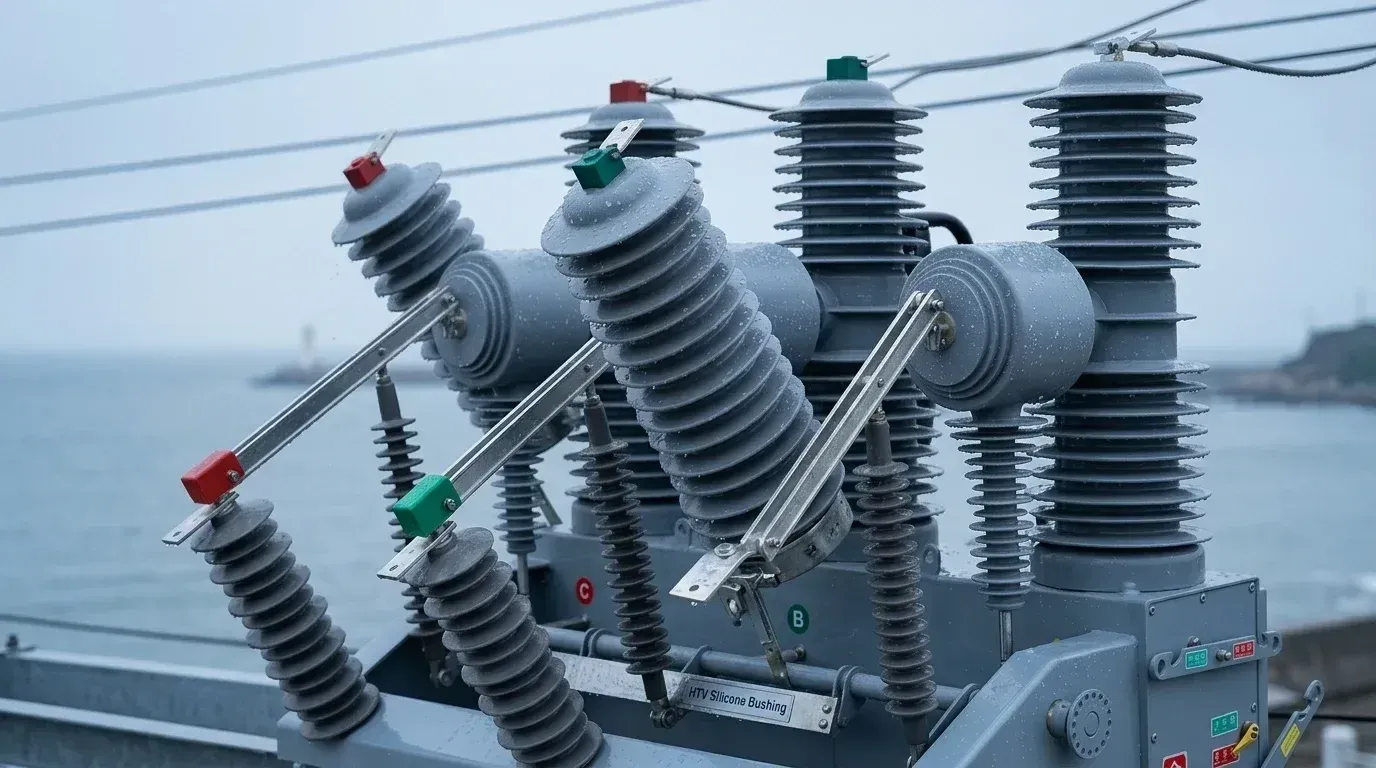
Standard epoxy bushings are a known problem outdoors. Under sustained sunlight and salt fog they crack and chalk quickly, and a chalked surface loses its water-repellent behaviour. Specifying them for open-air coastal use is a mistake that tends to surface after a season or two.
Inside outdoor housings, internal supports and insulating rods should use hydrolysis-resistant epoxy with a mould-resistant formulation, since the cavity will see condensation even if the exterior is well protected.
A silicone bushing has one trade-off to respect. Silicone ages faster under sustained heat, which is why the heater logic above and the advice against sealed outer covers later in this guide both matter.
Which Standards and Test Ratings Should the Specification Cite?
Cite IEC 62271-100 for the breaker, salt spray testing to IEC 60068-2-52, and an explicit IP rating. A specification that names these removes ambiguity at tender stage and gives you something to check against test reports.
IEC 62271-100 covers alternating-current circuit breakers for rated voltages above 1 kV. IEC 60068-2-52 is the environmental test method for cyclic salt mist exposure, and the neutral salt spray (NSS) duration you ask for should follow the exposure level: 200 h for inland humid sites, 500 h for near-coast sites and 1000 h for strong salt fog on islands and ports.
Ingress protection (IP) is the second rating to state. A standard outdoor pole-mounted breaker is typically specified at IP65, meaning dust-tight and protected against water jets.
Be careful about what an IP claim covers. Cable glands are the weak point in any rating, because the cable entry is where moisture and salt most easily travel into the housing. The rating on the enclosure drawing means little if the gland is a general-purpose type. Specify corrosion-resistant, waterproof glands and require the sealing arrangement around the cable to be part of the supplied configuration.
Finally, ask for type-test evidence tied to the exact configuration you are buying, not a related model.
How Should Exposure Level Map to Breaker Configuration?
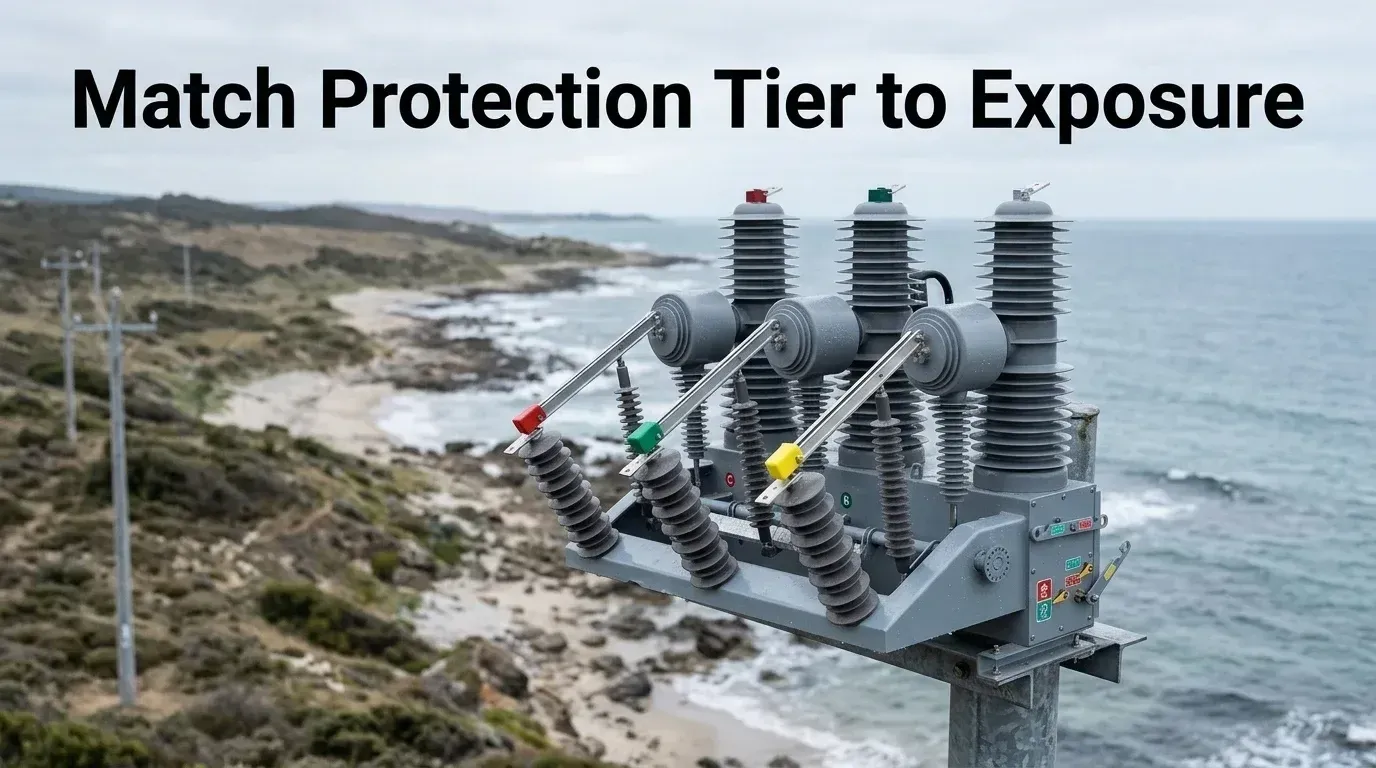
Three tiers cover most sites, set by distance from the sea and by exposure to salt fog. Choosing a tier first keeps the later details consistent and prevents both under-specification and paying for protection the site does not need.
| SITE | TIER | HOUSING | INSULATION AND FASTENERS | HEATER AND NSS TEST |
|---|---|---|---|---|
| Inland, humid and rainy | Basic outdoor | 304 | HTV silicone bushing | Built-in heater; NSS 200 h |
| Near-coast, 5–20 km | Medium | 304 | High-tracking-resistance silicone; 316 fasteners | Built-in heater; NSS 500 h |
| Islands, ports, under 5 km | Heavy | 316 | UV and salt-resistant silicone; full 316 fasteners | Built-in heater; NSS 1000 h |
The takeaway: each step toward the sea upgrades housing grade, fastener grade and test duration together, so do not mix a heavy-tier housing with light-tier fasteners.
Offshore wind farm substations belong in the heavy tier. They combine continuous salt fog, high humidity and limited access for repairs, which makes the cost of a failure far higher than the cost of the better configuration. Distance from the sea is a guide, not a law: prevailing wind, coastal topography and nearby industrial pollution can push a site up a tier.
When a site sits on a boundary, the safer choice is the higher tier. The extra cost is typically modest compared with an early replacement and the outage that comes with it.
What Is the Best Outdoor Circuit Breaker for Humid Environments?
No single model wins. An outdoor vacuum breaker whose protection tier matches the site is the sound default, and a short set of criteria confirms the match. Use the following to compare offers.
Exposure tier. Place the site in the basic, medium or heavy tier and check that housing, fasteners and salt spray duration all agree with it.
Rated voltage and short-circuit rating. When asking what is the best circuit breaker for humid environments, start with the ratings: the rated voltage must equal or exceed the maximum system voltage, and 12 kV and 17.5 kV are the classes discussed here. Interrupt ratings for medium voltage vacuum breakers typically run from 20 kA to 31.5 kA for outdoor distribution units, and higher for some designs. Size to the fault level of the network, not to the catalogue maximum.
Insulation material. HTV silicone for outdoor bushings, hydrolysis-resistant epoxy for internal parts.
Heater and humidity control. Built-in, with sensible start and stop thresholds, not a permanently energised heater.
Ingress protection. IP65 for outdoor units, with proper glands.
Maintenance access. Seals, heater and bushings should be inspectable without dismantling the unit.
Lifecycle cost. Compare the purchase premium of the higher tier against the cost of early replacement and outages.
Rule of thumb: when in doubt between two tiers, specify the higher one and verify it through test reports rather than brochure language.
Does the 80% Rule Apply to Outdoor Medium Voltage Breakers?
The 80% rule limits continuous load on a standard low-voltage breaker to 80% of its rating, for loads running three hours or more. It exists for thermal margin at terminals and within the breaker.
Does it carry over to medium voltage? Not as a fixed percentage. Medium voltage breakers are rated differently, with a rated continuous current defined under standard test conditions, so derating follows ambient temperature, altitude and the manufacturer's data rather than a blanket 80% figure.
Why does this matter at humid sites? Heaters raise enclosure temperature. A housing that is warmer than ambient has less thermal headroom for the current-carrying parts, and that warmth also feeds silicone aging. Check the temperature rise data against the actual conditions inside the housing, including heater operation and direct sun on a dark surface.
Should you apply a margin anyway? A sensible loading margin is good practice on coastal sites, particularly because corrosion at a contact raises resistance and heat. Ask the manufacturer for derating curves covering your altitude and maximum ambient, and size from those.
What Should the Installation and Maintenance Checklist Include?
Seal the cable entries, orient the wiring box downward, use hot-dip galvanized earthing with 316 terminals, and inspect annually. Good installation prevents most early failures, and a short routine prevents most of the rest. Use this checklist at commissioning and at each inspection.
Fit corrosion-resistant, waterproof cable glands at every entry.
Seal the cable exterior around each entry to stop salt and moisture travelling along the cable into the housing.
Face the secondary connection box downward so rain does not hit the wiring openings directly.
Use hot-dip galvanized flat steel for earthing and 316 stainless steel earth terminals.
Leave the breaker uncovered; do not wrap it in a sealed outer cover.
Check seals every year for hardening, cracking or compression set.
Inspect bushings for chalking, surface cracks and tracking marks.
Test heater and humidity controller operation, including start and stop thresholds.
Remove salt deposits from the sheds on a regular cycle.
The no-cover rule surprises people. An extra enclosure around the breaker traps heat and reduces ventilation, and in summer that sustained heat speeds up silicone aging. The better protection is the correct tier of breaker, not a second shell around a weaker one.
Cleaning intervals should follow the site. A heavily contaminated coastal location needs shed cleaning more often than a rainy inland one, because rain does a partial job of washing inland units.
Which Common Mistakes Undermine Coastal Breaker Specifications?
Four assumptions cause most of the avoidable failures. Each sounds reasonable at tender stage and each shows up later as a fault.
Treating a sealed interrupter as proof of a sealed system. The vacuum bottle is sealed; the housing, bushings, glands and secondary chamber are not automatically so. This is costly because faults appear in the parts the specification never examined. Instead, write requirements for the whole assembly: housing material, gasket type, IP rating, glands and salt spray duration.
Specifying standard powder coating. On the coast, ordinary powder coating tends to blister and rust within one to two years, and corrosion then spreads under the film. Choose 304 or 316 stainless steel, or thick-film epoxy over a passivation pretreatment where cast iron is used, and match the grade to the exposure tier.
Leaving heaters permanently on. It looks like the safest anti-condensation measure, but constant heat ages silicone rubber and shortens bushing life. Use a humidity controller with defined start and stop thresholds, around 65% RH on and 55% RH off, so the heater runs only when needed.
Wrapping units in covers. A sealed cover appears to add protection but traps heat and restricts ventilation, which speeds silicone aging in warm weather. Rely on a correctly specified breaker and on regular cleaning rather than on an added shell.
A fifth habit is worth avoiding as well: relying on carbon steel zinc-plated bolts because they are cheap. They can rust within months on the coast, and replacing them later costs far more in access and outage time than buying 316 in the first place.
FAQ
Which stainless steel grade should I choose, 304 or 316?
Use 316 for islands, ports and sites within about 5 km of the sea, and 304 for inland humid or lightly salt-exposed sites. Consider 316L where extensive welding is involved. The grade should follow the exposure tier and match the fasteners.
How often should coastal breakers be inspected?
At least once a year. Check seals, bushing condition, heater function and salt deposits. Heavily contaminated sites may need shorter cleaning intervals than the annual inspection.
Is a higher IP rating enough on its own?
No. An IP rating describes enclosure ingress protection and says nothing about salt corrosion, UV aging or insulation tracking. Cable glands are also a common weak point. Pair the rating with material specification, salt spray duration and gland requirements.
Do outdoor breakers need a heater in humid regions?
Yes, in most cases. A built-in heater controlled by a humidistat keeps internal surfaces above the dew point and limits condensation on rods, terminals and transformers. Choose a unit with defined start and stop thresholds rather than a permanently energised heater.