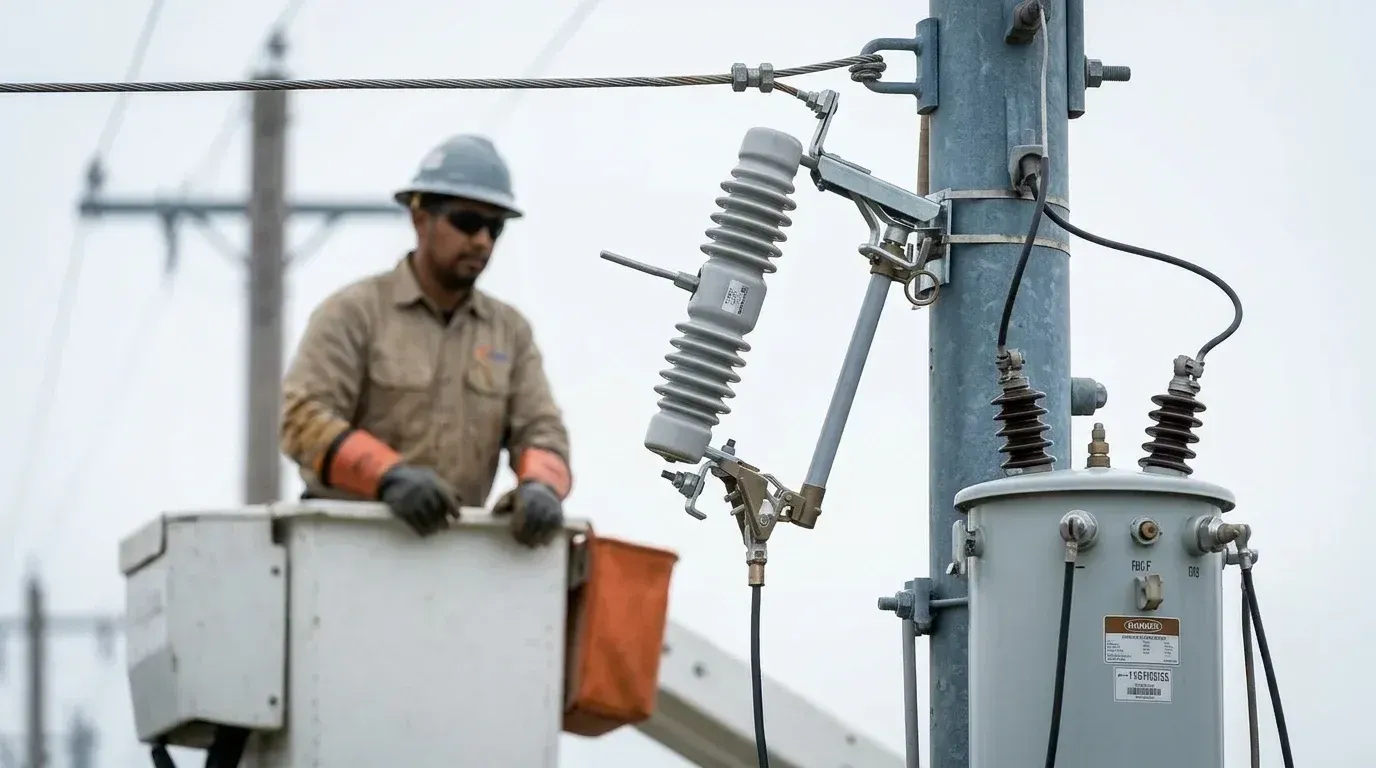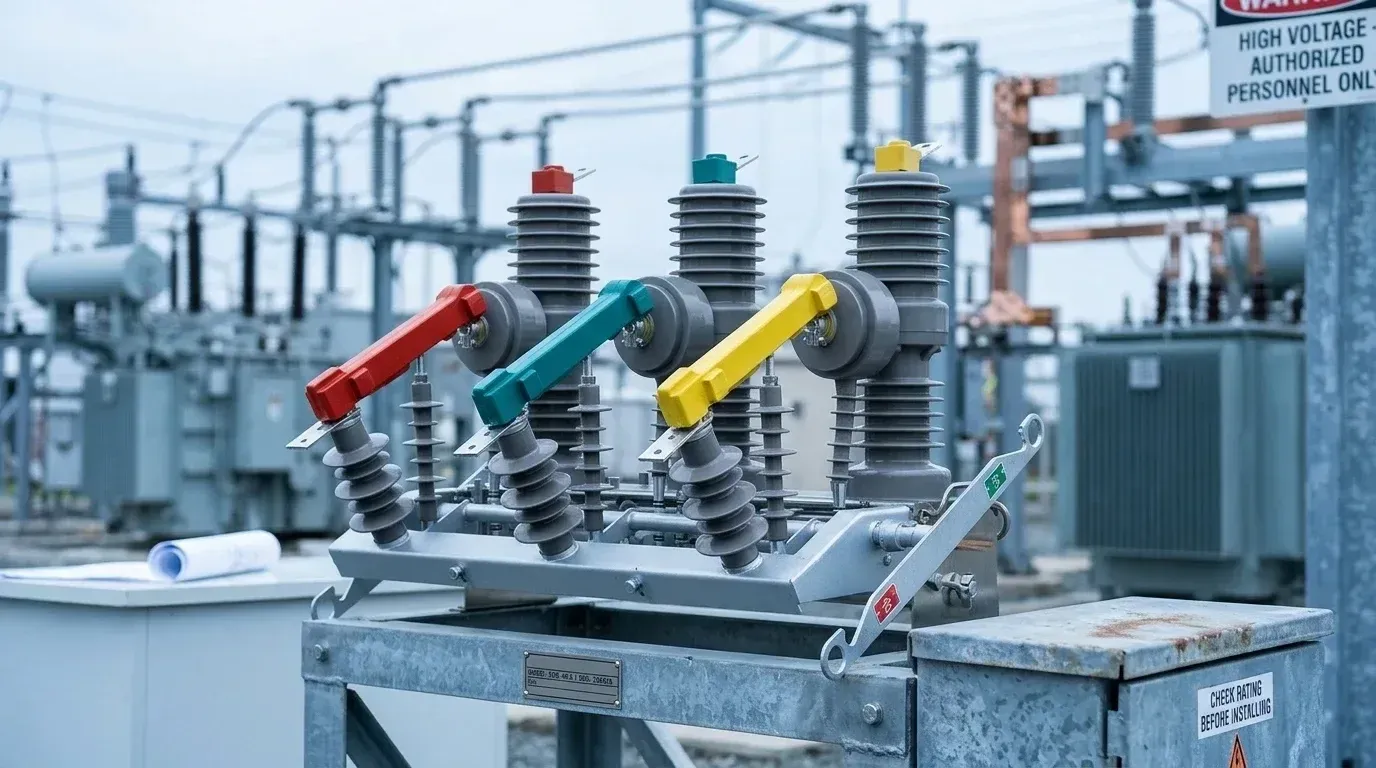

A firebreak stops a forest fire because nothing continuous is left to burn across the gap. An isolation transformer 120v unit works the same way. Power crosses by magnetic coupling, while noise, ground faults, and ground-loop currents find no conductive path to follow. Because a 1:1 unit changes no voltage, every purchasing decision comes down to sizing, shielding, grounding, and ratings.
A 120V to 120V isolation transformer is a 1:1 unit with separate primary and secondary windings that creates a new, electrically independent 120V source. Choose it by load VA plus margin, a grounded electrostatic shield, the right UL or IEC listing, and a core and enclosure that suit the duty cycle and the harmonics of your loads.
What Does a 120V to 120V Isolation Transformer Actually Do?
It makes no voltage change. What it does is create a separately derived 120V source with galvanic isolation, meaning no metallic connection between input and output. That cuts ground loops, attenuates common-mode noise and limits the paths a fault or a shock current can take.
The 1:1 ratio still earns its place on plant floors. Variable frequency drives, welders and contactor banks inject switching noise into shared feeders, and the PLC or instrument panel on the same panelboard sees all of it. Put the sensitive gear behind its own secondary and that noise has to cross a shield and a winding gap instead of simply riding the neutral and ground.
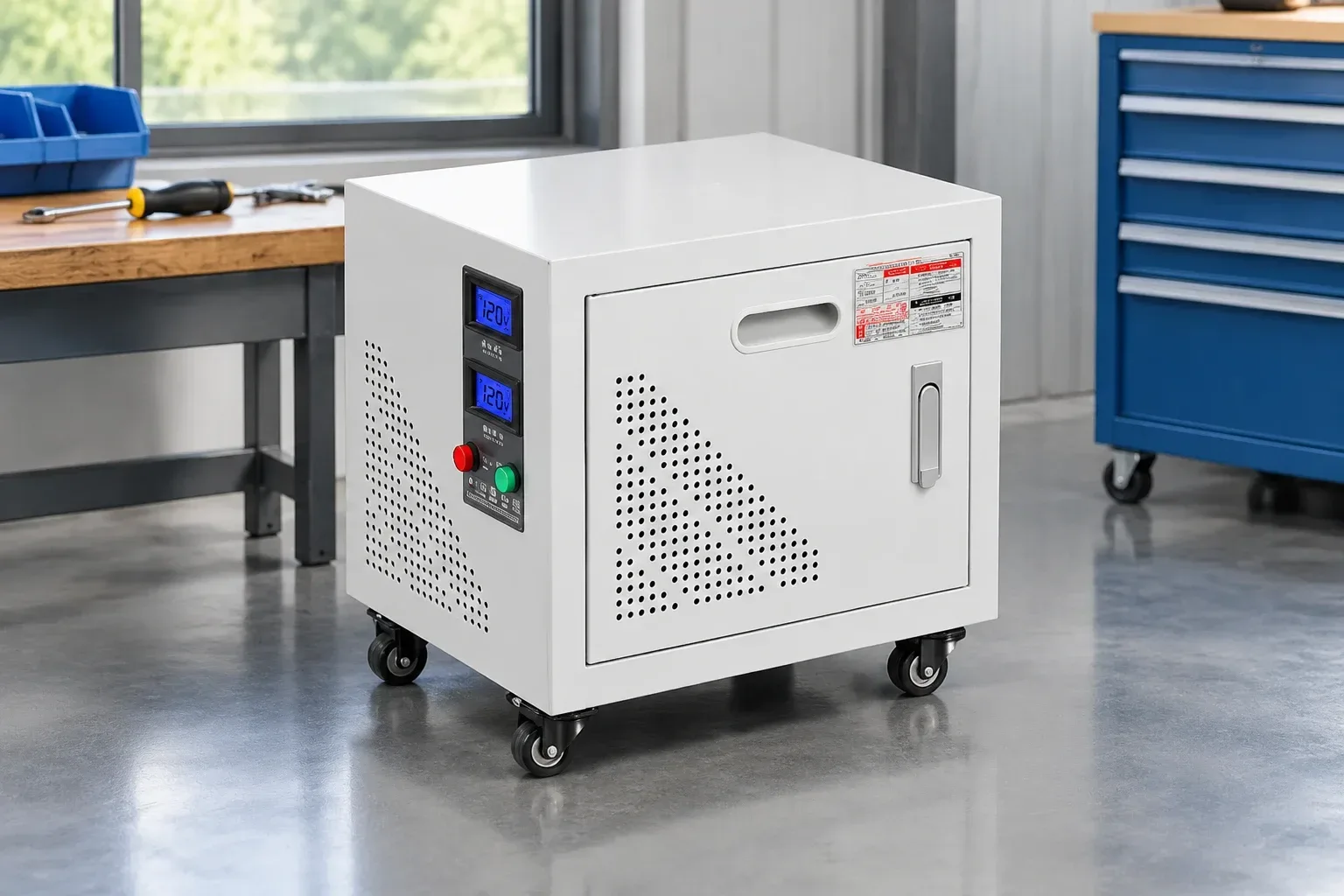
Isolation is not the same as an autotransformer. An autotransformer shares one winding between input and output, so there is a direct conductive path and nothing is isolated. It is smaller and cheaper, and it is the right tool for changing voltage, but it cannot break a ground loop or a fault path. If isolation is the reason for the purchase, a shared winding is a non-starter.
Grounding is where people slip. The secondary is a new separately derived system, so under the US National Electrical Code (NEC) the neutral is normally bonded to ground at the transformer or the first disconnect on the secondary side, and only there. Bond it once, in one place, and document where.
When Do You Need an Isolation Transformer 120V Unit, and When Is Something Else Better?
Compare the two problem types. Isolation fixes problems of noise, ground loops and shock hazard. A line conditioner, UPS or filter fixes problems of voltage level and continuity: sag, surge, outage. Buying the wrong class of device is the most common way to spend money and still have the problem.
Typical triggers for choosing an industrial isolation transformer for sensitive equipment are CNC controls that glitch whenever a nearby welder strikes, test benches where a grounded oscilloscope probe and a grounded device under test create a loop, and PLC and instrumentation panels with analog signals that drift. Medical-grade and laboratory equipment is another large group, where leakage current and patient or operator safety drive the requirement.
An isolation transformer will not fix undervoltage, brownouts or sustained overvoltage, so keep that in mind when you learn how to choose isolation transformer for your plant. It passes through whatever average voltage arrives, minus a few percent of regulation drop under load. If the plant sags to 108V when the compressors start, you will get a quiet 105V at the machine.
A double-conversion UPS does both jobs in part. It rebuilds the waveform, rides through short outages and isolates electronically in many designs. The trade-off is battery maintenance, heat, a higher purchase cost and a failure mode with more parts. For a machine that needs clean power and has no ride-through requirement, a plain transformer is simpler and lasts decades. Where you need both, it is common to see the transformer ahead of a regulator or UPS.
What Size Isolation Transformer Do I Need?
Add up the full-load amps of everything on the secondary, convert to VA, then add margin. At 120V, a transformer delivers about 8.3A per kVA, so a 1 kVA unit gives roughly 8.3A and a 1.5 kVA unit about 12.5A. Here is the sequence.
1. Read nameplate amps for every load, not wattage, because VA equals volts times amps and power factor is already baked into the amp figure.
2. Sum the amps and multiply by 120 to get the connected VA.
3. Add 20–25% headroom for growth, ambient temperature, and derating.
4. Round up to the next standard size and check the secondary breaker and wire against it.
Worked example
Take a control cabinet with a 24V DC supply drawing 4.0A at 120V, an HMI at 0.8A, servo drive control inputs at 3.0A and a service outlet and fan at 1.0A. The total is 8.8A, or 1,056VA. Add 25% and you land near 1,320VA, so a 1.5 kVA unit is the sensible pick. A 1 kVA unit would run at over 100% and would be a poor choice even though the loads look small on paper.
Inrush and motor loads
Two inrush events stack at startup: the transformer magnetizing inrush and the downstream load inrush. Toroidal units in particular can draw a very large current spike for a few cycles when energized, commonly quoted at ten to thirty times rated current. The primary breaker sees that spike, which is why a perfectly sized unit trips the breaker the moment it is switched on.
Motors, solenoids and capacitor-input supplies add their own inrush. If the secondary feeds a motor, size on starting current, not running current, or the voltage dip at startup will upset everything else on that secondary. A fractional-rated transformer simply cannot hold voltage through that event.
Why Does Core Construction Change Performance? Toroidal vs. EI Laminated
Toroidal cores run quieter, with lower stray flux and a smaller footprint, but they draw higher inrush. EI laminated cores cost less and tolerate inrush better, but they are heavier and hum more. In both, the quality of the grain-oriented silicon steel, meaning its loss grade and lamination thickness, largely sets the no-load losses.

| Attribute | Toroidal core | EI laminated core |
|---|---|---|
| Size and weight | Smaller and lighter for the same VA | Larger and heavier |
| Audible hum | Typically very low | Noticeable, more so with loose clamping |
| Stray magnetic field | Low, suits instruments near coils | Higher, needs spacing from sensitive parts |
| Inrush current | Higher, may need slow-blow or soft start | Lower, easier on breakers |
| Cost and typical use | Higher; test benches, lab and audio-grade gear | Lower; general panel and machine-tool power |
The takeaway: pick toroidal where size, hum and stray field matter, and EI where cost and breaker behavior matter more.
Efficiency matters on continuous duty. No-load loss is paid around the clock, whether the machine is running or not. Ask for the temperature-rise class as well: a unit built with higher-class insulation but wound for a lower rise runs cooler and ages slower than one pushed to its limit.
Which Shielding and Noise-Attenuation Features Matter?
For sensitive electronics, a grounded electrostatic shield between the windings is the feature that delivers meaningful common-mode noise attenuation. A plain isolation unit without one passes much of the noise across the winding gap through capacitive coupling. Check these criteria on the datasheet.

Shield count. A single shield helps a lot. Multiple shields, for example one on each winding, push attenuation higher and are usually what lab, medical and measurement applications call for. For a typical PLC panel, one properly grounded shield is often enough.
Interwinding capacitance. This is the number that tells you how much high-frequency noise can couple across. Lower is better, and the figure should be on the datasheet in picofarads. If a supplier cannot state it, treat the shield claim with caution.
Common-mode vs. transverse-mode attenuation. Common-mode noise appears on both conductors relative to ground, and the shield is the main defense. Transverse-mode noise appears between the conductors, and an isolation transformer alone does little against it; that is a filter's job. A datasheet should state attenuation in dB at stated frequencies and say which mode it refers to.
Shield termination. The shield lead must be brought out and tied to ground with a short, low-impedance connection. A long pigtail erodes the benefit at the frequencies that matter.
When requesting quotes, ask a manufacturer such as Weisho Electric to state the shield construction, interwinding capacitance and attenuation test conditions in writing. Vague wording like "noise suppression" tells you nothing you can compare.
How Do You Handle Non-Linear Loads and K-Factor?
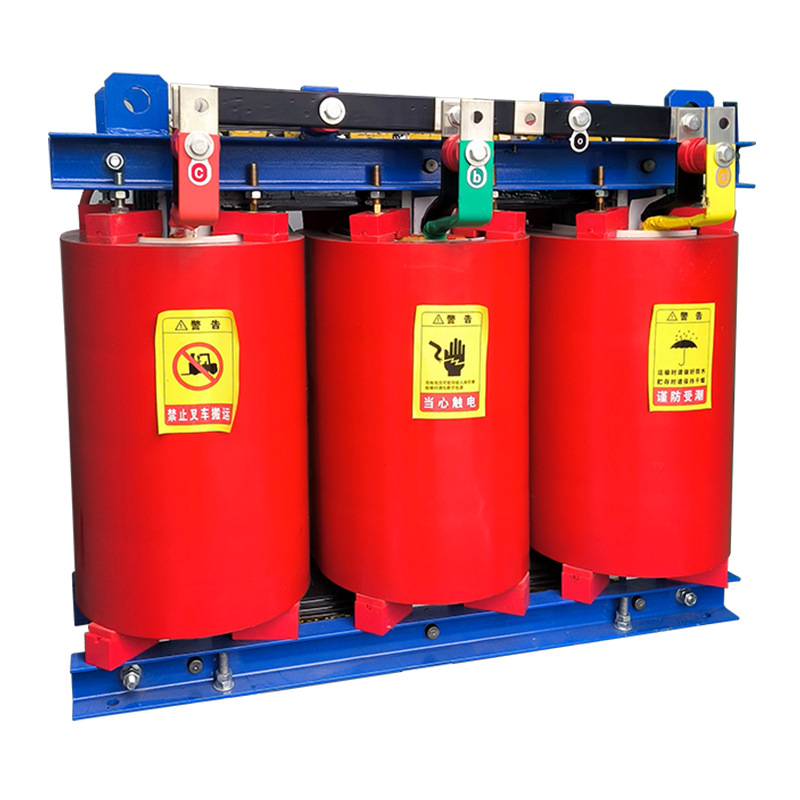
If the secondary feeds switch-mode power supplies, drives or rectifiers, specify a K-factor-rated unit, with K-4 and K-13 the common choices, or oversize a standard one to cover the harmonic heating. The K-factor rating is a number that expresses how much harmonic current a transformer can carry without overheating.
Standard windings are designed around a 50/60 Hz sine wave. Harmonic currents raise eddy-current and stray losses in the windings and core, and those losses grow with frequency squared, so a load that looks modest in amps can heat a standard unit well beyond its rise rating. A cabinet full of DC power supplies, VFD front ends and LED drivers is exactly that load.
Neutral currents deserve attention. Triplen harmonics add in the neutral instead of canceling, so the secondary neutral can carry more current than any single phase conductor. On a single-phase 120V secondary the neutral already carries the full load current, and harmonics can push it above the line current. Size neutral conductors and the neutral terminal to match.
K-rated units use heavier or transposed conductors, and often a larger or double-sized neutral. They cost more, and for a small secondary the premium can exceed the cost of simply stepping up one standard size. The rule of thumb is that oversizing is cheaper at low kVA with mild harmonics, and K-rated wins at higher kVA or when the load is mostly rectifier-fed. If you can get a harmonic survey or the loads' THD figures, use them rather than guessing.
Which Standards and Certifications Should the Unit Carry?
In North America, look for a UL 5085 or UL 1561 listing, and for CE marking against IEC 61558 where equipment or sites follow European requirements. Medical-grade applications call for their own isolation requirements on top of that. Match the standard to the product class, then to the site.
UL 5085 vs. UL 1561. UL 5085 is the family covering low-voltage isolating and power transformers, and UL 1561 covers larger dry-type general-purpose power transformers. Which one applies depends on the rating and the product class, so confirm against the listing itself rather than assuming. UL 1561 listings are also where K-factor ratings are commonly declared.
IEC 61558. This series sets safety requirements for transformers and power supply units, with part 2-4 addressing isolating transformers. It is the reference for equipment that will be installed or sold under CE conformity, and its insulation and creepage requirements differ from the UL approach.
Medical. Equipment intended for patient areas generally has to meet IEC 60601-1 on the equipment side, and hospital isolated power systems follow their own rules in NFPA 99. A general industrial isolation transformer is not automatically medical grade. Ask for leakage current limits stated on the datasheet.
Enclosure ratings. A NEMA 1 enclosure is fine in a clean electrical room. For dust, moisture or washdown, look at NEMA 3R, 4 or 4X, or the matching IP rating such as IP54 to IP65. Ventilated enclosures breathe dust; sealed ones run hotter and may need derating.
Finally, ask for the listing mark on the unit's own nameplate, not only on the catalog page. A catalog can describe a family, while the label shows what was actually built and tested.
Which Mistakes and Myths Cost Plants the Most?
The common belief is that any 1:1 transformer is an isolation transformer. It is not. The usual failures are buying by VA alone, skipping the neutral-ground bond, assuming isolation equals voltage regulation and ignoring ambient temperature.
Myth: any 1:1 unit isolates. A 1:1 autotransformer, or a unit with a tie between windings, provides no isolation. Check that the nameplate or datasheet says isolating and shows two separate windings, and that the listing covers isolation specifically.
Mistake: bonding the secondary wrongly. Leave the neutral unbonded and you have a floating system with unclear fault behavior. Bond it at both the transformer and a downstream panel and you create a double ground, which defeats the isolation and can carry circulating current. Bond once, at the source of the separately derived system.
Mistake: undersized primary protection and wire. Inrush and the primary current at full load both drive the breaker and conductor choice. Size the primary conductors and overcurrent device to the applicable code rules for transformers, and choose a breaker curve that rides through magnetizing inrush.
Mistake: closing it in a cabinet. A transformer rated for open-air ambient will overheat inside a sealed panel at 40°C or more. Allow clearance, add ventilation or derate. Heat is what shortens insulation life, and a few extra degrees over the rating can halve it.
How Do You Compare Quotes and Total Cost of Ownership?
Two quotes arrive for the same 1.5 kVA requirement. One is noticeably cheaper per VA, the other lists shield spec, temperature rise and listing in the first lines. Compare on losses, temperature rise, shield specification, listing and enclosure, not price per VA. A cheaper unit that runs hot or trips breakers costs more over its life.
No-load losses are the quiet line item. A unit energized 24 hours a day, 365 days a year pays its core loss every hour, and the difference between a good and a mediocre core grade shows up in the electricity bill and in the heat the cabinet has to shed. If one quote omits no-load loss and regulation figures, ask for them before you compare.
Look at the practical side as well: lead time on the exact kVA you need, the mounting footprint, the terminal type and size for your conductors, and whether a like-for-like replacement will be available in five years. A line stopped for a transformer that is on backorder is more expensive than any price gap. When you request a datasheet from Weisho Electric or any other maker, check that these items are in writing.
Before you place the order, run through this list.
Confirm total load amps from nameplates and convert to VA with headroom.
Check primary and secondary inrush against the breaker curve.
Identify harmonic content and decide between K-rated and oversized.
Specify the shield type and request interwinding capacitance figures.
Verify the UL or IEC listing mark on the unit itself.
Select the enclosure rating for dust, moisture and washdown exposure.
Record the ambient temperature and cabinet ventilation, and derate if needed.
Define the grounding plan, including where the neutral-ground bond is made.
FAQ
Can I use a 120V isolation transformer on a 240V circuit?
Not unless the nameplate shows a 240V primary or a dual-voltage primary. Energizing a 120V-only winding at 240V saturates the core and can destroy the unit quickly. Check the primary rating and wiring configuration before connecting.
Does an isolation transformer protect against surges?
Only partly. It attenuates fast transients through winding impedance and the shield, but it is not a surge protective device. Add a properly rated surge protector ahead of or behind it for lightning and switching surges.
Can I run a motor from an isolation transformer 120v?
Yes, if the transformer is sized for the motor's starting current, not only its running current. Large inrush can cause a voltage dip or trip the breaker. Small fractional-horsepower motors are usually fine on a transformer with generous margin.
Do I need to ground the secondary?
Usually yes. The secondary is a separately derived system, so the neutral is normally bonded to ground once, at the transformer or first disconnect. Some special applications, such as isolated power in medical areas, use ungrounded systems with monitoring instead.
Why does my transformer hum, and is it a problem?
Hum comes from magnetostriction in the core and is normal at a low level. A loud buzz suggests overvoltage, DC offset, loose laminations or overload. If it is new or louder than before, check input voltage and load.