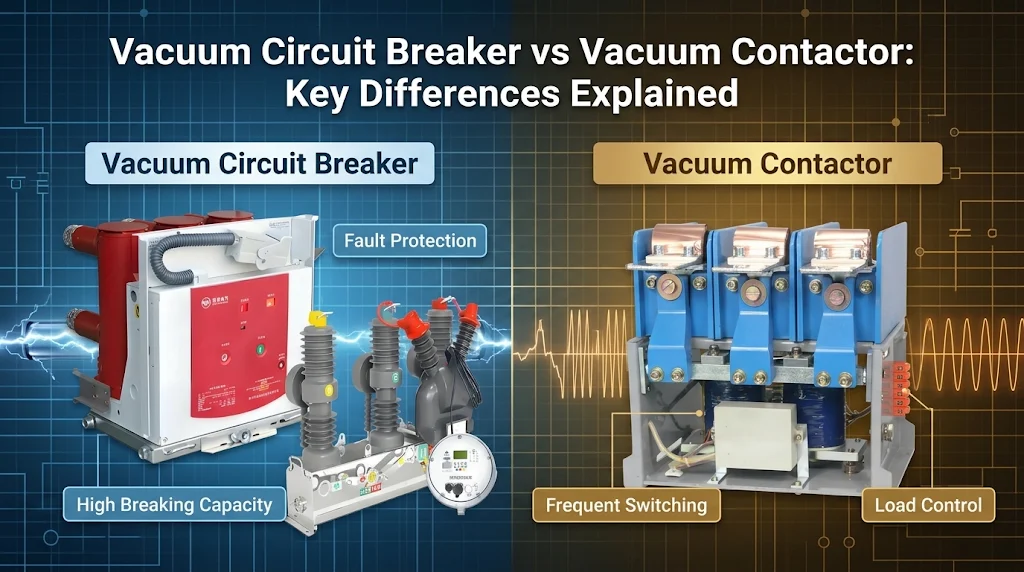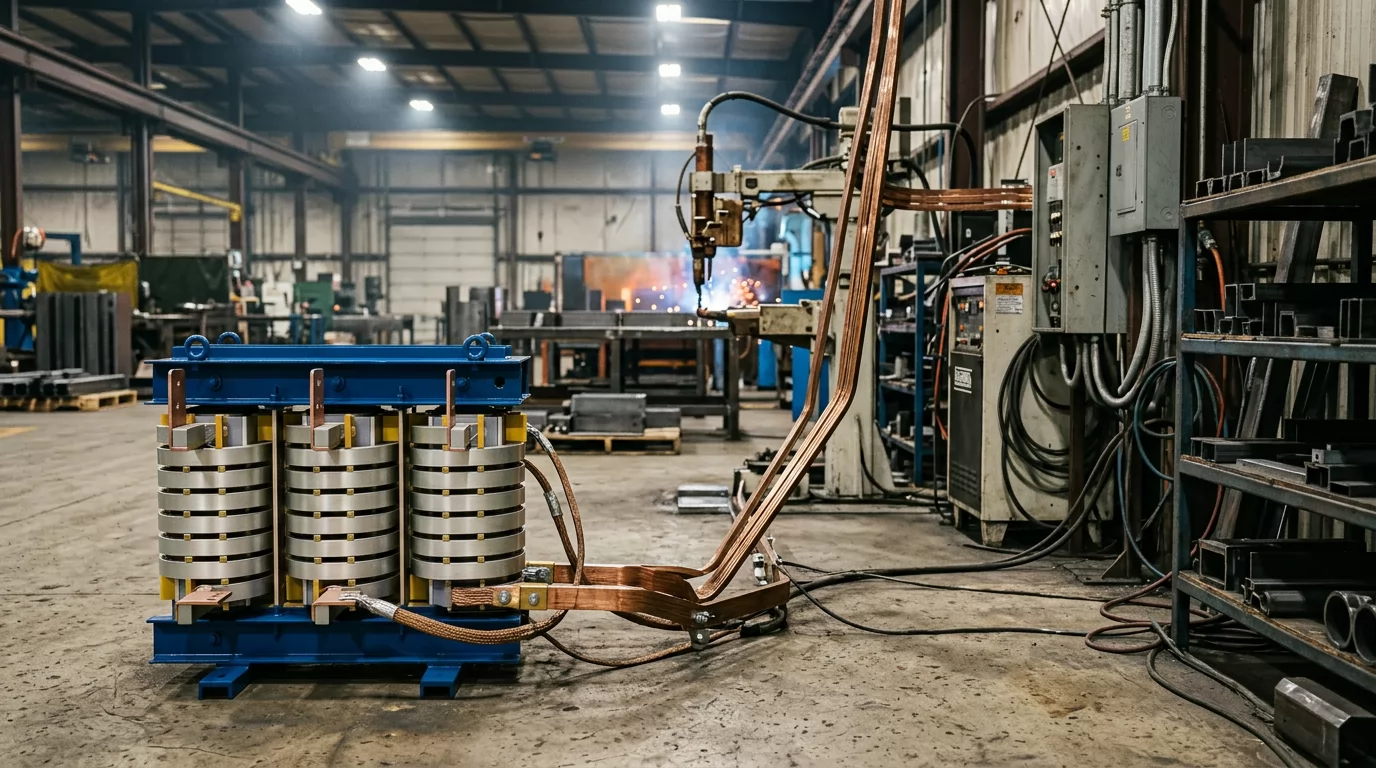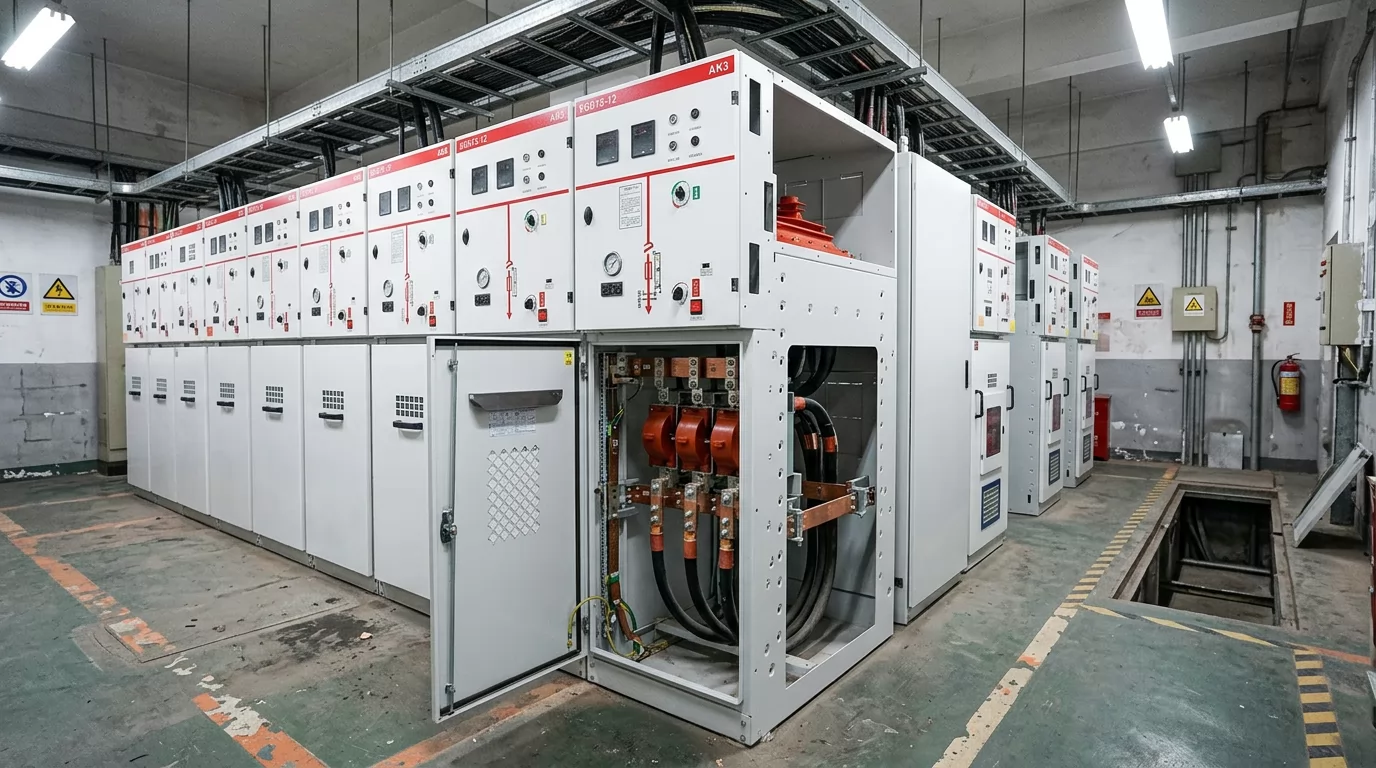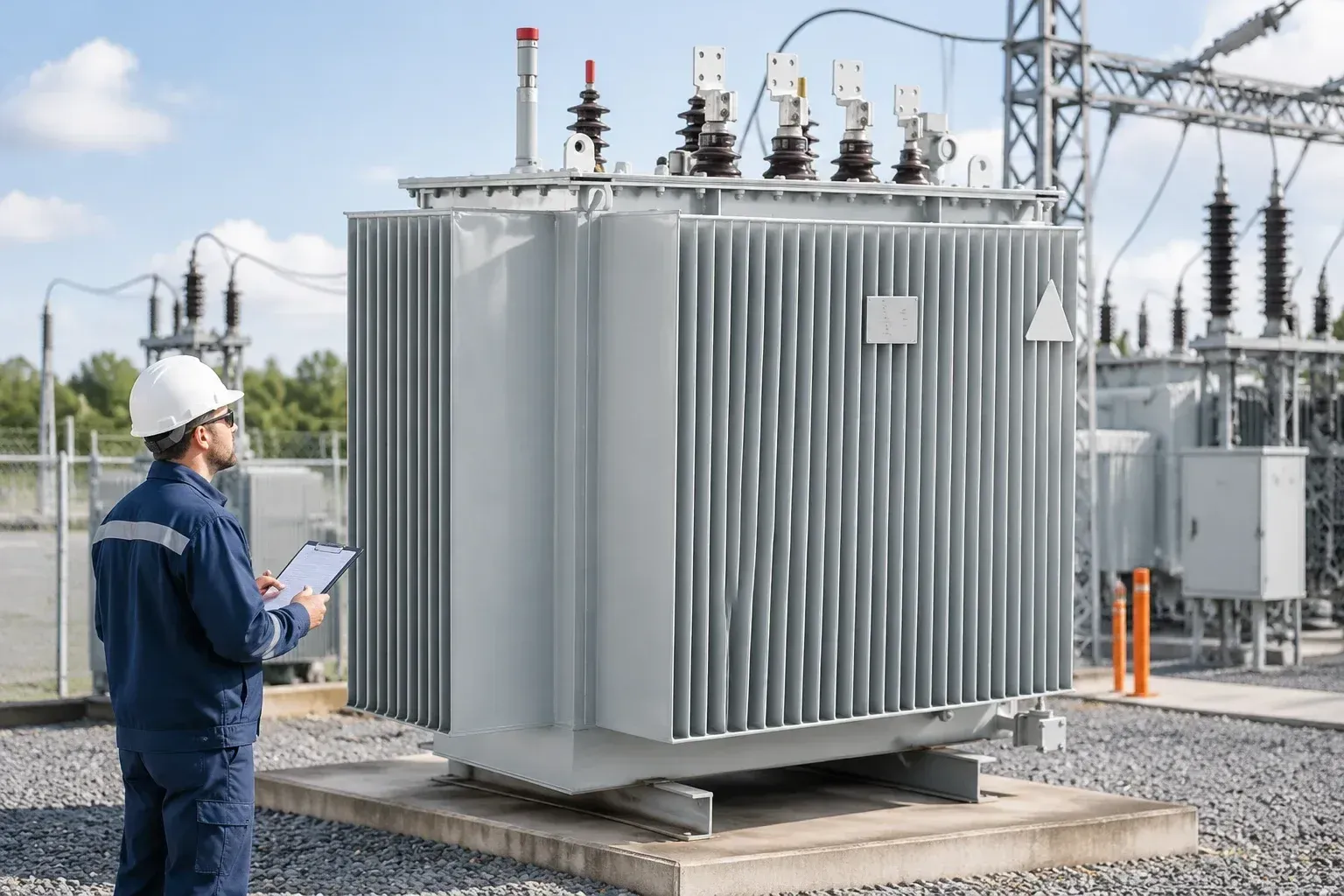
The cost of the wrong vacuum circuit breaker goes far beyond the unit price. Learn how to choose a vacuum circuit breaker and avoid costly VCB selection mistakes.
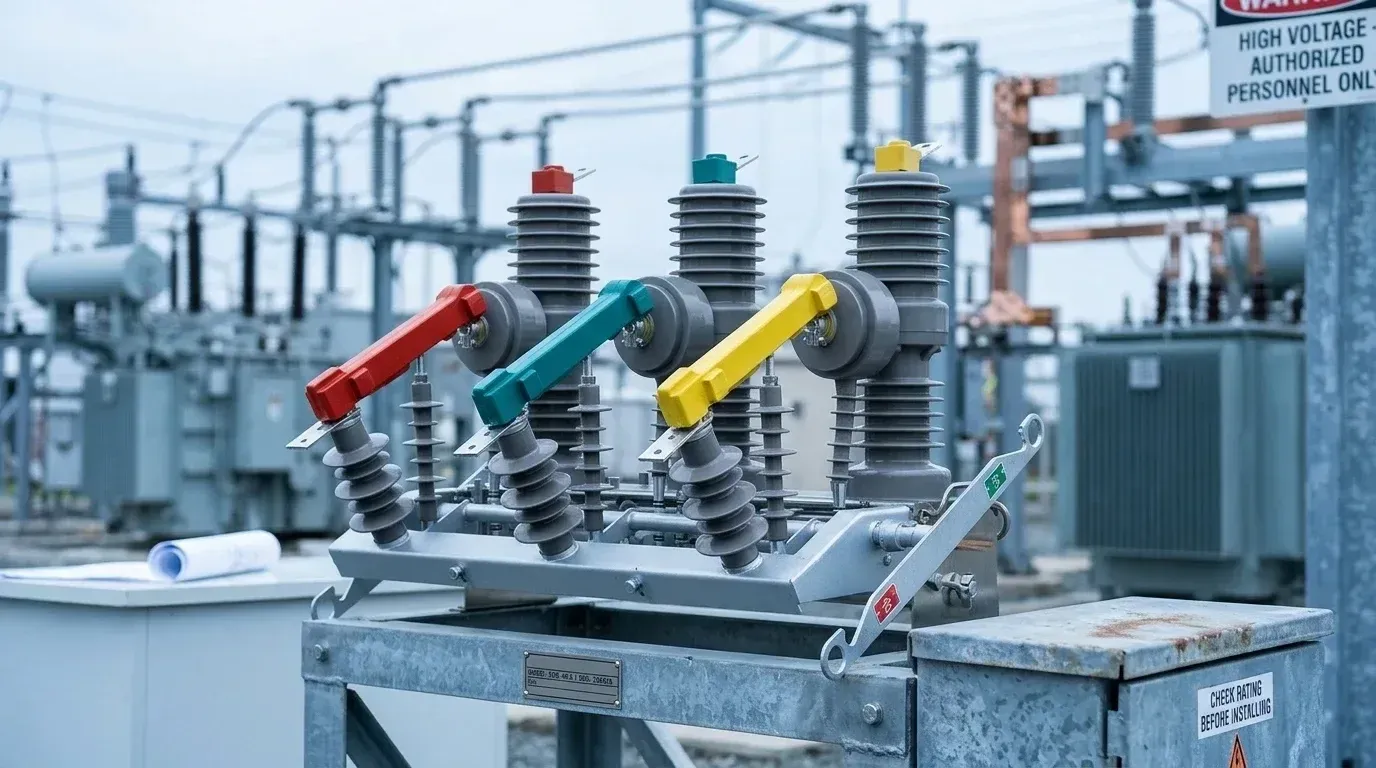
A breaker that passed commissioning is assumed to protect the plant, yet on the day of a fault it may fail to clear, and VCB selection mistakes only surface in the outage and repair bill.
A vacuum circuit breaker (VCB) is a switching device that interrupts current by separating contacts inside a sealed vacuum interrupter. The right one matches your fault level and load type, as well as the current type and the environment it will run in. The wrong one looks identical on the panel and costs far more than the price difference that tempted you.
Price is the smallest number. Downtime, switchgear damage and safety exposure dominate the cost of a failed breaker.
Fault level drifts. A rating that was correct at commissioning can be undersized after a few network additions.
Routine tests have limits. A pass does not prove vacuum integrity or mechanical health.
DC and aviation duty are different problems. A standard AC breaker may simply not open.
Evidence beats brochures. Require type-test reports that match your actual duty.
What Does a Wrong Vacuum Circuit Breaker Selection Actually Cost?
The breaker's purchase price is the smallest line item in a failure, and anyone learning how to choose vacuum circuit breaker should know that the wrong vacuum circuit breaker cost is rarely limited to the unit itself. Outage time, switchgear damage, repair labor and safety exposure make up most of the bill, and those are exactly the items a quotation never shows.
The scale depends on the project. For a small or mid-sized installation, a single failure typically costs tens of thousands to a few hundred thousand dollars. In large power stations, industrial plants and turnkey (EPC) projects, where one switchgear lineup feeds an entire process, losses can reach the millions.
The cost layers behind a single failure
Start with the equipment. A breaker that fails to interrupt rarely fails alone. The fault energy can destroy the panel, the busbars and sometimes the neighboring cubicles, so you are replacing a lineup section rather than a single device.
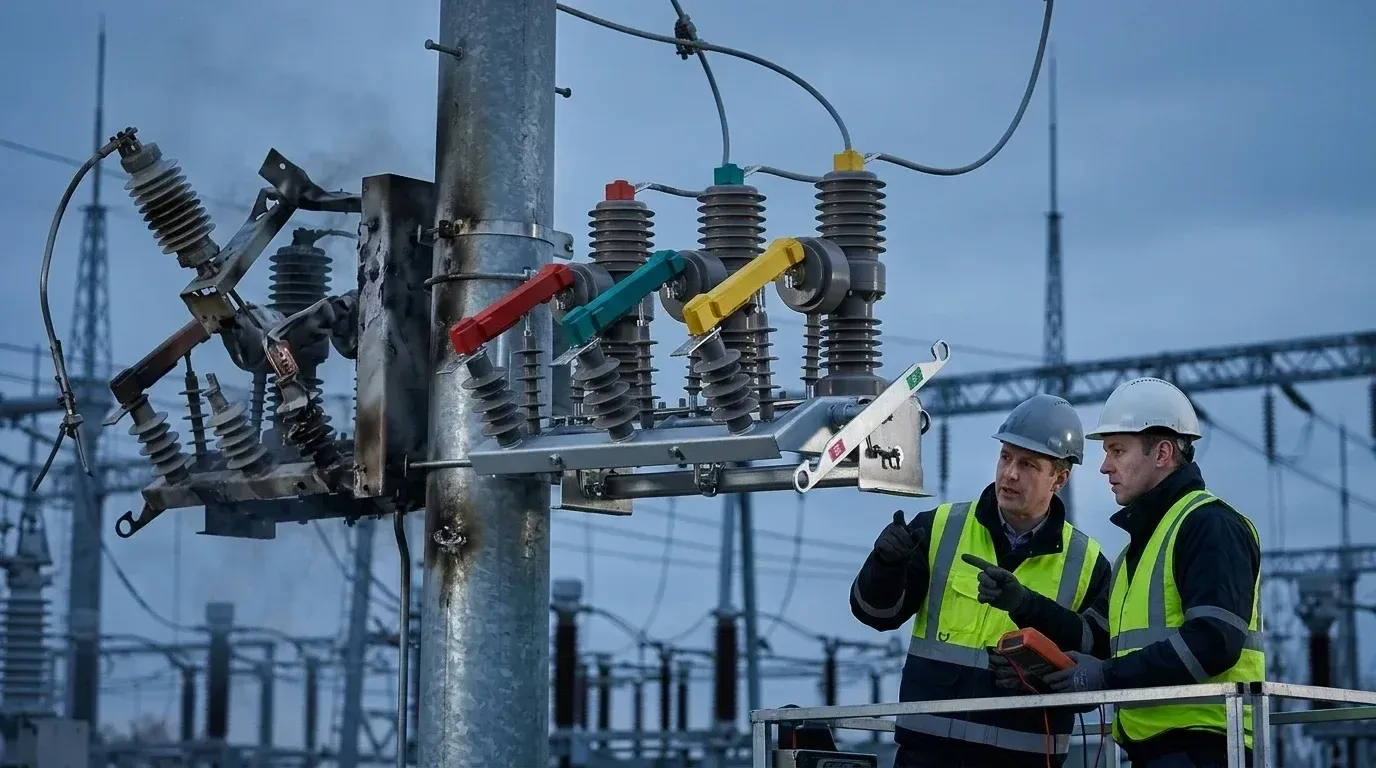
Then comes production. Medium-voltage switchgear often feeds whole process areas, and restoring it means waiting for replacement parts, investigation, insulation testing and a controlled re-energization. Plants with continuous processes also face scrap, restart losses and missed delivery penalties.
Recovery labor, temporary power rental, insurer scrutiny and regulator or safety-authority follow-up come on top. If someone was hurt, the cost stops being a spreadsheet matter at all.
Why the incident bill outweighs the savings from a cheaper unit
The comparison is lopsided by construction. On one side is the price premium for a breaker with the correct breaking capacity, endurance class and test evidence. In most projects that premium is a small fraction of the cost of the breaker itself, which is in turn a small fraction of the switchgear lineup.
On the other side is the total event cost, which scales with what the feeder supports. If one feeder carries a critical process, a single avoided failure pays for the correct specification many times over. The honest caveat: for a low-consequence feeder with a well-known duty, paying for extras is waste. Spend where the consequence is high.
What Happens If a VCB Is Undersized for Short-Circuit Duty?
Will a VCB actually fail if its rating is lower than the fault current? Yes: a fault current above the rated short-circuit breaking current can leave the breaker unable to interrupt, so the arc persists or restrikes, pressure builds, and the fault escalates into the switchgear.
Consider a plant that added a second transformer and a few large motors over several years. Each addition raised the available fault current at the main bus, but nobody reran the study. The original breakers still carry the same nameplate. On paper nothing changed. In practice, the first bolted fault is the first real test.
Reading the rating against your real fault level
The rated short-circuit breaking current is the highest fault current the breaker is proven to interrupt under defined conditions. Compare it with the calculated fault level at the breaker's exact location, not the plant-wide figure someone quoted years ago.
Three companions matter just as much. The making current (peak) is the highest current the breaker can close onto. The short-time withstand rating covers how long it carries fault current while upstream protection decides what to do. And the DC component, driven by the system's X/R ratio, can push asymmetrical current well beyond the symmetrical value. Near generators or large transformers, check this explicitly.
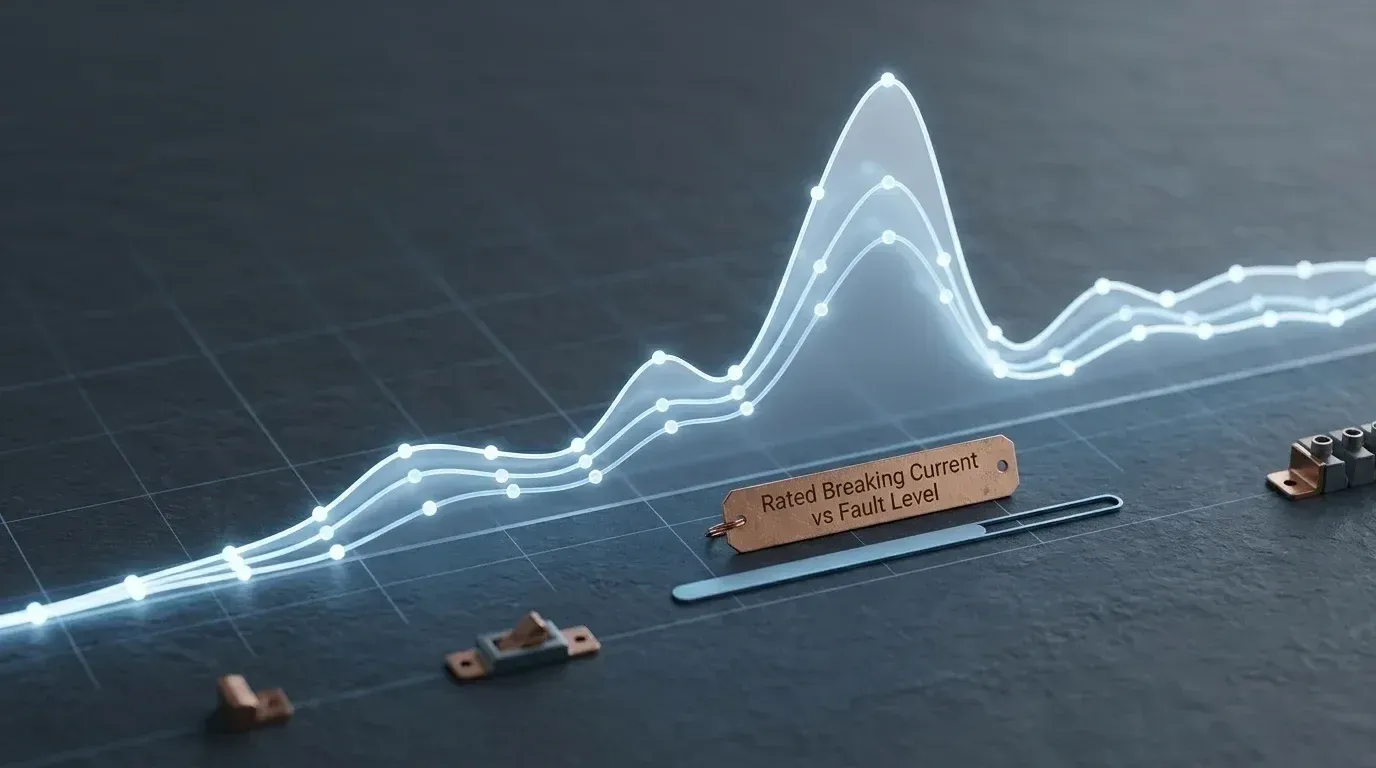
Re-verify fault levels after every significant network change: new generation, transformer additions, utility upgrades, or paralleled sources.
Where arc flash incident energy enters the picture
Arc flash incident energy depends heavily on how long the fault lasts. A breaker that clears in a few cycles limits it. One that is slow, or fails to interrupt and leaves the upstream device to clear the fault, extends exposure sharply. Selection and protection settings belong in the same conversation as your arc flash labels.
Which Rating Parameters Do Buyers Most Often Get Wrong?
Voltage class, fault duty, continuous current under real ambient conditions and duty-cycle assumptions are the usual points of mismatch. Each looks simple on a datasheet. Each is easy to get wrong when a legacy specification gets copied forward.
Vacuum circuit breaker rating selection guide: the core checks
Rated voltage and insulation level. Match the system's highest voltage and check the impulse and power-frequency withstand values, especially at altitude or where surge exposure is high.
Continuous current. Nameplate current assumes standard conditions. Inside a hot, tightly packed enclosure, or above roughly 1,000 meters of altitude, derate. A breaker running near its limit all day ages faster.
Breaking capacity. Covered above. Verify, do not assume.
Operating sequence. If your scheme uses auto-reclosing, the breaker needs a rated sequence that supports it. A unit proven only for a single open-close cycle is the wrong choice.
Load type matters
Load type changes the answer. Capacitor banks produce high inrush currents and, if the interrupter restrikes, damaging overvoltages, so you want a breaker with a verified capacitive switching class. Motors, particularly during starting, create switching overvoltages that may call for surge protection. Transformers bring magnetizing inrush and, on small unloaded units, chopping effects. Arc furnaces switch hundreds of times a day, which turns endurance into the deciding factor.
When the load is unusual, say so in the specification. A general-purpose breaker is a fair default only for general-purpose duty.
Why Does Mechanical Wear Go Unnoticed Until It Is Too Late?
Many assume a breaker that rarely operates is a breaker that rarely wears. That is wrong. Mechanism wear, lubricant aging and contact erosion degrade performance gradually, and a breaker that sits idle for years can still fail on the one demand that counts.
Grease stiffens. Latches and linkages develop friction. Springs relax. None of this triggers an alarm. The breaker simply opens a little slower, or not at all, the day it matters.
Mechanical endurance and the M2 class
IEC 62271-100 defines mechanical endurance classes. M1 covers normal mechanical life, typically 2,000 operations. M2 covers extended life, typically 10,000 operations, and is meant for frequent switching. Neither number is a promise for your specific unit; they are the proven test scope.
Match the class to switching frequency. A feeder that operates a handful of times per year is well served by M1. A motor or furnace feeder switching daily should specify M2 and, for the electrical side, the matching electrical endurance class. Choosing M1 there is a false economy that shows up in year five.
Where the maintenance budget pays back
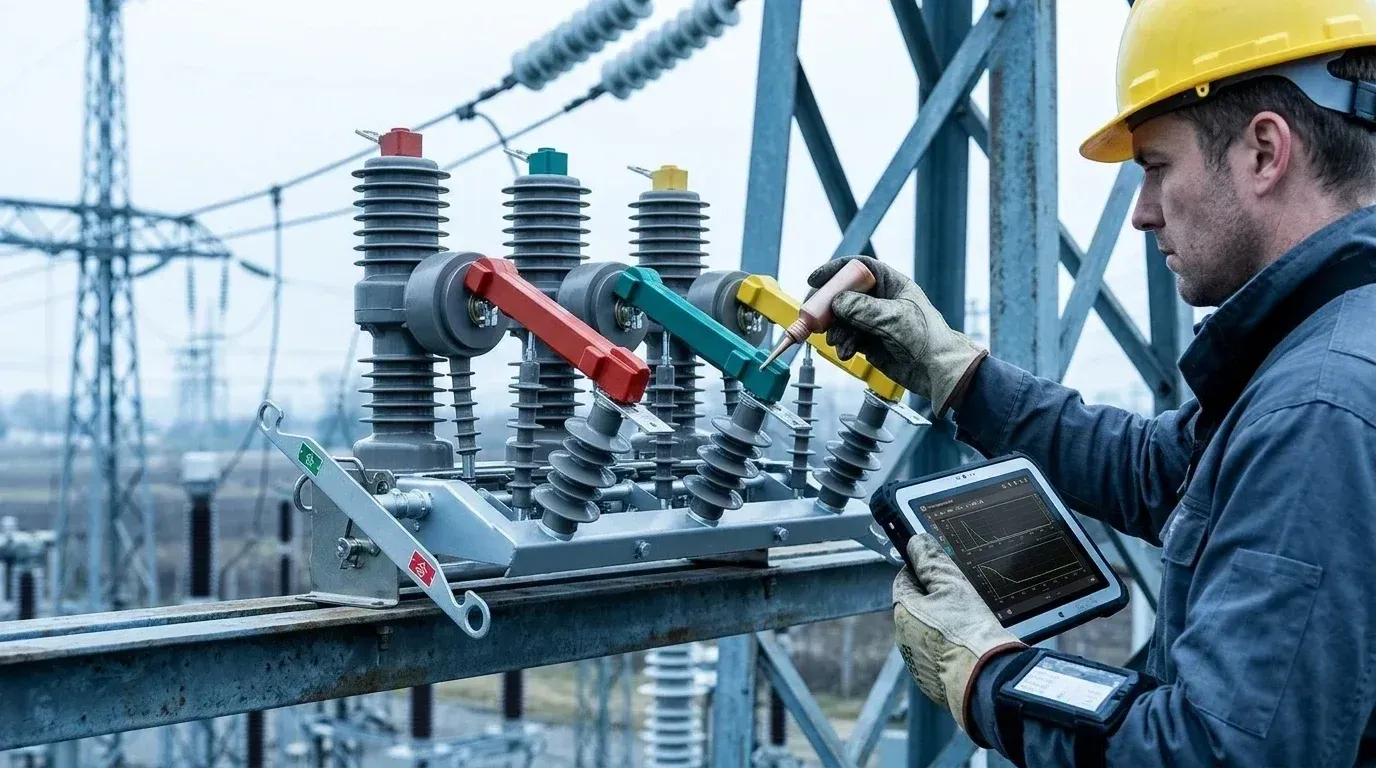
Blanket overhaul schedules spend money evenly, which is rarely where the risk sits. Direct the budget at three things: mechanism inspection and re-lubrication on a defined interval, timing and travel measurements that reveal slow drift, and contact wear indicators on the interrupter. Trend the measurements. A single reading says little; a changing one says a lot.
This is cheaper than periodic full strip-downs, and it catches the failures that actually happen.
Can a Standard Vacuum Test Hide a Failing Interrupter?
Yes. A routine power-frequency withstand test across open contacts is useful, but a pass does not fully prove vacuum integrity. For critical feeders, extra diagnostics can be justified.
The contrast is worth stating plainly. A routine test answers whether the gap holds a given voltage at that moment. A diagnostic approach asks how the interrupter is trending, and whether its condition supports interruption under fault stress. The first gives a snapshot. The second gives a direction.
What routine tests miss
A vacuum interrupter is a sealed bottle with copper-chromium (CuCr) contacts. Vacuum can degrade slowly through micro-leaks or outgassing. Early on, the dielectric withstand may still pass, because even a degraded vacuum can hold moderate voltage. The weakness appears under the higher stress of interruption.
Contact condition is a second blind spot. Erosion from repeated fault and load interruptions reduces contact material and changes the gap. A single test point cannot see that either.
Extra testing vs. failure cost
The extra work is modest: more detailed dielectric checks, contact resistance and wear measurement, and trending against baseline values recorded when the breaker was new. Compared with an outage and a replaced lineup section, the cost is small.
Apply it selectively. Critical, high-consequence feeders, older breakers, and units that have interrupted faults deserve it. A lightly loaded auxiliary feeder with a spare at hand does not.
How Do DC Systems Change Breaker Selection?
DC current has no natural zero crossing, so a standard AC vacuum breaker may be unable to clear the arc without a dedicated interruption scheme. The failure looks like this: the contacts part, the arc keeps burning, and the breaker does not open the circuit.
That is not a rating shortfall. It is a physics mismatch.
Why AC-rated units fail in DC duty
An AC vacuum interrupter relies on the current passing through zero twice per cycle. At that instant the arc extinguishes and the gap recovers its dielectric strength. In a DC circuit, current only falls to zero if something forces it there.
Two routes exist. One is forced commutation, where an auxiliary circuit (typically a precharged capacitor and inductor) injects a counter-current to create an artificial zero. The other is a purpose-built DC design. Whichever you use, the inductance and resistance of the circuit set its time constant, which determines how much energy the interruption has to absorb.
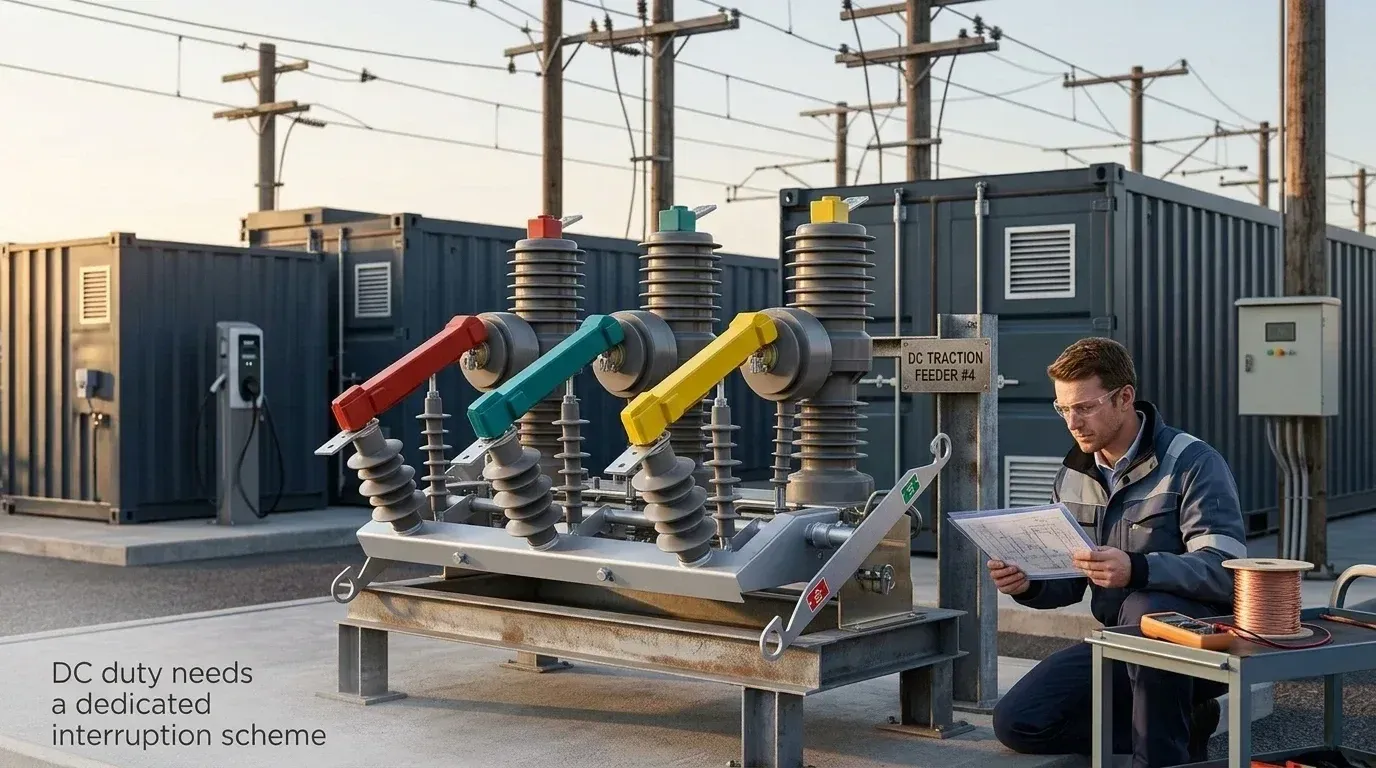
Do not put an AC breaker on DC and hope the arc dies. Do not take a vendor's AC rating as a DC rating, either.
Cost of the right DC approach vs. a non-opening breaker
The extra equipment adds real cost: commutation components, controls and added engineering and testing. The alternative is a protective device that cannot do its one job. In battery storage, traction supply or DC industrial buses, where fault currents rise fast and stored energy is large, the added cost is easy to justify.
Ask for DC interruption test evidence at your voltage and time constant, not a generic statement of capability.
Are Standard Breakers Enough for High-Frequency and Aviation Applications?
Usually not. Elevated frequency, reduced pressure and tight weight limits call for purpose-designed interrupters and verified ratings. Standard industrial breakers are proven for 50 or 60 Hz on the ground.
The decision is between adapting a standard design and buying a specialist one. Adapting is cheaper up front and weakest on evidence. A specialist design costs more and arrives with tests that match the environment. For anything safety-critical, the second wins.
What changes in these environments
At higher frequency, current passes through zero more often and changes faster near zero. The interrupter's recovery has to keep pace with a steeper rate of change, and the thermal load on contacts and conductors rises. Equipment proven at power frequency does not automatically carry over.
Altitude and low ambient pressure weaken external air insulation, so clearances that work at sea level may not hold. The vacuum inside the bottle is unaffected, but everything around it is. Add vibration and shock, which stress mechanisms and mounting, and size and weight limits that rule out the bulk of a standard industrial design.
Airborne equipment is usually qualified against environmental test standards such as RTCA DO-160, rather than the switchgear standards used on the ground.
Specialist premium vs. system failure risk
Use three questions. What does failure cost, including safety? Can the environment be reproduced in a test, and did the supplier do it? And is there a fallback if the breaker fails to open?
If failure is costly, the environment is demanding and no fallback exists, pay the premium. If the equipment sits in a conditioned ground facility, the standard unit is often enough.
Which Standards and Test Evidence Should You Require?
Ask for type-test evidence to IEC 62271-100 or ANSI/IEEE C37.04 as applicable to your market, and check that the tested duty matches your application. A report that proves a different duty proves nothing for you.
IEC 62271-100 covers alternating-current circuit-breakers for high-voltage service. ANSI/IEEE C37.04 sets the rating structure for AC high-voltage circuit breakers in North American practice, with preferred ratings in ANSI/IEEE C37.06. Switchgear assemblies carry their own standards, such as IEC 62271-200 or IEEE C37.20.2 for metal-clad switchgear.
Reading a type-test report
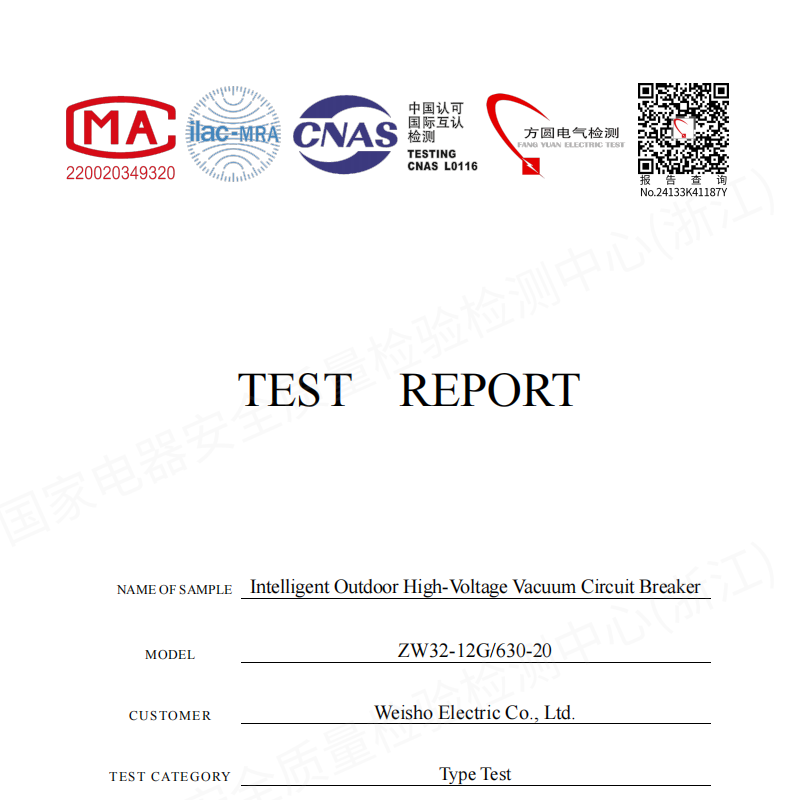
Look past the cover page. Confirm which duties were proven: short-circuit breaking and making at the rated current, capacitive current switching with its restrike class (C1 or C2), and mechanical and electrical endurance. Check the test voltage, the rated sequence and the exact breaker variant tested.
Then look at scope. Reports usually cover a specific design. A different interrupter, mechanism or pole spacing may mean the report doesn't apply. When you request this documentation from any manufacturer, including Weisho Electric, ask for the report that matches the exact model and ratings in your quote, and for the issuing laboratory's name.
Specification clauses worth writing in
Name the endurance classes you require (for example M2 and the matching electrical class). State the operating duty and sequence. List site conditions: altitude, ambient temperature range, humidity and pollution. Specify routine tests at the factory and acceptance tests at site, and require baseline timing and contact resistance values to be recorded and handed over. Those baselines feed the trending described earlier.
How Will SF6 Phase-Down, Higher Voltage Classes and Condition Monitoring Change Your Investment?
Three trends matter. Regulatory pressure on SF6 favors vacuum technology, vacuum is moving into higher voltage classes, and monitoring shifts spend from repair toward prevention. Each changes what you should buy now and what you should keep.
SF6 alternatives as a compliance question
SF6 is a very potent greenhouse gas used as insulation and arc-quenching medium in much switchgear. The direction of regulation is toward restricting it. The European Union's revised F-gas rules, for example, set out phase-out steps for SF6 in medium-voltage switchgear, with dates that differ by voltage and application. Check the current text for your jurisdiction rather than relying on a summary.
The practical point: this is a compliance risk, not a technology preference. A new lineup bought today may need to run for 25 to 30 years. Choosing vacuum-based, SF6-free designs for new medium-voltage projects reduces the chance of stranded assets and of future gas-handling obligations.
Voltage classes moving upward
Vacuum interrupters are now offered at 126 kV, and development at 252 kV has been reported. That stretches vacuum beyond what used to be the medium-voltage boundary.
For your existing medium-voltage fleet, this is not an obsolescence trigger. Those breakers keep working. The effect shows up in new transmission-level substations, where vacuum may become a real alternative to SF6 designs.
From fix-on-failure to predictive maintenance
Modern breakers can report operation counts, travel and timing curves, coil current signatures and contact wear. A change in coil current profile can flag a sticking latch months before it blocks an operation.
The savings come in two forms: fewer routine inspection hours, and fewer unplanned outages. The second is far larger. Specify monitoring-ready breakers on critical feeders now, even if you switch the analytics on later.
Mistakes to Avoid and a Self-Check Before You Specify
Most errors trace to unverified fault levels, copied legacy specifications and ignored duty type. The mistakes below, and the checklist after them, catch most of them before purchase.
Common VCB selection mistakes
Reusing an old fault level. Networks grow. Recalculate at the breaker's location and specify a margin.
Copying the last project's specification. Loads differ. Rewrite duty, endurance and site conditions from scratch each time.
Treating a pass as proof. A routine test passing does not show vacuum health. Baseline and trend critical units.
Buying on price alone. The cheapest quote often lacks a matching type-test report. Compare evidence first, price second.
Assuming AC ratings cover DC or special duty. They do not. Demand evidence at your actual conditions.
Pre-purchase checklist for engineers
Verify the fault level at each breaker location, including DC component and future growth.
Confirm duty type: feeder, motor, capacitor bank, transformer, furnace or DC.
Select the mechanical and electrical endurance class to match switching frequency.
Apply derating for enclosure temperature and altitude.
Flag DC, high-frequency or airborne needs and request purpose-specific evidence.
Request type-test reports to IEC 62271-100 or ANSI/IEEE C37.04 that match the exact model.
Agree on spares, service intervals and baseline measurements before ordering.
Share this list with every supplier you shortlist, Weisho Electric included, and compare answers line by line.
What decision-makers should weigh over the next three years
Look at three items. First, regulation: if SF6 restrictions apply to your sites, plan replacements before they are forced. Second, voltage-class expansion: it affects new substations more than your installed base, so do not write off healthy equipment. Third, monitoring: budget for it on feeders where an outage hurts most.
Getting the selection right costs little next to a single failure. That is a shared argument between engineers and budget owners.
FAQ
How much margin should I leave on short-circuit rating?
Typically, choose the next standard rating above your calculated fault level. Leave room for planned network growth. The exact margin depends on how reliable your fault study is and how likely additional sources are.
Can I upgrade existing switchgear with newer VCBs?
Often yes, through retrofit or replacement breakers, but only if the new unit is verified for the cubicle's dimensions, interlocks and busbar ratings. Confirm compatibility with the switchgear manufacturer or a qualified retrofit engineer.
How often should a VCB be tested?
Follow the manufacturer's interval, commonly every few years for inspection and sooner for frequently switched units. Test after any fault interruption. Trend results against baseline values.
Does a vacuum breaker need maintenance at all?
Yes. The interrupter needs little, but the operating mechanism needs inspection, lubrication and timing checks. Skipping them is the usual path to failure on demand.
What does getting the selection right cost?
Usually a modest premium over a minimal specification, mostly for verified ratings, endurance class and testing. Compared with outage, repair and safety exposure, it is a small share of the event cost.