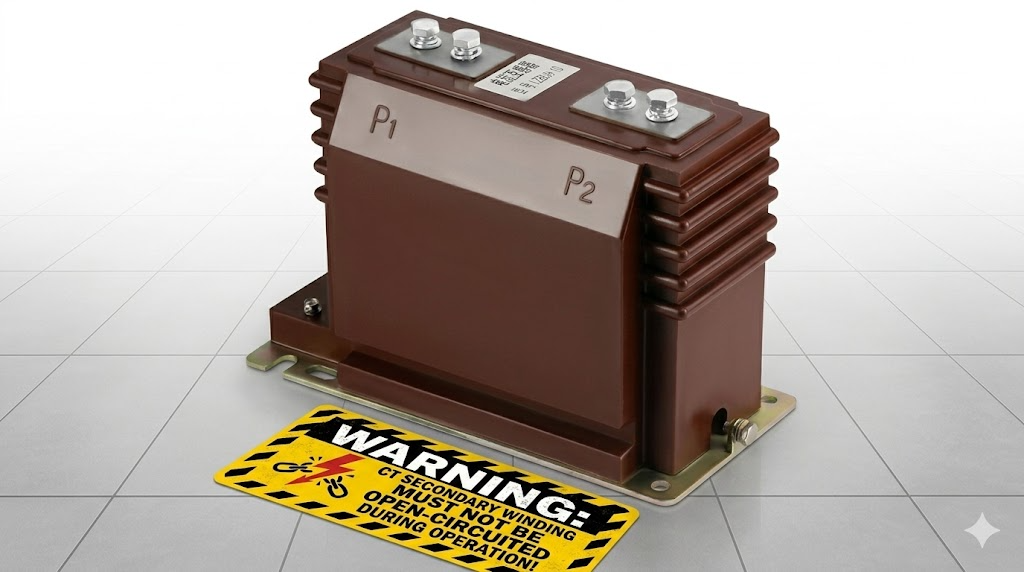
A current transformer can “blow up” when its secondary is opened under load because the CT is trying to force secondary current through a path that no longer exists. That lost burden drives a sharp CT secondary voltage rise explosion risk: voltage can jump high enough to puncture insulation, arc across terminals, carbon-track the panel, damage relays and meters, and in severe cases rupture resin, terminal blocks, or nearby components.
This is why every experienced protection engineer repeats the same rule: never leave a CT secondary open-circuited while primary current is flowing. In utilities, plants, and switchgear rooms, this is not a textbook warning. It is a field-proven injury and equipment-loss hazard.
A CT Secondary Open Circuit Can Create Dangerous High Voltage Almost Instantly
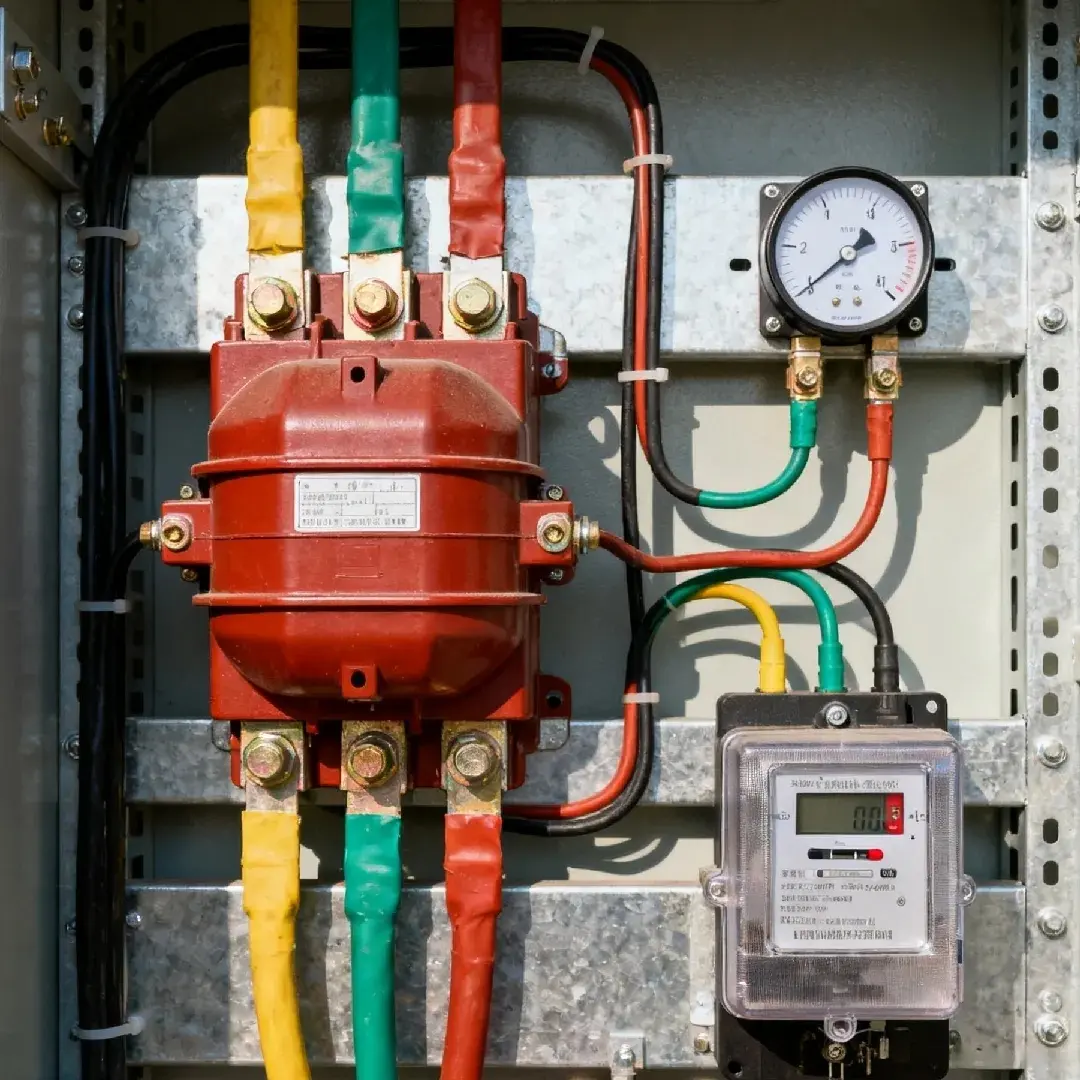
A CT normally works with a low-impedance secondary loop. The connected burden keeps secondary voltage relatively low while the CT reproduces primary current in scaled form.
When that loop is opened, the CT still “sees” primary current. Instead of delivering current into a burden, it develops a rapidly rising voltage across the open secondary terminals.
This is the core current transformer secondary open circuit hazard. The rise can be fast enough to cause immediate shock risk, arcing, overheating, and insulation stress before a technician realizes what happened.
What Happens Inside a Current Transformer When the Secondary Is Open
Inside the CT, the primary current creates magnetic flux in the core. Under normal operation, secondary current produces opposing ampere-turns that balance most of that flux.
Open the secondary, and that balancing current disappears. Core flux rises sharply, the core moves toward saturation, and the winding voltage increases in an attempt to drive current.
In plain terms, the CT is not a harmless low-voltage signal source. It is an energized magnetic device that can generate dangerous voltage when denied its current path.
Why Open Circuit CT Leads Are Dangerous in Real Facilities
In real panels, why open circuit CT leads are dangerous becomes obvious in the damage pattern. The first casualty may be the weakest insulation point, not the CT body itself.
Flashover at test blocks
Terminal rupture or melted links
Smoke and ozone in metering cubicles
Relay input damage
Meter burnout
Unexpected shock to the technician handling “small” wires
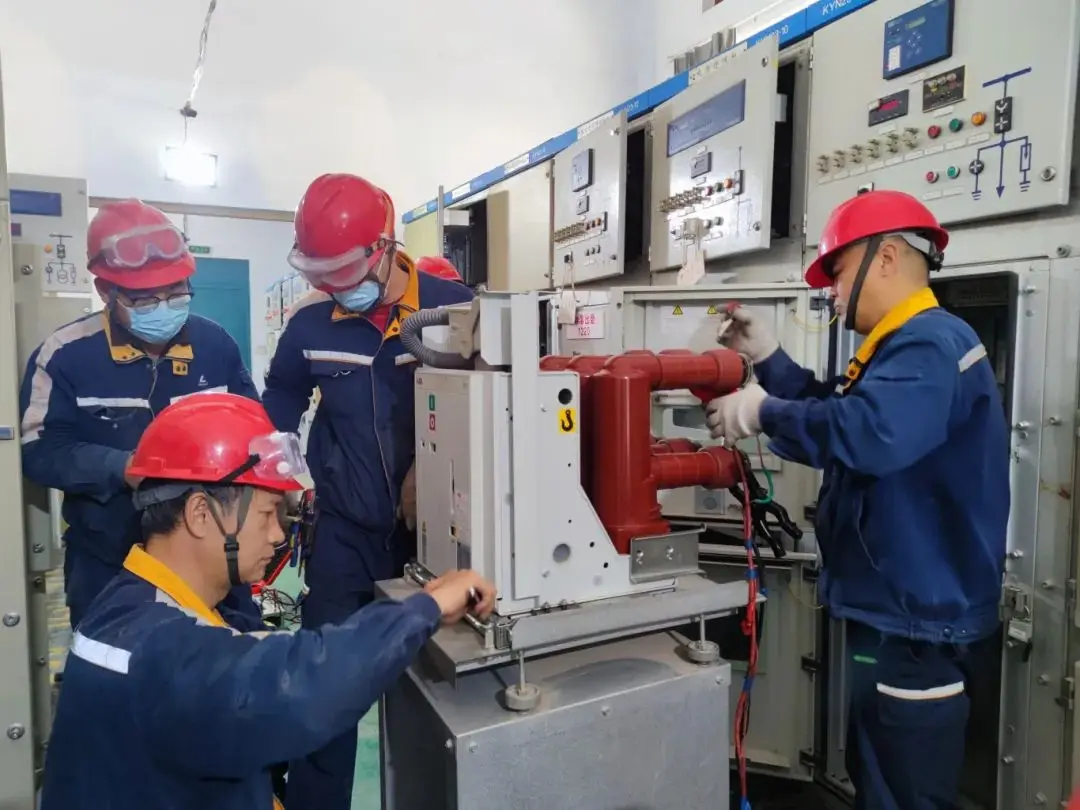
Plants often report that the event began during routine work: meter replacement, relay testing, tightening screws, or panel retrofit. The task looked low-energy because the secondary current rating was 1 A or 5 A. That assumption is exactly what makes CT incidents dangerous.
Current Transformer Secondary Open Circuit Hazard: The Physics in Plain English
A CT is designed to reproduce current, not voltage. With the circuit closed, the burden controls voltage.
With the circuit open, burden control disappears. The CT raises secondary voltage as high as needed, within the limits of its core, insulation, turns ratio, and connected geometry.
That is why high voltage induced in CT secondary winding is a known and serious hazard. Even if the secondary circuit normally feeds only a meter, the open condition can produce a voltage level that is far beyond what the meter terminals, insulation, or human hands are prepared to handle.
CT Secondary Voltage Rise Explosion Risk: How High Can the Voltage Go
There is no single universal number. Actual open-circuit voltage depends on:
Primary current at the moment of opening
CT ratio and turns count
Core material and saturation behavior
Secondary winding insulation condition
Lead length and circuit geometry
Transient switching conditions
Whether the CT is metering-class or protection-class
In practice, field engineers and OEM guidance repeatedly warn that open-circuit CT secondary voltage can rise from “surprisingly painful and damaging” to “lethally high.” Utility training documents often use language such as hundreds to thousands of volts may develop under the wrong conditions.
The business takeaway is simple: do not design procedures around a “probably low” assumption.
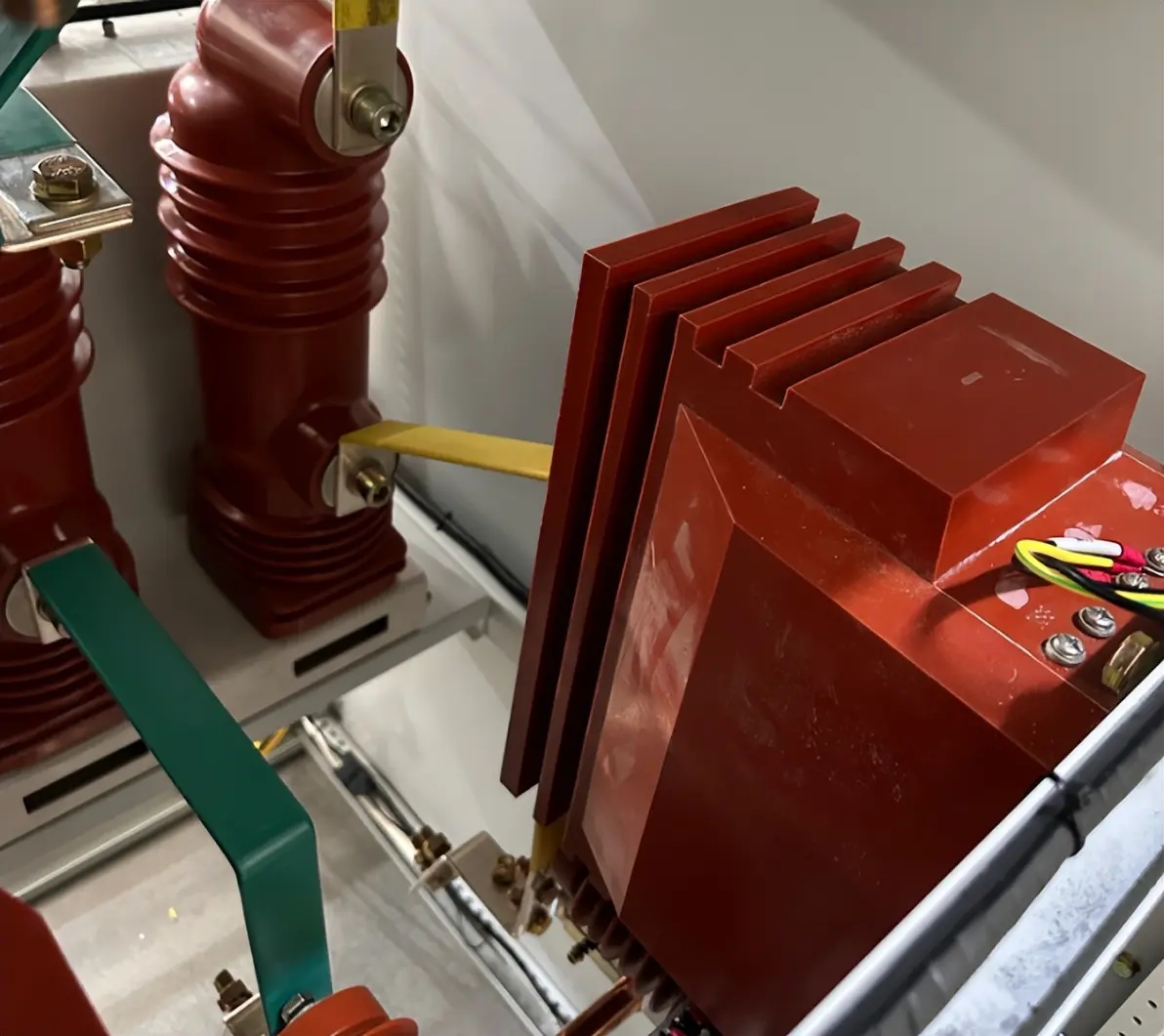
High Voltage Induced in CT Secondary Winding: Why Grounding Alone Is Not Enough
Current transformer safety grounding practices matter, but grounding is not the same as shorting. A grounded secondary has a reference to earth, usually at one point, to reduce shock exposure and stabilize the circuit.
But a grounded open secondary is still open. It can still develop dangerous voltage across the break.
Grounding helps manage reference and fault behavior. It does not replace the need to keep the CT secondary shorted or properly burdened during maintenance, testing, or equipment removal.
The Most Common Field Scenarios That Cause CT Secondary Open Circuits
Most incidents are not exotic. They are ordinary maintenance mistakes or aging-panel failures.
Maintenance Isolation Without a Shorting Link
A technician isolates a meter or relay input but forgets that the CT secondary must be shorted first. The disconnect creates an immediate voltage rise and may produce a visible arc at the terminal being lifted.
Loose or Corroded Secondary Terminations
Vibration, thermal cycling, corrosion, and poor torque can create intermittent opens. These are especially dangerous because the CT may behave normally for weeks, then arc only under higher load.
Meter or Relay Removal Under Load
Removing a meter base, transducer, or relay plug-in unit without securing the CT path is a classic trigger. The operator may think the panel is de-energized because control power is off, while the primary conductor is still carrying load.
Hidden Opens During Retrofits and Panel Modifications
Contractors often reroute wiring, replace terminals, or separate panels without understanding CT circuits. A missing shorting bridge, swapped terminal, or forgotten return wire may stay hidden until load current increases.
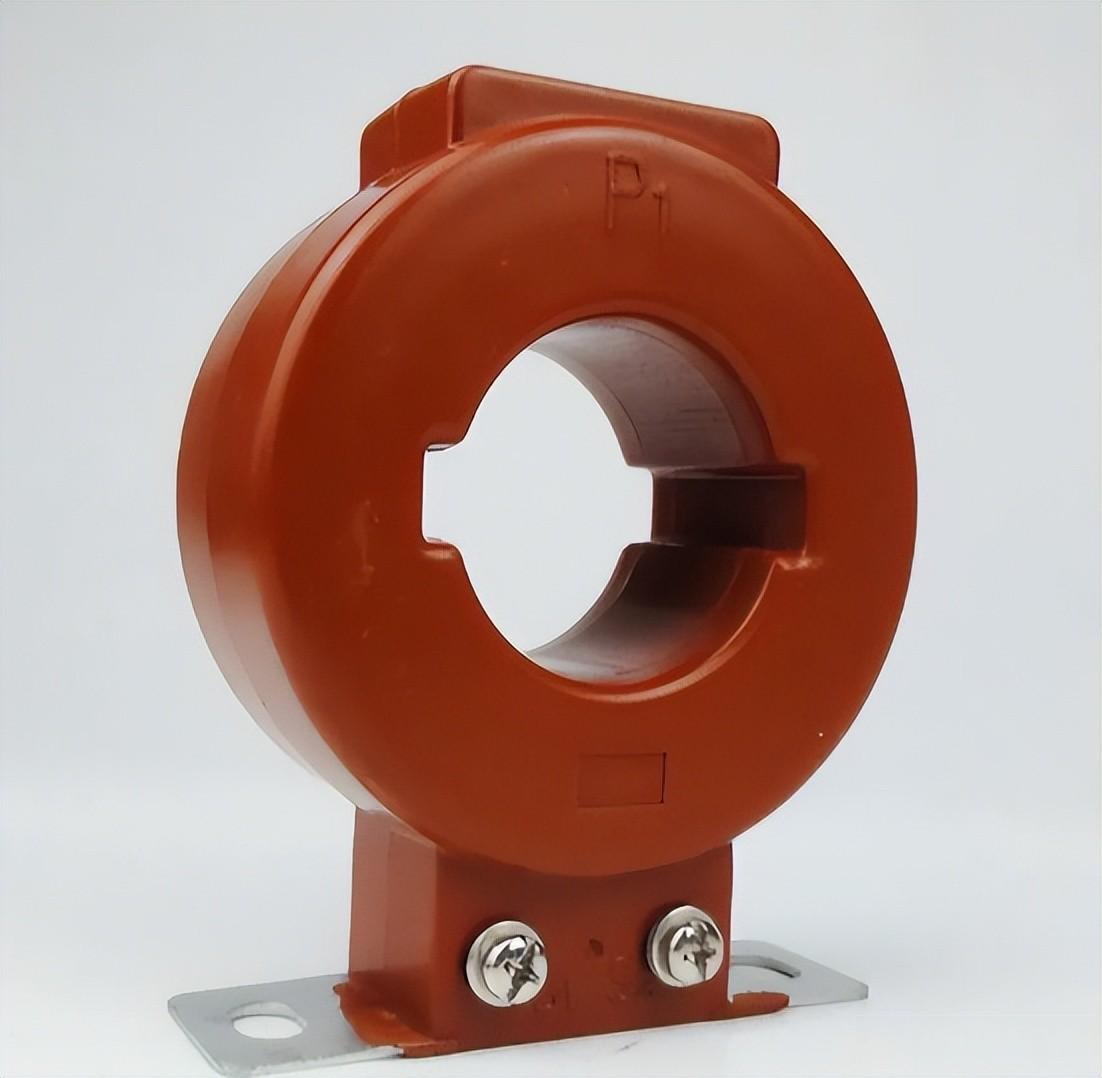
Why CTs “Explode”: The Actual Failure Modes Behind the Term
“Explosion” is often shorthand used by technicians. Technically, several different failure modes may sit behind that word.
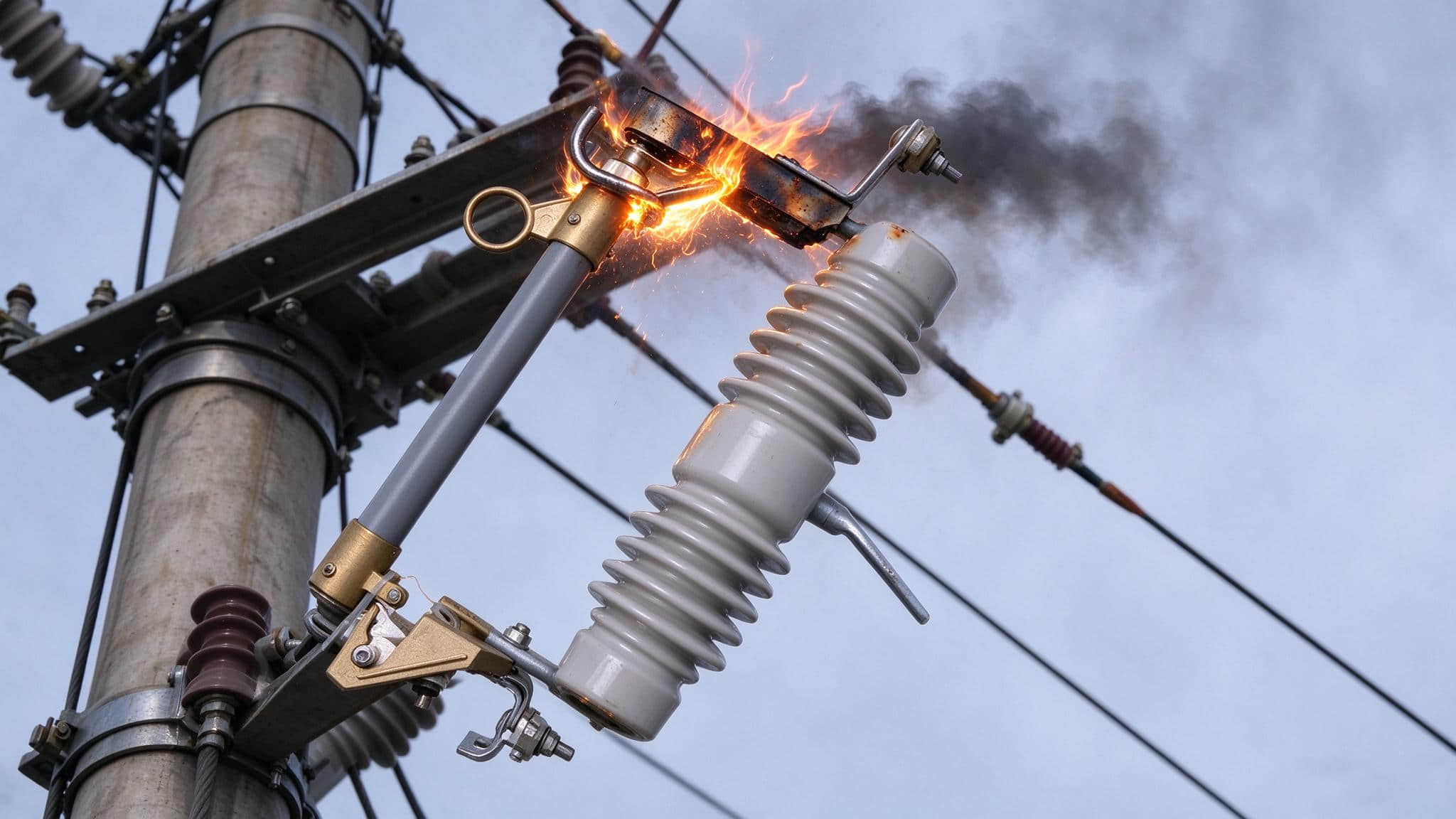
Arc flash at open terminals: Air breakdown across the gap produces heat, light, and metal spatter.
Insulation puncture: Secondary winding or terminal insulation fails internally.
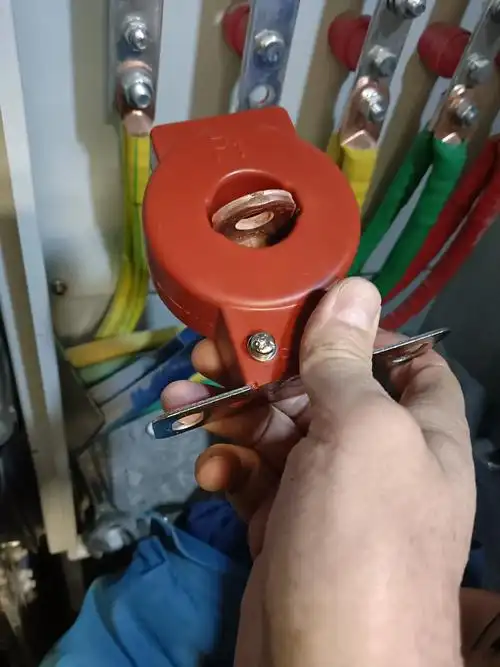
Resin cracking: Cast resin CTs may fracture from thermal and dielectric stress.
Terminal blowout: Small instrument terminals can rupture or eject fragments.
Heat-driven rupture: Localized overheating can damage housings, links, and adjacent wiring.
In other words, the CT may not always detonate like a power breaker. But the open-circuit event can absolutely create violent failure, smoke, flame, and injury risk.
Table: CT Open Circuit Failure Modes, Warning Signs, and Consequences
| Failure Mode | Early Warning Signs | Likely Damage | Operator Risk Level |
|---|---|---|---|
| Terminal arcing | Snapping sound, spark, ozone smell | Burnt terminals, carbon tracking, meter input damage | High |
| Insulation breakdown | Unstable readings, heating, intermittent faults | CT winding damage, relay/meter failure | High |
| Resin cracking or rupture | Audible hum increase, hot spots, visible cracks | Permanent CT failure, panel contamination | High |
| Loose-link overheating | Discoloration, warm terminals, nuisance alarms | Open circuit, melted hardware, secondary flashover | Medium to High |
| Secondary lead flashover to ground or adjacent circuit | Scorch marks, odor, unexpected tripping | Multi-circuit damage, shock hazard | High |
Real-World Data and Case Examples From Utilities, Plants, and OEM Guidance
Across utility training bulletins, OEM manuals, relay lab guidance, and industrial safety instructions, one message is repeated with unusual consistency: CT secondary circuits must never be opened under load.
Published manufacturer instructions for protection relays, meters, and test switches routinely specify shorting-before-disconnection. Utility safety notes and substation training material commonly warn that dangerous voltage can develop instantly if the burden is removed.
In relay labs and commissioning environments, the most repeated near-miss pattern is not catastrophic CT body failure. It is unexpected arcing at a test block or terminal during a seemingly routine instrument task. That distinction matters because many incidents begin as “small sparks” before becoming panel damage or personal injury.
Table: Published Incident Patterns and Reported Outcomes
| Setting | Trigger Event | Observed Voltage Behavior | Equipment Damage | Personnel Impact |
|---|---|---|---|---|
| Utility substation panel | Test switch operated incorrectly | Immediate arc at terminal gap | Scorched block, relay input stress | Near-miss shock/arc exposure |
| Industrial MCC or switchgear | Meter removed under load | Rapid voltage rise on CT leads | Burnt meter, damaged wiring | Operator startled, minor injury risk |
| Retrofit project panel | Return lead left open after rewiring | Fault appeared only when load increased | Carbon tracking, CT replacement | Delayed hazard, difficult troubleshooting |
| Aging plant metering cubicle | Loose or corroded termination | Intermittent high-voltage event | Melted terminal, erratic readings | Hidden exposure to maintenance staff |
What Reddit, Quora, and Practitioner Forums Repeatedly Warn About
Technician and engineer discussions on Reddit, Quora, and specialist forums show a striking pattern: even among experienced people, CT open-circuit incidents often happen during “quick” troubleshooting.
Common user feedback can be summarized like this:
“I knew the rule, but the panel looked dead.”
“We pulled the meter and got a crack and burn mark.”
“The CT circuit was only a few amps, so the apprentice thought it was safe.”
“One loose screw caused weeks of strange relay behavior before anyone found it.”
These forum discussions are valuable because they surface the field details that formal manuals often skip: confusion between control power isolation and CT safety, overconfidence around low-voltage wiring, and rushed maintenance under outage pressure.
“It Was Fine Until the Meter Was Pulled.”
A repeated practitioner scenario is routine meter removal under load. Users describe a panel behaving normally until the meter or transducer was unplugged, followed by a sharp snap, visible spark, or sudden smell of burned insulation.
“The Panel Looked Dead, but the CT Was Still Alive”
This is a major industry pain point. Operators may isolate the instrument supply and assume the panel is safe, forgetting that the CT remains energized as long as current flows in the primary conductor.
“One Loose Screw Created a High-Voltage Surprise”
Forum veterans often warn that a partial or intermittent open is worse to diagnose than a clean disconnection. The symptoms can mimic bad meters, relay problems, or nuisance trips before the actual loose CT termination is discovered.
Unique On-Site Details Only Experienced Technicians Master
Real CT open-circuit trouble rarely announces itself with a label. It shows up in sensory clues that technicians learn the hard way.
A CT or panel section that suddenly hums louder than normal
A faint ozone or “electrical storm” smell near the test blocks
Brown or black carbon marks creeping from the terminal edges
Scorched shorting links that still “look connected” from a distance
Meters that read wildly wrong only at higher loads
Heat discoloration on one screw head, not the whole terminal strip
An operator assuming 5 A secondary means low risk, when the real risk is open-circuit voltage
These details matter because they help teams catch the problem before the next maintenance action triggers a worse event.
Why Current Transformer Safety Grounding Practices Matter
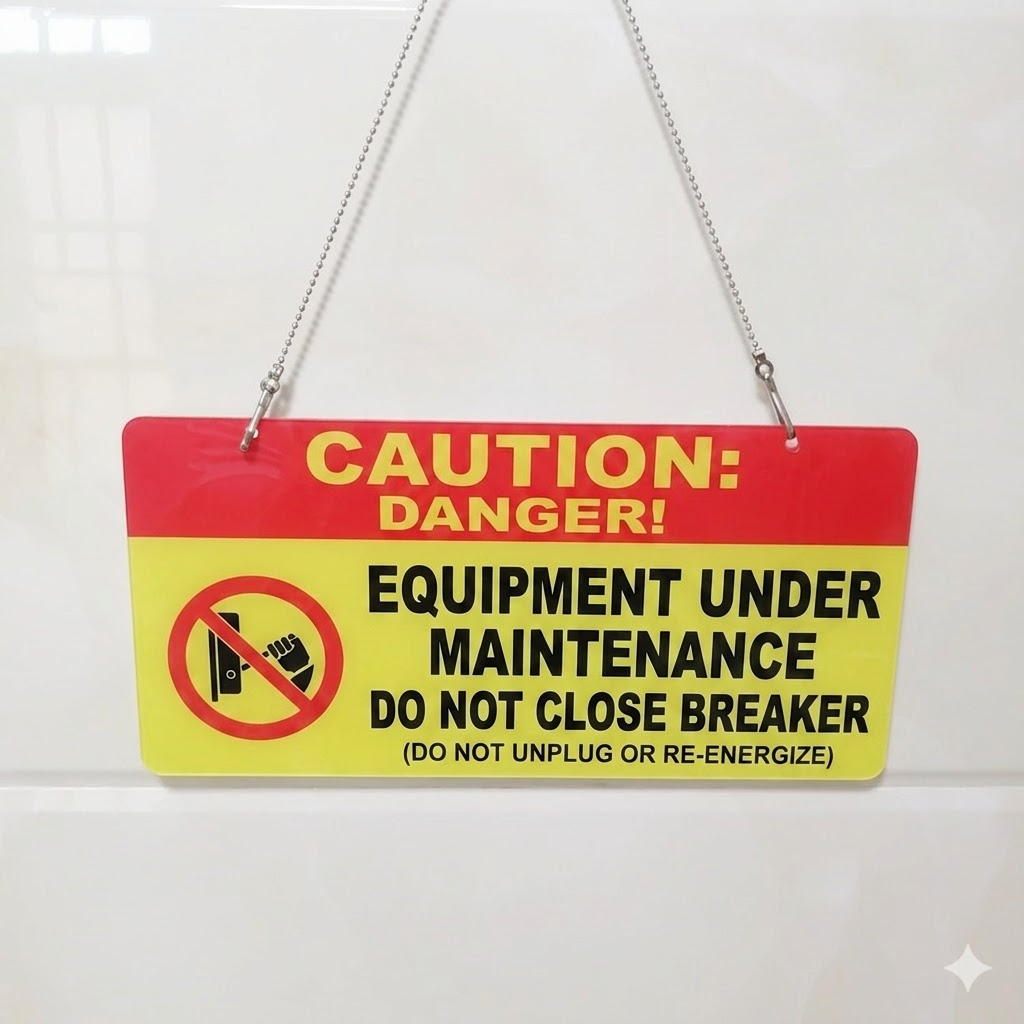
Good grounding reduces exposure, but only when used correctly. Standard practice is typically a single-point secondary ground to avoid floating potentials and improve safety.
Multiple grounds can create confusion and circulating paths. No ground can leave the circuit floating at an unpredictable potential.
Still, the critical rule remains: grounding is not a substitute for maintaining a closed or shortened secondary circuit. The best programs teach both rules together, not separately.
Authoritative Solution: How to Prevent CT Secondary Open Circuit Accidents
The prevention framework is operational, not theoretical. Safe plants reduce CT risk through hardware, procedures, labeling, verification, and training.
Always Short the Secondary Before Any Disconnection
This is the non-negotiable rule. Before removing a meter, relay, transducer, test plug, or wire, apply the approved shorting means and verify it is effective.
Use Shorting Terminal Blocks and Test Switches
Do not rely on improvised jumpers when proper shorting blocks or make-before-break test switches are available. Good hardware removes memory failure and speed pressure from the task.
Apply Lockout-Tagout Specific to CT Secondary Work
General electrical isolation is not enough. CT tasks require a procedure that explicitly addresses primary current presence, secondary shorting, instrument removal sequence, and re-termination verification.
Verify Continuity and Burden Before Re-Energization
Before returning equipment to service, confirm the CT secondary path is continuous, correctly landed, and connected to the intended burden. This catches hidden opens introduced during retrofit or maintenance.
Train Teams on CT-Specific Hazards, Not Just General HV Safety
Many incidents involve personnel who understand high-voltage bus safety but underestimate instrument circuits. CT awareness training should explain why a “small wire” can become a dangerous high-voltage induced source when opened.
Table: Safe CT Handling Checklist for Maintenance, Testing, and Retrofit Work
| Step | Required Action | Why It Matters |
|---|---|---|
| 1. Pre-job review | Identify all CT circuits, ratios, burdens, and connected devices | Prevents hidden energized paths and wrong-circuit work |
| 2. Procedure check | Use CT-specific switching and isolation instructions | Avoids generic LOTO mistakes |
| 3. Apply shortening means | Close the shorting block or test switch before any disconnection | Eliminates open-circuit voltage rise |
| 4. Verify short | Visually and electrically confirm the short path | Catches failed or mis-positioned links |
| 5. Disconnect the device | Remove the meter/relay only after the short is secure | Prevents surprise arcing |
| 6. Inspect terminations | Check torque, corrosion, heat marks, and insulation condition | Finds latent causes of intermittent opens |
| 7. Reconnect burden | Restore the intended circuit and verify the wiring against drawings | Prevents hidden retrofit errors |
| 8. Continuity test | Confirm secondary loop integrity before removing the short | Stops re-energization with an open path |
| 9. Remove short in sequence | Only after the burden is fully restored | Maintains control of circuit state |
| 10. Post-energization review | Check readings, smell, sound, and thermal condition | Detects early failure signs immediately |
Design Best Practices for Engineers and Plant Managers
Prevention starts in design. A well-designed CT circuit is easier to maintain correctly and harder to open by mistake.
Prefer Finger-Safe Shorting Links and Clearly Labeled Test Blocks
Use hardware that supports make-before-break behavior and obvious position indication. Clear labeling should state that the CT secondary must be shorted before disconnection.
Separate Metering and Protection CT Workflows
Mixed-purpose panels create confusion. Separate layouts, documents, and procedures reduce the chance that a metering task accidentally disturbs a protection CT path.
Add Inspection Points for Loose Connections and Heat Damage
Include periodic torque checks, thermal scans, and visual inspection of test links, terminations, and carbon tracking zones. Aging terminations are a repeat offender in open-circuit events.
How to Explain the Risk to Non-Electrical Decision Makers
For plant managers and executives, this is not just an electrical theory issue. It is a preventable operational risk.
Safety: avoid technician injury and investigation exposure
Reliability: prevent meter, relay, and protection system failure
Cost: reduce outage time, panel repair, and equipment replacement
Compliance: strengthen procedures, training, and auditable controls
Insurance: limit losses tied to avoidable maintenance errors
The message is simple: one missed shorting step in a CT circuit can turn a routine panel task into an incident with safety, downtime, and liability consequences.
Featured Snippet Summary: Why Does a CT Secondary Open Circuit Lead to Explosion Risk
A CT secondary open circuit is dangerous because the transformer loses its normal current path and responds by generating a high induced voltage across the open secondary. That voltage can overstress insulation, create arcing, overheat terminals and windings, damage meters and relays, and in severe cases cause rupture or explosion-like failure.

FAQ
Why is an open circuit on a current transformer secondary dangerous?
Because the missing burden lets the secondary voltage rise sharply. That creates shock risk, arc risk, insulation breakdown risk, and equipment damage risk.
Can a CT really explode if the secondary is open?
Yes. It can fail violently through arcing, overheating, insulation puncture, resin cracking, or terminal rupture, especially when primary current is high.
How much voltage can appear on an open CT secondary?
The voltage can range from hazardous to extremely high depending on CT ratio, primary current, core saturation behavior, insulation condition, lead length, and connected geometry. In industry practice, engineers treat it as potentially lethal.
Does grounding the CT secondary prevent an explosion?
No. Grounding improves reference and may reduce shock exposure, but it does not replace the need to keep the CT secondary shorted or properly burdened.
What are the warning signs of an open CT secondary problem?
Common signs include humming, heating, ozone smell, unstable readings, carbon marks, sparking at terminals, scorched links, and unexplained relay or meter behavior.
What should technicians do before disconnecting CT secondary wires?
They should apply approved shorting links or test switches, verify the short is effective, and follow CT-specific lockout-tagout and reconnection procedures.
Are metering CTs and protection CTs equally at risk?
Yes. Both can develop dangerous voltage when opened. The connected equipment and system consequences may differ, but the hazard remains real in both cases.
Can a loose terminal cause the same hazard as a fully open wire?
Yes. An intermittent or high-resistance open can still generate dangerous voltage and may be harder to identify because the fault appears only under certain load or vibration conditions.
What is the safest way to test a CT circuit?
Use dedicated test blocks or switches with built-in shorting capability, confirm continuity, and never remove instruments under load without securing the secondary path first.
Audit Every CT Secondary Circuit Before the Next Maintenance Window
Do not wait for the next near miss. Audit every CT secondary circuit now: verify shorting provisions, confirm single-point grounding, inspect labels, check terminations, review test-switch design, and retrain technicians on CT-specific open-circuit hazards.
A routine meter pull or retrofit should never become a preventable explosion event. If your site has aging panels, undocumented modifications, or inconsistent CT procedures, schedule a formal CT secondary safety review before the next outage window.